The Allure of the Wrong Solution
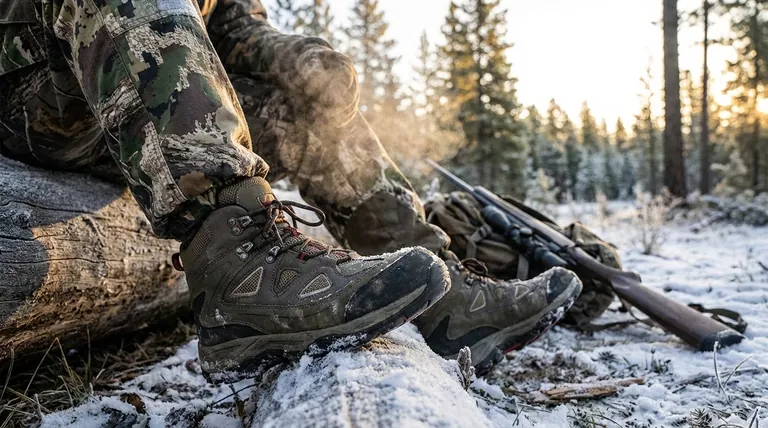
Imagine a hunter, miles from civilization, sitting motionless as dawn breaks. The air is sharp with cold. His focus should be on the landscape, on the subtle signs of movement. Instead, it’s on his feet—a deep, biting cold is seeping into his toes, turning them numb and distracting him from the mission.
This scenario isn't a failure of insulation alone. It's often a failure of design philosophy, born from a psychological trap: the assumption that "more protection" is always better.
The decision to wear a steel-toe boot for a hunt seems logical on the surface. It feels like a responsible choice. But in engineering, as in life, every design choice is a trade-off. The features that make a boot safe in an industrial plant can make it dangerous in the wilderness.
The Physics of Failure
A tool designed for one environment often fails spectacularly in another. A steel-toe boot is a specialized tool for the construction site or factory floor, engineered to protect against crushing impacts from machinery and dropped materials. The wilderness presents an entirely different set of problems.
The Weight Penalty: A Tax on Every Step
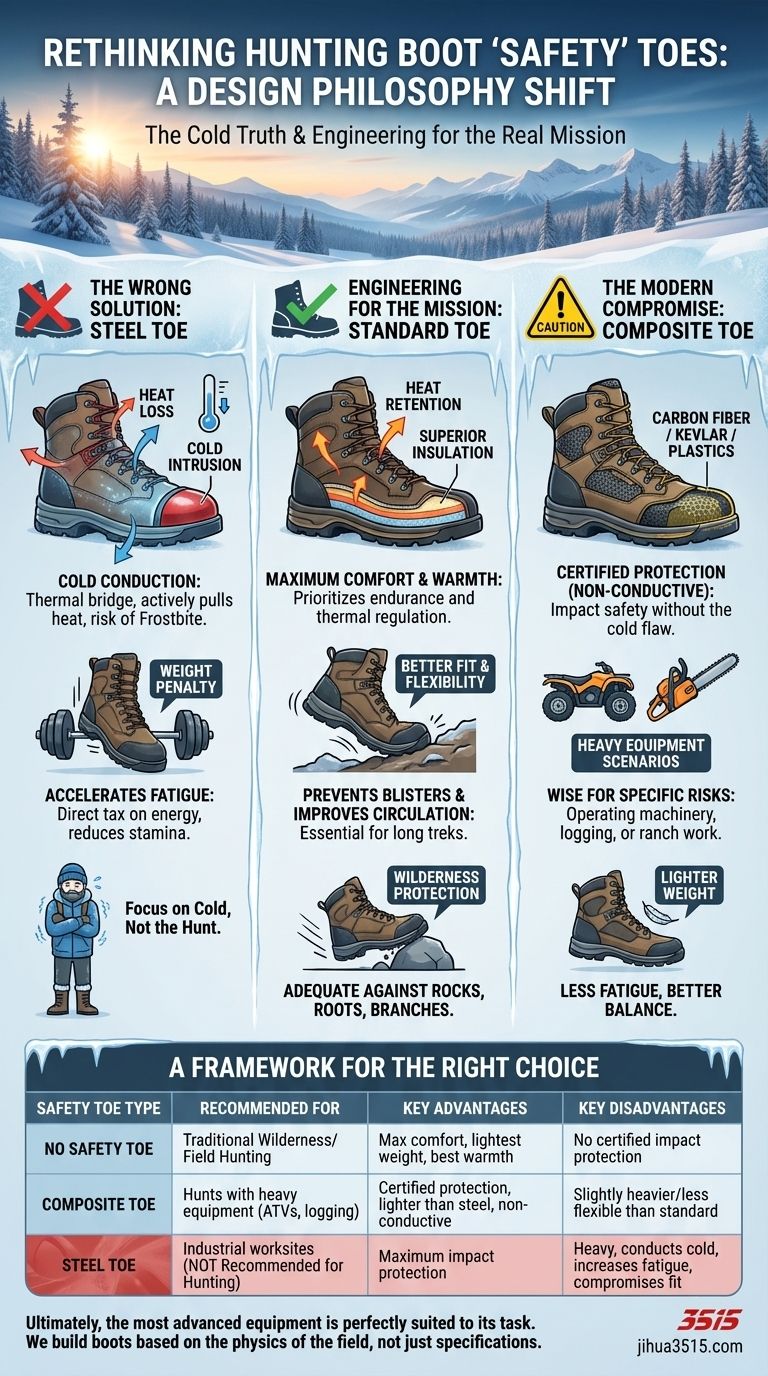
Hunting demands endurance. It often involves trekking for miles over uneven, challenging terrain. In this context, weight is the enemy. The added mass of steel caps, while seemingly small, compounds with every single step. It is a direct tax on your energy, accelerating fatigue and reducing the stamina required for a successful and safe hunt.
The Cold Conduction: A Direct Thermal Attack
This is the most critical design failure of steel toes in cold environments. Metal is a superb thermal conductor. Instead of insulating your foot, a steel toe cap acts as a thermal bridge, actively pulling heat from your body and transferring the biting cold of the outside world directly to your toes.
This isn't just a matter of discomfort. It dramatically increases the risk of frostbite and impairs your ability to remain still and focused when it matters most.
Engineering for the Real Mission
The true mission of a hunting boot is not to withstand a forklift accident. It is to enable the hunter to move efficiently, comfortably, and safely through a natural environment for extended periods. This requires a different set of engineering priorities.
The Elegance of the Standard Toe
For the vast majority of hunting scenarios, the optimal design choice is a well-constructed boot with no certified safety toe.
This is not a "missing" feature; it is a deliberate decision to prioritize what actually keeps a hunter safe and effective:
- Reduced Weight: Maximizing endurance and minimizing fatigue.
- Superior Insulation: Protecting against the pervasive threat of cold.
- Better Fit: A more flexible toe box allows for better circulation and prevents blisters, which can be a mission-ending event in the field.
A properly built boot with a reinforced, standard toe box provides more than enough protection against the real hazards of the wilderness—rocks, roots, and branches.
The Modern Compromise: Composite Toes
Of course, some situations do introduce industrial-style risks into the wild. A hunter might be operating an ATV, clearing lanes with logging equipment, or working on a ranch with heavy animals. In these specific cases, a certified impact rating is a wise precaution.
Here, the modern engineering solution is the composite toe. Made from materials like carbon fiber, Kevlar, or specialized plastics, composite toes offer certified impact protection without the fatal flaws of steel. They are significantly lighter and, most importantly, they do not conduct cold. They solve the specific problem without compromising the boot's primary mission.
A Framework for the Right Choice
Choosing the right footwear requires moving past the simple marketing label of "safety" and making an informed decision based on a clear-eyed assessment of risk and environment. The "more is better" mindset is a cognitive bias that can lead to poor outcomes.
The hierarchy of needs for a hunting boot is clear: first comes fit and comfort, then thermal regulation and durability, and finally, the appropriate level of impact protection for the specific task at hand.
| Safety Toe Type | Recommended For | Key Advantages | Key Disadvantages |
|---|---|---|---|
| No Safety Toe | Traditional wilderness/field hunting | Maximum comfort, lightest weight, best warmth | No certified impact protection |
| Composite Toe | Hunts involving heavy equipment (ATVs, logging) | Certified protection, lighter than steel, non-conductive | Slightly heavier and less flexible than a standard toe |
| Steel Toe | Industrial worksites (Not Recommended for Hunting) | Maximum impact protection | Heavy, conducts cold, increases fatigue, compromises fit |
Ultimately, the most advanced piece of equipment is the one that is perfectly suited to its task. For the business sourcing footwear for distributors or brand owners, understanding these nuanced user needs is critical. At 3515, we manufacture a comprehensive range of footwear, applying the right engineering for the right application—from lightweight, high-performance boots for the field to specialized composite-toe solutions for high-risk environments. We build boots based on the physics of the field, not just the specifications on a sheet.
If your business requires footwear built with this level of mission-specific insight, Contact Our Experts.
Visual Guide
Related Products
- Wholesale Lightweight Tactical Boots Custom Manufacturer for Desert & Combat Use
- High-Traction Suede Tactical Boots Wholesale & Custom Manufacturing
- Durable Leather Tactical Boots Wholesale & Custom Manufacturing for Brands
- Durable Military Combat Boots with Water Drainage for Wholesale & OEM
- Wholesale Waterproof Tactical Boots Custom Suede & High-Traction Soles
Related Articles
- Why Your Tactical Boots Keep Failing—And Why 'Tougher' Isn't the Answer
- Why Your Tactical Boots Wear Out So Fast—And the Procurement Mistake Behind It
- The Agility-Protection Paradox: Deconstructing Safety in Modern Tactical Footwear
- Why Your Tactical Boots Are Failing: It’s Not the Pattern, It’s the Platform
- Tactical vs. Combat Boots: Are You Equipping Your Team for Speed or Survival?