The Illusion of the "Safe" Shoe
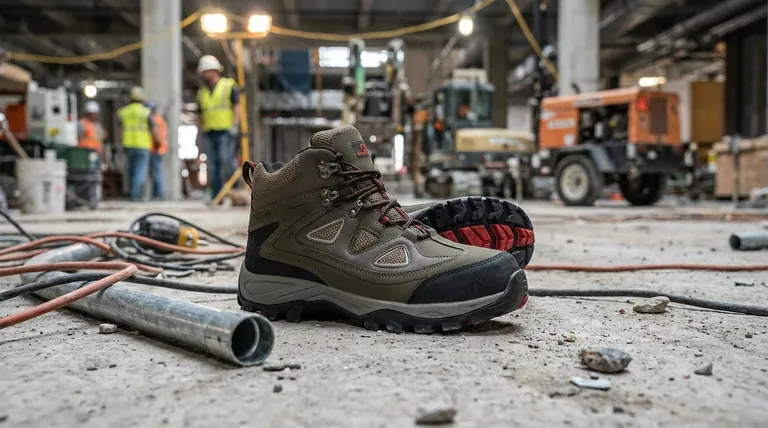
An employee drops a heavy part, but their foot is fine. The steel-toed boot did its job. On the surface, this is a safety success story.
But what if that same employee, wearing the same boot, walks across a floor with an unseen, live electrical wire? Or steps on a discarded nail that punctures the sole?
The feeling of safety was an illusion. The protection was incomplete because the real risk was misunderstood. This highlights a critical, often-overlooked truth in workplace safety: the most dangerous threat isn't the hazard you see, but the one you haven't properly planned for.
Compliance isn't about buying a "safety shoe." It's about implementing a system.
The Two Pillars of Foot Protection
Understanding that system begins with understanding the distinct roles of two key organizations: OSHA and ASTM International. They work in tandem, creating a framework of legal responsibility and engineering precision.
OSHA: The Mandate of "Why"
The Occupational Safety and Health Administration (OSHA) doesn't design shoes. It sets the legal mandate.
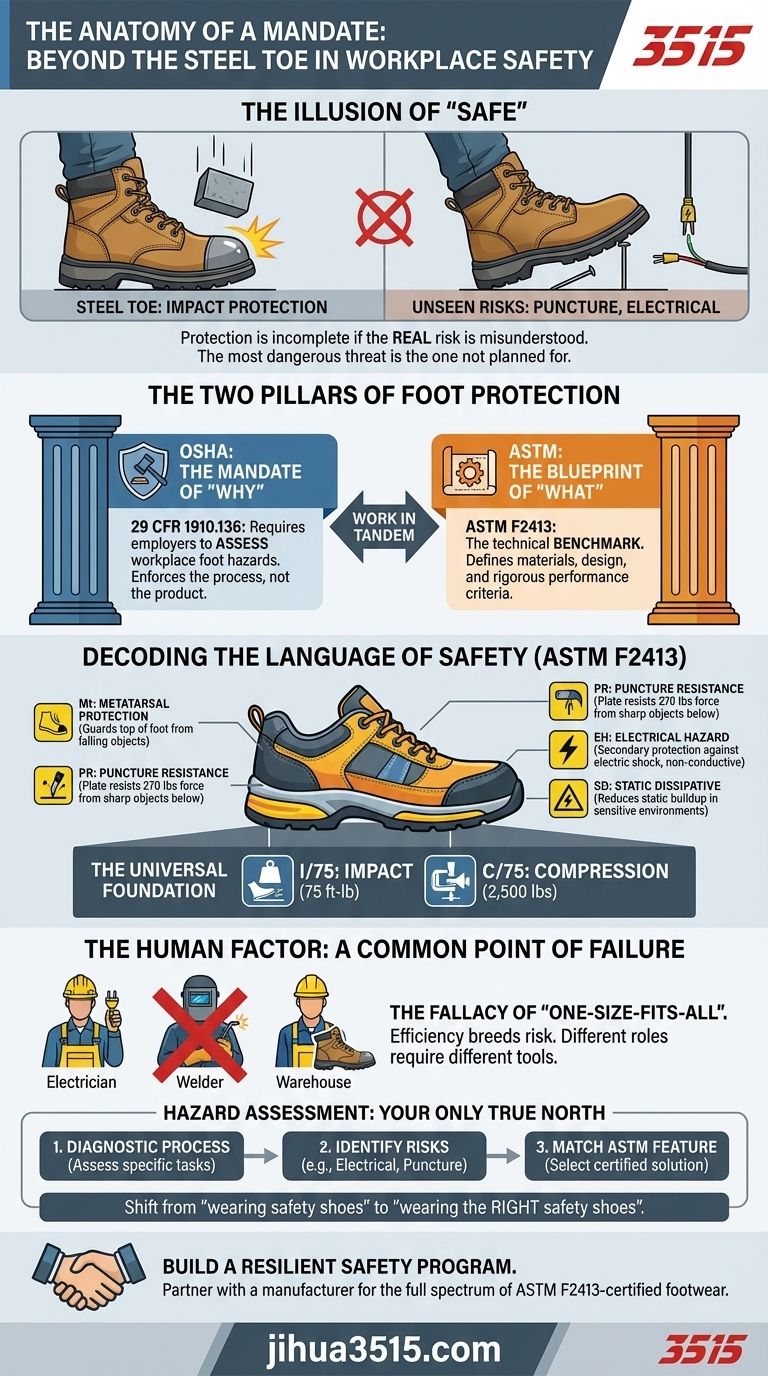
Under regulation 29 CFR 1910.136, OSHA requires employers to perform a crucial act of foresight: assess the workplace for foot hazards. If a danger exists, the employer is legally bound to ensure employees wear footwear that protects against it. OSHA's role is to enforce this process, not to certify the equipment.
ASTM: The Blueprint of "What"
This is where ASTM International comes in. OSHA points to their standard, ASTM F2413, as the technical benchmark.
ASTM defines the "what." It provides the detailed engineering blueprint for what a shoe must do to be considered protective. It specifies the materials, design, and, most importantly, the performance criteria under rigorous testing.
When OSHA says "provide appropriate footwear," they mean footwear that is lab-certified to meet the specific clauses of the ASTM F2413 standard relevant to the identified hazard.
Decoding the Language of Safety
An ASTM F2413-compliant shoe carries a label—a short-hand code that tells the story of its protective capabilities. Understanding this language is non-negotiable for anyone responsible for safety.
The Universal Foundation: I/75 & C/75
Every shoe certified to the ASTM F2413 standard must, at a minimum, protect the toes from impact and compression.
- Impact (I/75): The toe box can withstand a 75 foot-pound impact.
- Compression (C/75): The toe box can withstand 2,500 pounds of crushing force.
This is the baseline. But for many jobs, it's only the beginning.
Guarding Against Specific Threats
True safety requires matching specialized features to specific risks. The ASTM label identifies these capabilities:
- Metatarsal Protection (Mt): Guards the delicate bones on the top of the foot. Essential in environments where objects can drop flat onto the foot, not just the toes.
- Puncture Resistance (PR): A plate in the sole resists a minimum of 270 pounds of force, protecting against nails, metal shards, and other sharp objects from below. A necessity on construction and demolition sites.
- Electrical Hazard (EH): Designed with non-conductive soles and heels to offer a secondary source of protection against electric shock from live circuits. This is a critical feature, not an add-on, for electricians and maintenance crews.
- Static Dissipative (SD): Reduces the buildup of static electricity, channeling it to the ground. This is vital in sensitive electronics manufacturing or environments with flammable vapors where a simple spark could be catastrophic.
The Most Common Point of Failure: The Human Factor
The system of standards is robust, but its implementation often fails due to simple cognitive biases.
The Fallacy of the "One-Size-Fits-All" Program
The most common mistake is providing a single type of "safety shoe" to an entire workforce. It's an act of efficiency that breeds risk.
Giving a puncture-resistant boot to an electrician working near live circuits provides a false sense of security. They are protected from a risk they likely don't face while being exposed to one that could be fatal. The warehouse worker, welder, and maintenance technician all operate in different risk ecosystems and require different tools for the job.
The Hazard Assessment: Your Only True North
The mandatory hazard assessment is not a bureaucratic checkbox. It is the diagnostic process that makes the entire safety system function.
It forces a shift from "are my people wearing safety shoes?" to "are my people wearing the right safety shoes for the specific tasks they perform?" Without this assessment, any footwear selection is just a guess.
This is why partnering with a manufacturer that understands the full spectrum of risk is so crucial. A supplier's role isn't just to sell footwear; it's to provide the specific, certified solutions that are the output of a thoughtful safety assessment. As a large-scale manufacturer producing a comprehensive range of ASTM F2413-certified footwear, we equip distributors and large-scale clients to solve this exact problem—ensuring every role gets the precise protection it demands.
To build a truly resilient safety program, you need a supply chain that can deliver the full range of protection, from impact and compression to specialized EH and PR solutions. Contact Our Experts
Visual Guide
Related Products
- Premium Suede Sport Safety Shoes for Wholesale & Bulk Orders
- Premium Lightweight Safety Shoes for Wholesale & Bulk Orders
- Wholesale Anti-Smash & Puncture-Proof Safety Shoes Custom Manufacturing for Brands
- Premium KPU Injection Athletic Style Safety Shoes
- Premium Safety Shoes with Rotating Buckle Safety Sneakers
Related Articles
- The Ghost in the Machine: Why an Obsolete Footwear Standard Creates Modern Risk
- Beyond the Steel Toe: The Hidden Ergonomics of Workplace Safety
- Why Traditional Laces Are a Hidden Safety Risk—And What to Do About It
- The True Cost of Skipping Safety Shoes: Long-Term Risks and Smart Protection
- How Safety Shoe Engineering Prevents Workplace Injuries Across Industries