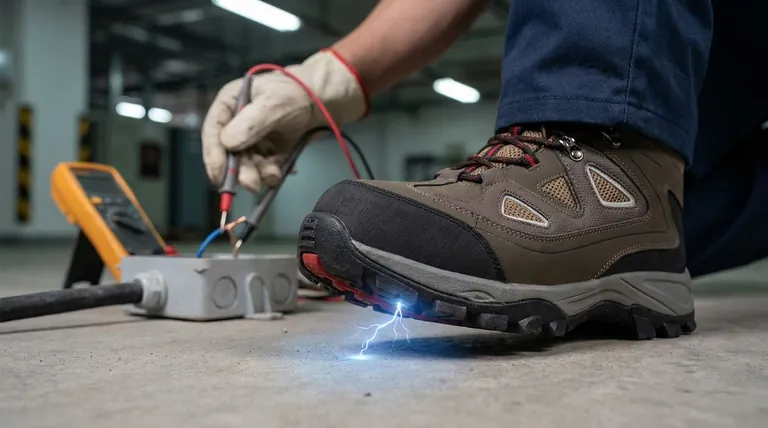
An electrician kneels on a concrete floor, focused on a junction box. The main breaker is off, the area is secured—or so it seems. An unmarked, mislabeled wire, still live from another circuit, brushes against the metal tool in their hand.
In that split second, 120 volts are searching for the path of least resistance to the ground. The human body, being mostly saltwater, is an excellent conductor. The electricity wants to flow through the arm, across the torso, down the legs, and into the earth.
This is the moment where physics becomes brutally personal. And the only thing preventing a tragedy is the half-inch of specialized rubber and polyurethane separating the foot from the floor.
The Physics of a Fatal Mistake
We rarely think of ourselves as potential components in an electrical circuit. It’s a psychological blind spot. We see electricity as something that happens in wires, not through us.
But for a shock to occur, a circuit must be completed. A person must touch a live source while also being connected to the ground, creating an uninterrupted path for the current to flow.
Electrical Hazard (EH) rated footwear is engineered around a single, elegant principle: break that circuit.
Engineering an Interruption
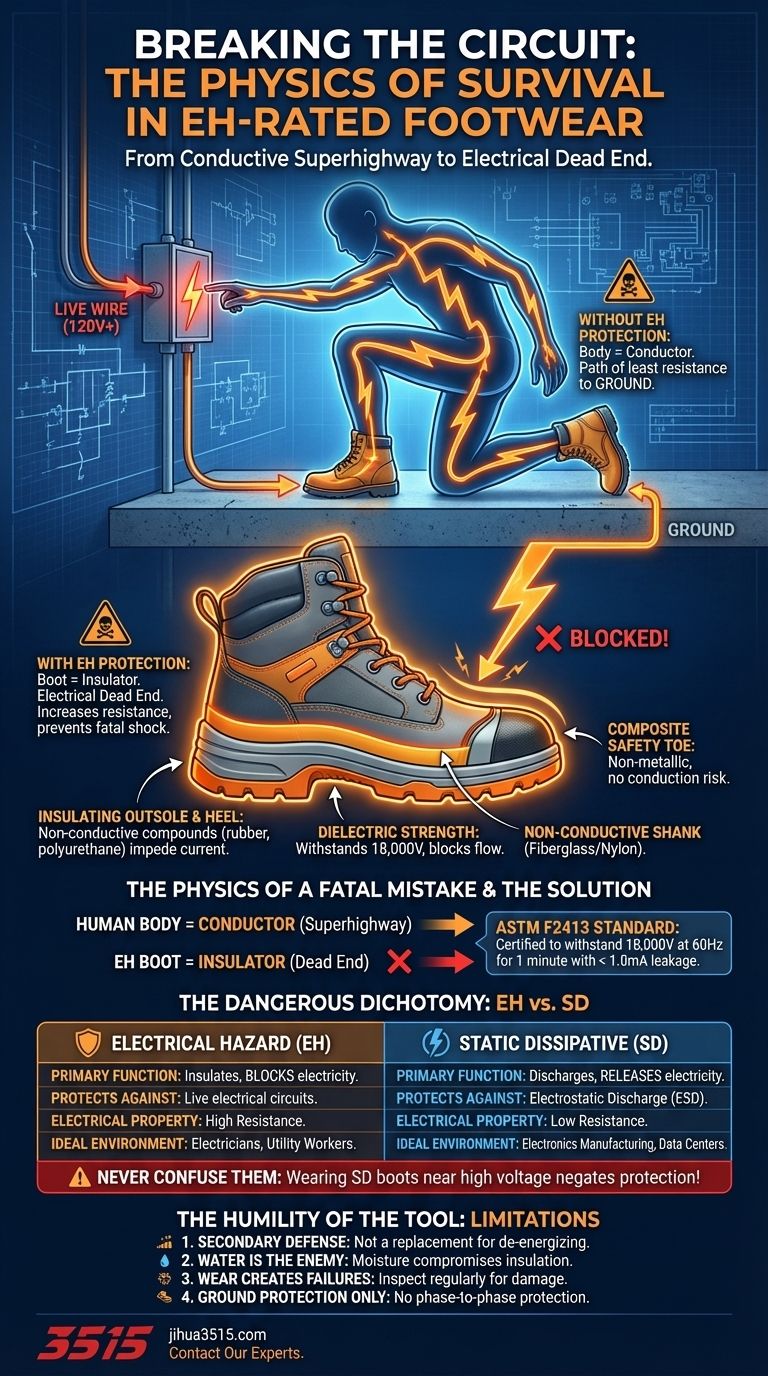
An EH-rated boot is not just a boot. It’s a wearable, non-conductive insulator designed to drastically increase the electrical resistance between you and the ground. It turns your body from a superhighway for electricity into a dead end.
The Principle of Insulation
The sole and heel of an EH boot act as a resistor. They are built from materials that fundamentally impede the flow of electricity. When you step on a live conductor, this insulation denies the current an easy path to ground through your feet, forcing it to look for another route—or, ideally, preventing a dangerous level of current from flowing at all.
Material Science at Your Feet
This protective capability is born from material science. The outsoles are made from non-conductive compounds like specially formulated rubber or polyurethane. These materials are chosen for their high dielectric strength—a technical term for their ability to withstand a high voltage before they break down and begin to conduct electricity.
The Hidden Weakness of Steel
To maintain this insulating integrity, every component matters. This is why EH-rated boots almost universally feature composite safety toes instead of steel toes.
While a steel-toed boot can be EH-rated if insulated correctly, the presence of a large piece of metal introduces an unnecessary risk. A non-metallic composite toe, made from materials like carbon fiber or fiberglass, offers the same impact protection without creating a potential conductor inside the boot. The arch-supporting shank is also made of non-conductive nylon or fiberglass, not steel.
A Standard Forged in High Voltage
Trust in safety equipment cannot be based on marketing claims. It must be verifiable.
Footwear claiming EH protection must meet the ASTM F2413 standard. This isn't a simple pass/fail check. The test is severe: the footwear must withstand 18,000 volts at 60 Hz for one full minute without allowing more than 1.0 milliamp of current to leak through. It’s a promise of performance, certified under conditions far more extreme than a typical worksite accident.
The Dangerous Dichotomy: EH vs. SD
One of the most critical—and potentially fatal—misunderstandings in safety footwear is confusing Electrical Hazard (EH) with Static Dissipative (SD) boots. They are designed for opposite purposes.
- EH boots are built to BLOCK electricity. They insulate you to prevent shock.
- SD boots are built to RELEASE electricity. They safely bleed off static charge to protect sensitive electronics.
Choosing one when you need the other is not a minor error. Wearing SD boots while working on high-voltage equipment negates your protection. Wearing EH boots in a clean room for microchip assembly could allow static buildup to destroy thousands of dollars of components with a single touch.
| Feature | Electrical Hazard (EH) | Static Dissipative (SD) |
|---|---|---|
| Primary Function | Insulates the wearer from the ground | Safely discharges static buildup into the ground |
| Protects Against | Accidental contact with live electrical circuits | Electrostatic discharge (ESD) that can damage electronics |
| Electrical Property | High electrical resistance (non-conductive) | Controlled, lower electrical resistance |
| Ideal Environment | Electricians, utility workers, maintenance personnel | Electronics manufacturing, clean rooms, data centers |
The Humility of the Tool
Like any tool, EH footwear has limitations. Overconfidence is its greatest enemy. Understanding its boundaries is as important as wearing it.
- It is a SECONDARY defense. The primary safety measures are always de-energizing circuits, lockout/tagout procedures, and using insulated tools. Your boots are your last line of defense, not your first.
- Water is the enemy. The insulating properties of EH boots are severely compromised by moisture. If the boots are wet or you are standing in water, the protective barrier is functionally gone.
- Wear creates invisible failures. As a sole wears down or is punctured by a metal shaving or nail, its insulating capacity degrades. Regular inspection is not just a recommendation; it's a critical safety habit.
- It only protects from the ground up. EH boots offer no protection against phase-to-phase contact, like touching two separate live wires simultaneously.
The choice of safety footwear is a direct reflection of your understanding of the work environment. It’s a decision based on physics, not preference. As a large-scale manufacturer, we at 3515 produce a comprehensive range of EH-rated footwear because we understand these non-negotiable safety requirements. We engineer solutions that provide distributors, brand owners, and industrial clients with the critical secondary protection their teams depend on.
Ensuring your team has the right, certified protection for the specific hazards they face is a foundational responsibility. Contact Our Experts
Visual Guide
Related Products
- Durable High-Ankle Tactical Boots Wholesale Manufacturer for Custom & Bulk Orders
- Heavy-Duty Waterproof Nubuck Safety Boots Safety Shoes for Bulk Supply
- Durable Leather High-Ankle Tactical Boots for Wholesale & Custom Manufacturing
- Wholesale Breathable Training Shoes Custom Athletic Footwear Manufacturer
- Premium Suede Sport Safety Shoes for Wholesale & Bulk Orders
Related Articles
- The Agility-Protection Paradox: Deconstructing Safety in Modern Tactical Footwear
- Why Your Tactical Boots Wear Out So Fast—And the Procurement Mistake Behind It
- Why Your Tactical Boots Keep Failing—And Why 'Tougher' Isn't the Answer
- Why Your Team Hates Their Tactical Boots: A Manufacturer's Guide to Mission-Critical Trade-Offs
- Why Your Tactical Boots Are Failing: It’s Not the Pattern, It’s the Platform



















