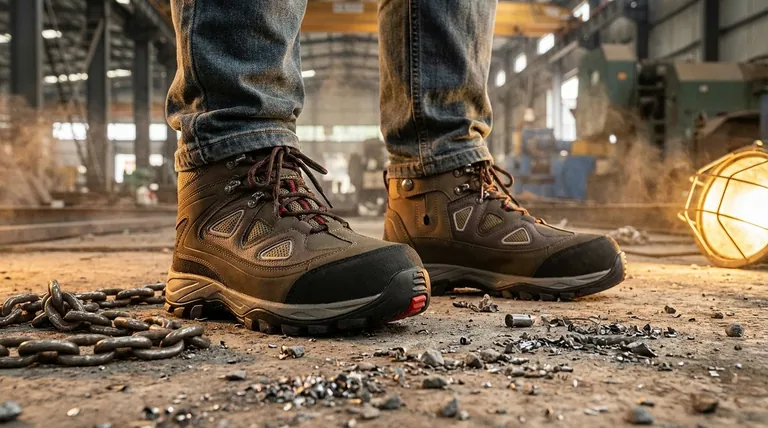
A 75-Pound Weight and a Moment of Truth
Imagine a 75-foot-pound weight dropped onto the toe of a boot. It’s a moment of violent, concentrated energy. For the worker wearing that boot, the outcome is decided not in that instant, but by a system of rules and engineering established years earlier.
The difference between a trip to the first-aid station and a life-altering injury isn't just a piece of steel. It's a quiet collaboration between a government agency and an international standards organization. Understanding this relationship is the foundation of any effective workplace safety program.
The Mandate vs. The Blueprint
The system has two key players, often confused but with distinct roles:
-
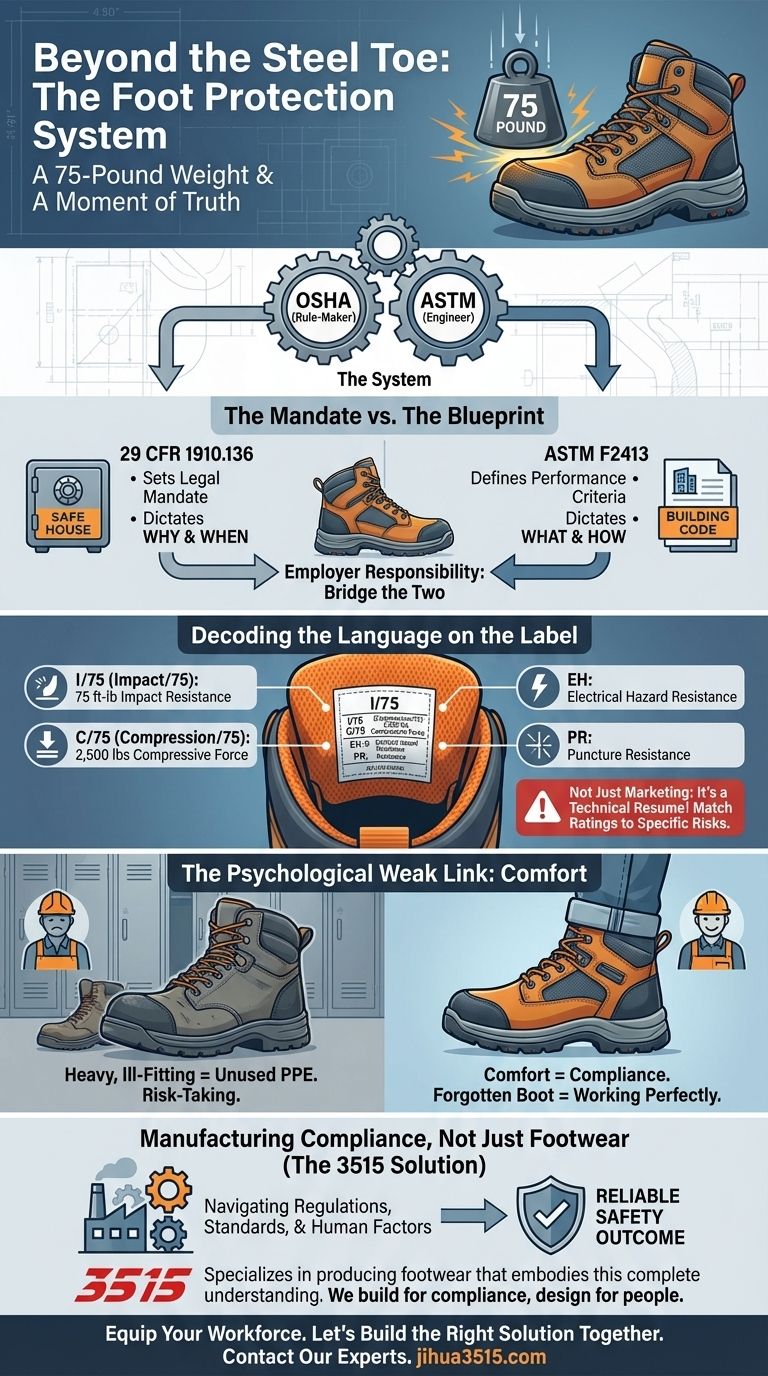
OSHA (Occupational Safety and Health Administration): The rule-maker. OSHA sets the legal mandate. Their regulation, 29 CFR 1910.136, simply says employers must ensure employees use protective footwear when facing foot hazards. They dictate the why and the when.
-
ASTM International: The engineer. ASTM develops the technical standards. Their blueprint, ASTM F2413, defines the specific performance criteria for impact resistance, compression, and other hazards. They dictate the what and the how.
OSHA tells you to build a safe house; ASTM gives you the building code. An employer's core responsibility is to bridge the two—assessing their specific site hazards and then selecting footwear built to the correct code.
Decoding the Language on the Label
Footwear compliant with ASTM F2413 speaks a specific language, usually printed on an internal label. This isn't marketing; it's a technical resume.
- I/75 (Impact/75): The safety toe can withstand a 75 foot-pound impact.
- C/75 (Compression/75): The safety toe can withstand 2,500 pounds of compressive force.
- EH: Electrical Hazard resistance, crucial for electricians.
- PR: Puncture Resistance, for environments with sharp objects underfoot.
Simply buying a "steel-toed boot" is like hiring a candidate without checking their qualifications. The specific ratings must match the specific, identified risks of the job.
| Organization | Role in Safety Footwear | Key Standard / Regulation |
|---|---|---|
| OSHA | Sets legal mandate for when protective footwear is required. | 29 CFR 1910.136 |
| ASTM International | Defines technical performance criteria for what makes it compliant. | ASTM F2413 |
The Psychological Weak Link: Comfort
Here is a truth that regulations can’t fully capture: the most technically perfect safety boot is useless if it stays in a locker.
The single greatest threat to a footwear safety program is human nature. If a boot is heavy, ill-fitting, or causes discomfort, workers will find reasons not to wear it correctly. They’ll loosen the laces, wear the wrong socks, or switch to other shoes "just for a minute."
This is why comfort is not a luxury; it's a critical component of compliance. The psychological burden of wearing uncomfortable PPE every day leads to risk-taking. A boot that is forgotten by its wearer is a boot that is working perfectly.
Manufacturing Compliance, Not Just Footwear
For distributors, brand owners, and large-scale industrial buyers, navigating this ecosystem of regulations, technical standards, and human factors is a significant challenge.
The goal isn't just to purchase boots. It's to procure a reliable safety outcome. This requires a manufacturing partner who understands the entire system—from the legal force of OSHA and the material science of ASTM to the critical importance of ergonomic design for user adoption.
As a large-scale manufacturer, 3515 specializes in producing footwear that embodies this complete understanding. We build to the standards required for compliance, but we design for the people who will depend on them every day.
Ensuring your team is protected involves more than a checklist; it requires a solution built on a deep understanding of the entire safety system. If you need to equip your workforce with footwear that is safe, compliant, and wearable, let's build the right solution together. Contact Our Experts
Visual Guide
Related Products
- Premium Suede Sport Safety Shoes for Wholesale & Bulk Orders
- Premium Lightweight Safety Shoes for Wholesale & Bulk Orders
- Wholesale Anti-Smash & Puncture-Proof Safety Shoes Custom Manufacturing for Brands
- Premium KPU Injection Athletic Style Safety Shoes
- Premium Safety Shoes with Rotating Buckle Safety Sneakers
Related Articles
- The Ghost in the Machine: Why an Obsolete Footwear Standard Creates Modern Risk
- Beyond the Steel Toe: The Hidden Ergonomics of Workplace Safety
- Why Traditional Laces Are a Hidden Safety Risk—And What to Do About It
- The True Cost of Skipping Safety Shoes: Long-Term Risks and Smart Protection
- How Safety Shoe Engineering Prevents Workplace Injuries Across Industries