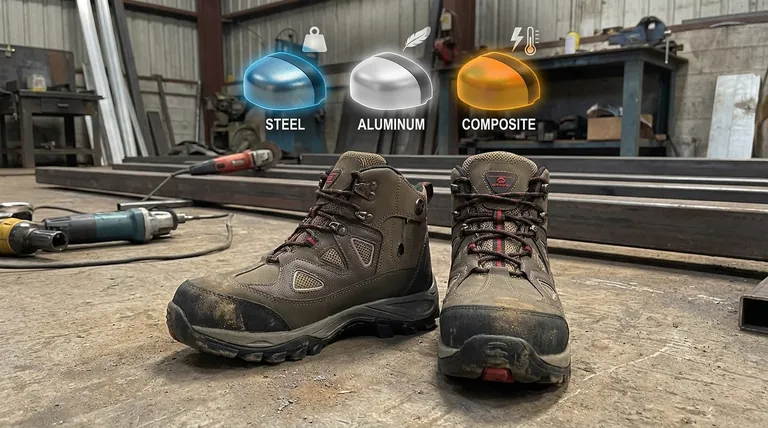
The Illusion of a Single "Best"
An operations manager is outfitting a new crew for a sprawling manufacturing facility. The default choice for safety boots? Steel toe. It's the traditional answer, the one that feels intuitively strongest.
But this intuition hides a cognitive trap. We often mistake the most traditional or heaviest option for the most protective one. The reality is that the "best" safety toe is not a universal material but a specific solution matched to a unique set of problems.
The choice between steel, aluminum, and composite is less about which is strongest and more about understanding the work environment as a complete system—where factors like fatigue, electrical risk, and temperature are just as critical as impact resistance.
The Unseen Foundation: Certified Protection
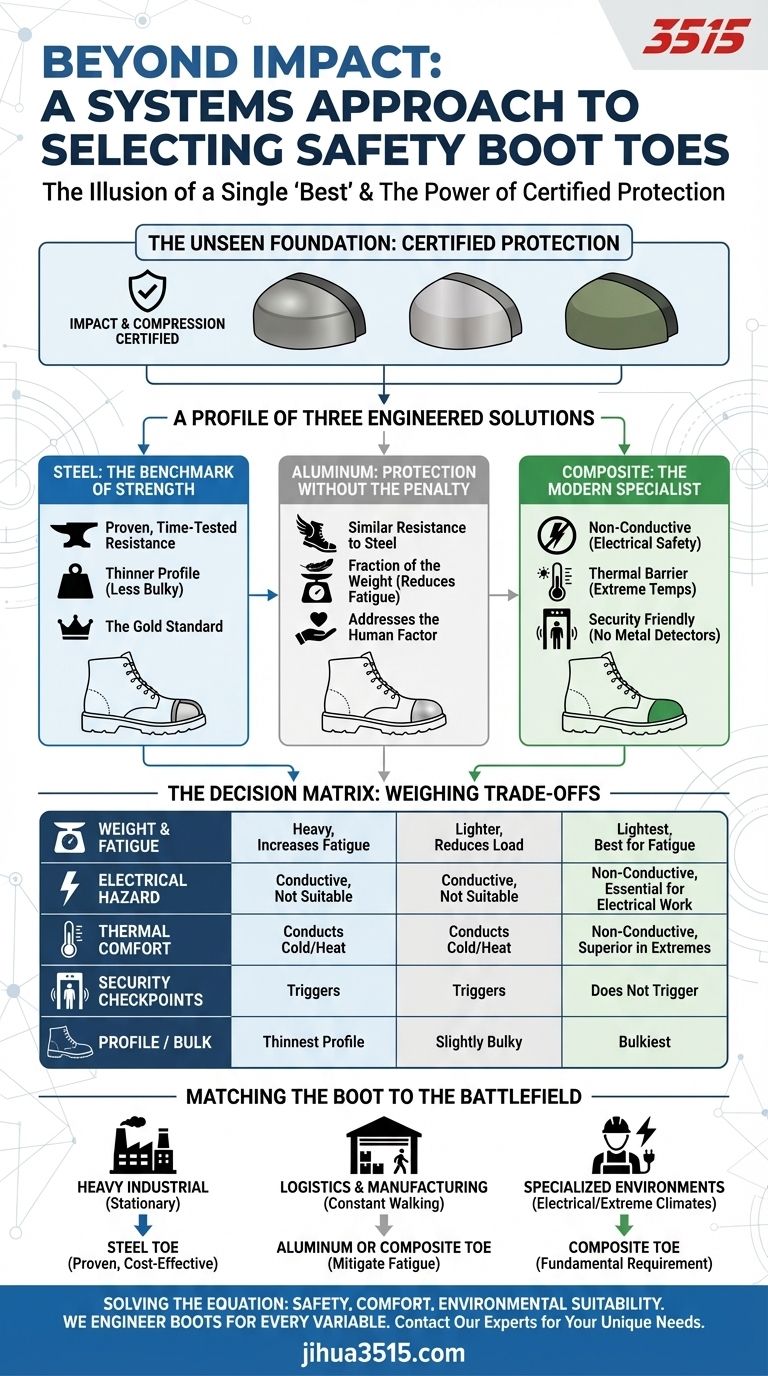
Before comparing materials, it's crucial to establish a baseline: all legitimate safety toes, regardless of material, meet the same core safety standards for impact and compression.
Whether it’s steel, aluminum, or a composite, a certified toe cap is engineered to shield you from a specific, tested amount of force. The material is simply the medium. This levels the playing field and shifts the decision from "which is safer?" to "which offers the right properties for the job?"
A Profile of Three Engineered Solutions
Each safety toe material represents a different philosophy of protection, with inherent strengths tailored for specific applications.
H3: Steel: The Benchmark of Strength
Steel is the industry standard for a reason. It offers proven, time-tested resistance to impact and compression. Its inherent strength and density mean that a steel toe cap can be made thinner than its composite counterpart while providing the same level of protection.
This often results in a less bulky, more streamlined boot profile, which has been the classic look and feel of a work boot for generations. It is the gold standard against which others are measured.
H3: Aluminum: Protection Without the Penalty
Aluminum offers a similar level of impact and compression resistance to steel, but at a fraction of the weight. This is not a minor detail.
Over a ten-hour shift, a few ounces on each foot translates to lifting hundreds of extra pounds. This cumulative load is a direct contributor to physical fatigue, which in turn is a leading cause of workplace accidents. Aluminum toes address the human factor, providing robust metal protection without the energy penalty.
H3: Composite: The Modern Specialist
Composite toes—made from materials like Kevlar, carbon fiber, and specialized plastics—are the non-metallic solution. Their defining characteristic is what they don't do.
They don't conduct electricity, making them the only logical choice for an electrician or anyone working near live circuits. They don't conduct heat or cold, providing a critical thermal barrier for workers in freezers or foundries. And because they contain no metal, they allow workers to pass through security checkpoints without hassle. They are the specialist's tool.
The Human Element: Why Fit Is a Safety Feature
Often listed alongside material types is the "wide toe" option. This isn't a material but a critical design consideration related to fit.
A cramped toe box is more than just an inconvenience; it's a chronic distraction. It can cause foot pain, reduce circulation, and contribute to fatigue. In an environment where focus is paramount, persistent discomfort is a systemic liability. A proper fit, with adequate room for your toes, is a foundational safety feature, available across steel, aluminum, and composite models.
The Decision Matrix: A Framework for Trade-offs
Choosing the right toe is an exercise in weighing objective trade-offs. The best choice becomes clear when you map material properties to your specific workplace hazards.
| Variable | Steel Toe | Aluminum Toe | Composite Toe |
|---|---|---|---|
| Weight & Fatigue | Heaviest; can increase fatigue over long shifts. | Lighter than steel; reduces cumulative load. | Lightest option; best for minimizing fatigue. |
| Electrical Hazard | Conductive; not suitable. | Conductive; not suitable. | Non-conductive; essential for electrical work. |
| Thermal Comfort | Conducts cold and heat. | Conducts cold and heat. | Non-conductive; superior in extreme temperatures. |
| Security Checkpoints | Will trigger metal detectors. | Will trigger metal detectors. | Will not trigger metal detectors. |
| Profile / Bulk | Thinnest profile for a given strength rating. | Slightly bulkier than steel. | Tends to be the bulkiest to meet standards. |
Matching the Boot to the Battlefield
Your work environment dictates the optimal choice. The goal is to align the tool with the task.
-
For heavy industrial settings where maximum impact is the primary concern and workers are largely stationary, a traditional steel toe provides proven, cost-effective protection.
-
For logistics, manufacturing, or any role requiring constant walking, the weight savings from an aluminum or composite toe are critical for mitigating end-of-day fatigue and maintaining alertness.
-
For specialized environments—electricians, utility workers, airport staff, or jobs in extreme climates— a composite toe is not just a preference; it is a fundamental requirement for safety and operational efficiency.
Solving this complex equation of safety, comfort, and environmental suitability is what defines a truly effective safety footwear program. As a large-scale manufacturer producing a comprehensive range of footwear, we specialize in engineering boots that solve for these exact variables. Our capabilities cover all toe types—steel, aluminum, and composite—ensuring that distributors, brand owners, and bulk clients can equip their teams with the precise tool for the job.
To ensure your team has the right combination of protection and performance for your unique operational needs, Contact Our Experts.
Visual Guide
Related Products
- Puncture-Resistant Velcro Safety Boots for Wholesale & Custom Manufacturing
- Durable Steel Toe Safety Boots Wholesale & Custom Manufacturing
- Wholesale Leather Safety Boots with Customizable Protective Toe
- Wholesale Durable Breathable Safety Boots Custom OEM Manufacturer
- Heavy Duty Nubuck Safety Boots Safety Shoes for Global Distribution
Related Articles
- The Unseen Engineering: Why Steel Toes Succeed or Fail in Oily Environments
- The Anatomy of Trust: A Systems Approach to Workplace Foot Protection
- The Lacing Paradox: Why the Safest Boots Contain Their Own Greatest Risk
- How Industrial Professionals Can Balance Safety Boot Requirements with Professional Appearance
- How to Choose Safety Boots That Reduce Fatigue Without Sacrificing Protection