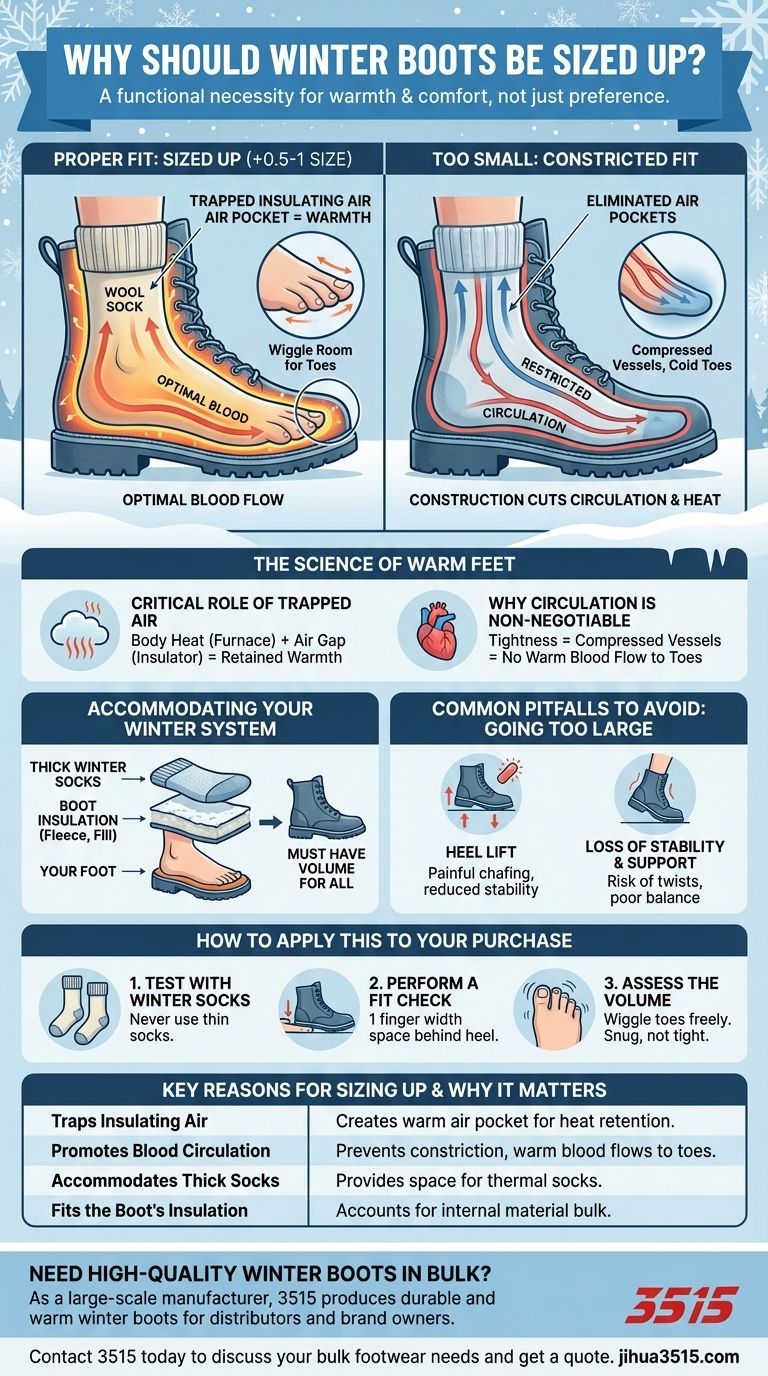
Sizing up your winter boots is a functional necessity, not a matter of preference. You should typically go up a half to a full size from your standard shoe size to accommodate thicker winter socks and the boot's own internal insulation, ensuring your feet have the space they need to stay warm.
The core principle of a warm winter boot is creating a system that traps air and promotes blood flow. A boot that is too small constricts your foot, eliminating vital air pockets and cutting off circulation, which are the two most critical components for keeping your feet warm.
The Science of Warm Feet: Why Space Matters
A proper fit for a winter boot is fundamentally different from a sneaker or dress shoe. The goal isn't just to match the length of your foot, but to create an environment optimized for heat retention in cold conditions.
The Critical Role of Trapped Air
Your body heat is the furnace that keeps your feet warm. The boot's job is to prevent that heat from escaping.
A key element in this process is trapped, or "dead," air. Air is a poor conductor of heat, so a small, still layer of it around your foot acts as a powerful insulator. Sizing up ensures there is enough space for this insulating air pocket to form.
Why Circulation is Non-Negotiable
The most insulated boot in the world will fail if your circulation is compromised. Your blood is what carries heat to your extremities.
A boot that is too tight compresses the blood vessels in your foot, drastically reducing the flow of warm blood to your toes. This is often the primary reason people experience cold feet, even in high-quality boots.
Accommodating Your Winter System
Winter footwear is a system, not a single item. The boot must have enough volume to hold both your foot and your thick socks without creating pressure.
Most people wear thicker wool or synthetic socks in the winter. The boot's size must account for this extra material. Additionally, the boot's own insulation—be it fleece, shearling, or a synthetic fill—takes up significant internal space.
Common Pitfalls to Avoid
While sizing up is crucial, going too large creates its own set of problems. The goal is a boot that is roomy, not sloppy.
The Problem of Heel Lift
The most common issue with an oversized boot is heel lift. If the boot is too long or voluminous, your heel will slide up and down with every step.
This constant rubbing will quickly cause painful blisters and chafing. It also reduces your stability and control, which can be dangerous on icy or uneven surfaces.
Loss of Stability and Support
A boot that fits too loosely cannot provide adequate ankle support or hold your foot securely. This makes you less stable and increases the risk of twists or sprains. Your foot will slide around inside the boot, compromising your balance.
Compromised Insulation
If the air gap around your foot is too large, your body has to work much harder to heat that excessive volume of air. In some cases, this can lead to your feet feeling colder as your body heat dissipates into the cavernous space instead of being trapped in a small, effective layer.
How to Apply This to Your Purchase
Finding the perfect fit requires a practical approach when you try on boots. Always test them under the conditions you expect to use them in.
Always Test with Your Winter Socks
Never try on winter boots with thin athletic or dress socks. Bring the thickest pair of socks you intend to wear with you to the store to get a true assessment of the fit.
Perform a Fit Check
With the boot on and unlaced, slide your foot forward until your toes touch the front. You should be able to comfortably slide one finger—but not much more—between your heel and the back of the boot.
Assess the Volume
Once the boot is laced up, you should be able to wiggle all of your toes freely. The boot should feel snug and secure around the sides of your foot and heel, but it should not feel tight or constricted across the top or ball of your foot.
Making the Right Choice for Your Goal
Your ideal size depends on your specific use case.
- If your primary focus is casual daily wear: Sizing up a half size is often sufficient to provide comfort and warmth with standard winter socks.
- If your primary focus is active winter sports like hiking: Consider a full size up to accommodate thick performance socks and natural foot swelling during activity, but be meticulous about checking for heel lift.
- If you have circulation issues or consistently cold feet: Prioritize creating that insulating air gap, ensuring you can easily wiggle your toes even with your thickest socks on.
Properly sizing your winter boots transforms them from simple footwear into a critical system for warmth, comfort, and safety.
Summary Table:
| Key Reason for Sizing Up | Why It Matters |
|---|---|
| Traps Insulating Air | Creates a warm air pocket around your foot, which is critical for heat retention. |
| Promotes Blood Circulation | Prevents constriction, ensuring warm blood flows freely to your toes. |
| Accommodates Thick Socks | Provides necessary space for the thermal socks that are part of your winter system. |
| Fits the Boot's Insulation | Accounts for the internal bulk of materials like fleece or synthetic fill. |
Need High-Quality Winter Boots in Bulk?
As a large-scale manufacturer, 3515 produces a comprehensive range of durable and warm winter boots for distributors, brand owners, and bulk clients. Our expertise ensures every pair is designed with the precise fit and insulation needed for maximum comfort and safety in cold conditions.
Contact 3515 today to discuss your bulk footwear needs and get a quote.
Visual Guide
Related Products
- Premium Insulated Safety Boots and Shoes for Wholesale & Bulk Orders
- Factory Direct Wholesale Rain Boots Durable Waterproof & Fully Customizable
- Durable Waterproof Rain Boots | Custom Manufacturer for Wholesale & Brands
- Wholesale Waterproof Tactical Boots Custom Suede & High-Traction Soles
- Premium Waterproof High-Cut Industrial Safety Boots for Wholesale and Bulk Orders
People Also Ask
- What are the recommended insulation ratings for mild winter conditions? A Guide for Active & Stationary Workers
- How does insulation thickness correlate with temperature ranges? A Guide to Choosing the Right Warmth
- What insulation level is needed for severe cold and stationary work? 1200g or Higher is Essential
- What safety advantages do insulated boots offer beyond warmth? Dielectric Protection & Superior Grip
- How does fleece lining contribute to the warmth of insulated boots? Trapping Air for Superior Cold Protection