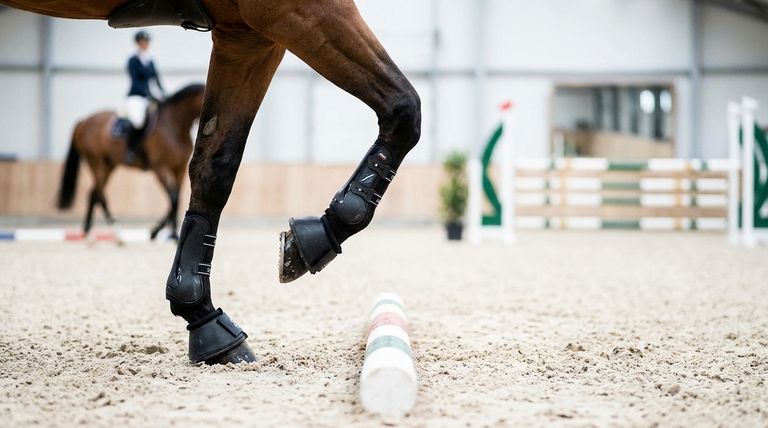
In short, horse boots are a critical tool for enhancing equine safety and performance. Their primary role is to provide physical protection against trauma, offer structural support to critical tendons and ligaments during exertion, and in some cases, improve coordination through enhanced sensory feedback to the horse.
The true value of horse boots is not just in preventing injury, but in providing targeted protection and support that allows a horse to perform with greater confidence and efficiency. However, their benefits are directly tied to selecting the right boot for the specific task and ensuring a perfect fit.
The Three Core Functions of Horse Boots
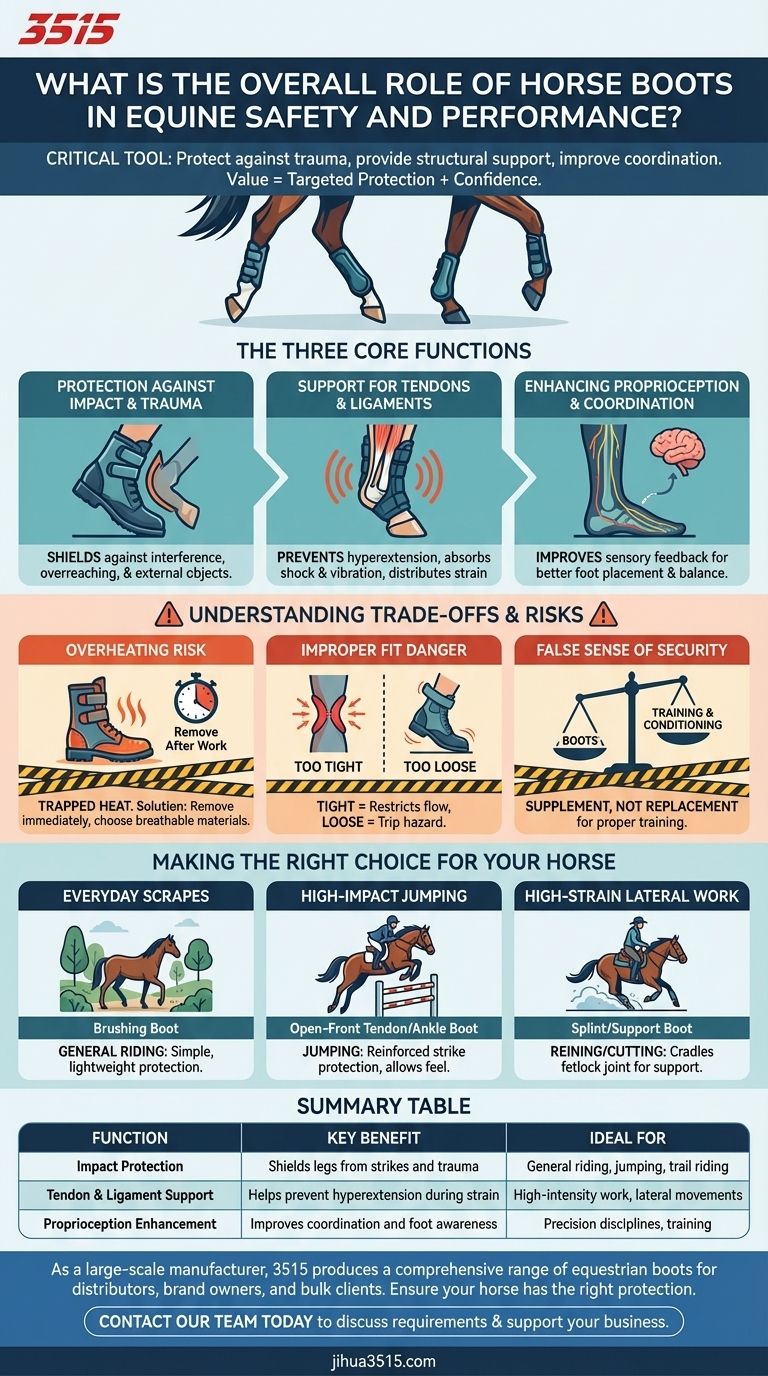
To understand their role, we must break down their function into three distinct categories. Each addresses a different type of risk associated with training and competition.
Protection Against Impact and Trauma
This is the most straightforward function of any horse boot. A horse's lower legs are surprisingly delicate, with very little muscle or tissue to cushion the bones, tendons, and ligaments.
Boots act as a shield against common injuries caused by interference, where one hoof strikes an adjacent leg, or overreaching, where a hind hoof strikes the back of a front leg. They also protect against impacts from external objects like jump rails or trail obstacles.
Support for Tendons and Ligaments
During high-intensity work, the horse's tendons and ligaments are put under immense strain. They stretch and recoil like powerful elastic bands to absorb concussion and propel the horse forward.
Certain types of boots, often called support boots, are designed to help prevent the hyperextension or over-stretching of these soft tissues. By wrapping the leg, they can help absorb and distribute some of the shock and vibration associated with high-impact movements.
Enhancing Proprioception and Coordination
Proprioception is the horse's innate sense of where its limbs are in space without having to look. It is a critical component of balance and coordination.
A well-fitted boot provides a gentle, consistent pressure on the leg. This added sensory information can enhance the horse's proprioceptive feedback, making it more aware of its foot placement and potentially leading to quicker, more precise movements and a reduced risk of a costly misstep.
Understanding the Trade-offs and Risks
While beneficial, horse boots are not a cure-all and come with critical considerations. Misuse can be more dangerous than not using a boot at all.
The Risk of Overheating
The tendons in a horse's lower leg have a poor blood supply, which makes them susceptible to heat-related damage. Boots can trap a significant amount of heat during exercise.
It is crucial to remove boots immediately after work to allow the legs to cool. Choosing boots made from modern, breathable materials can help mitigate this risk during use.
The Danger of Improper Fit
A boot that is too tight can restrict blood flow and cause pressure sores, a condition known as a "boot rub." It can also damage the very tendons it is meant to protect.
Conversely, a boot that is too loose can slip down the leg, becoming a dangerous trip hazard. It can also chafe or fail to provide any meaningful protection or support.
Creating a False Sense of Security
Boots are a risk-mitigation tool, not a guarantee against injury. They reduce the likelihood of certain injuries but cannot prevent them all.
The foundation of equine safety and performance will always be proper conditioning, correct training, and good horsemanship. Boots are a supplement to this foundation, not a replacement for it.
Making the Right Choice for Your Horse
Selecting the right boot depends entirely on your horse's job and specific needs.
- If your primary focus is preventing everyday scrapes and nicks: A simple, lightweight brushing boot is often the most effective and practical choice for general riding and turnout.
- If your primary focus is high-impact jumping: Look for specialized open-front tendon boots and ankle boots that provide reinforced strike protection while allowing the horse to feel the rail.
- If your primary focus is support during high-strain lateral work: A well-fitted splint or support boot that cradles the fetlock joint is essential for disciplines like reining or cutting.
Ultimately, a horse boot is a piece of technical equipment that, when chosen and used correctly, empowers your horse to perform its job more safely and effectively.
Summary Table:
| Function | Key Benefit | Ideal For |
|---|---|---|
| Impact Protection | Shields legs from strikes and trauma | General riding, jumping, trail riding |
| Tendon & Ligament Support | Helps prevent hyperextension during strain | High-intensity work, lateral movements |
| Proprioception Enhancement | Improves coordination and foot awareness | Precision disciplines, training |
Ensure your horse has the right protection for its specific needs.
As a large-scale manufacturer, 3515 produces a comprehensive range of equestrian boots for distributors, brand owners, and bulk clients. Our production capabilities encompass all types of protective boots, ensuring durability, safety, and performance.
Let us help you equip your equine athletes with confidence. Contact our team today to discuss your requirements and discover how we can support your business with high-quality, reliable footwear.
Visual Guide
Related Products
- Wholesale High-Traction Camo Boots - Custom Manufacturer for Brands
- Wholesale Lightweight Tactical Boots Custom Manufacturer for Desert & Combat Use
- High-Traction Suede Tactical Boots Wholesale & Custom Manufacturing
- Durable Leather Tactical Boots Wholesale & Custom Manufacturing for Brands
- Wholesale Perforated Comfort Dress Shoes | Custom Derby Shoe Manufacturer
People Also Ask
- What are the key features of the new line of camo boots? Built for Extreme Cold & Rugged Terrain
- Are camo boots necessary for hunting success? Prioritize Performance Over Pattern
- What is the technical logic behind using closed-eye testing for tactical boots? Unlocking Peak Footwear Stability
- How does the Rank Score Test identify the primary causes of premature failure in tactical and work boots? Key Insights
- What shoes to wear for a security job? Durable, Protective Footwear for Long Shifts