
Simply put, motorcycle boots are not overlooked because they are purpose-built safety systems. Unlike casual footwear, they are engineered to protect your feet and ankles from the specific, violent forces encountered in a motorcycle accident, including impact, abrasion, and twisting. They are as critical to your safety as a helmet or jacket.
Motorcycle boots are not just footwear; they are a crucial piece of safety equipment designed to manage impact, abrasion, and torsional forces that would otherwise shatter the complex bone structure of your feet and ankles in a crash.
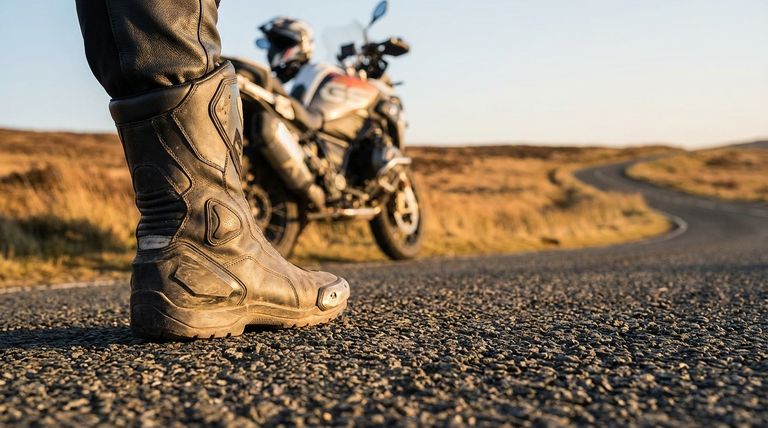
The Anatomy of Motorcycle Boot Protection
To understand their importance, you must understand the specific problems they are engineered to solve. A motorcycle boot is a technical system with distinct components, each addressing a unique type of force.
Managing Impact Forces
The most obvious danger in a crash is direct impact. Motorcycle boots integrate armor, often made of thermoplastic polyurethane (TPU), into critical areas.
This rigid armor over the heel, toes, and shin is designed to distribute the force of a sudden impact across a wider area, preventing the focused energy that causes fractures.
Resisting Abrasive Forces
When a rider falls, they often slide across the pavement. Standard shoes or boots are not designed for this and will be shredded in seconds, exposing skin to the road.
Motorcycle boots use highly abrasion-resistant materials, such as thick leather or advanced textiles, to withstand this friction. This layer acts as a sacrificial barrier, protecting your skin from severe road rash.
Preventing Twisting and Hyper-Extension
Perhaps the most critical function of a proper riding boot is providing torsional rigidity. Your ankle is not designed to twist or bend sideways.
High-quality boots have a reinforced structure, sometimes an external brace, that stabilizes the ankle. This system prevents the unnatural, high-force twisting motions during a tumble that lead to severe sprains, ligament tears, and debilitating fractures.
Understanding the Trade-offs and Common Pitfalls
Choosing the right boot involves balancing different factors. Recognizing common misconceptions is key to making a safe decision.
The Stiffness vs. Comfort Equation
Generally, a higher level of protection results in a stiffer boot. A full-length race boot offers maximum torsional support but is often awkward to walk in.
Conversely, a shorter "riding shoe" offers more comfort and flexibility for walking around off the bike but provides less shin protection and ankle support than a full boot.
The Fallacy of "Sturdy" Work Boots
Many riders mistakenly believe that a heavy-duty work boot is a safe substitute. This is a dangerous assumption.
Work boots, especially those with steel toes, are designed for crush and puncture protection from above, not the impact and sliding forces of a motorcycle crash. A steel toe can bend or sever in an accident, causing more severe injury. They also lack the necessary ankle and torsional support.
Making the Right Choice for Your Riding Style
Your choice of boot should directly reflect your primary riding environment and risk exposure.
- If your primary focus is maximum track safety: You need a full-height race boot with external armor, replaceable sliders, and an advanced torsion control system for the highest level of protection.
- If your primary focus is daily commuting or touring: Look for a waterproof, CE-rated boot that balances certified protection in the ankle, heel, and toe with enough comfort for all-day wear.
- If your primary focus is casual, short-distance riding: Choose a CE-rated riding shoe that offers fundamental ankle reinforcement and abrasion resistance far superior to any casual sneaker or boot.
Investing in proper motorcycle footwear is a direct investment in your ability to walk away from the unexpected.
Summary Table:
| Protection Feature | How It Works | Key Benefit |
|---|---|---|
| Impact Protection | Armor (TPU) in heel, toes, and shin distributes force. | Prevents fractures from direct impact. |
| Abrasion Resistance | Thick leather or advanced textiles withstand road friction. | Protects skin from severe road rash during a slide. |
| Torsional Rigidity | Reinforced structure stabilizes the ankle. | Prevents severe sprains, ligament tears, and fractures from twisting. |
As a large-scale manufacturer, 3515 produces a comprehensive range of CE-certified motorcycle boots for distributors, brand owners, and bulk clients. Our production capabilities ensure top-tier protection, durability, and style for every riding scenario. Secure your supply of high-quality, safety-focused footwear—contact us today to discuss your needs and place an order!
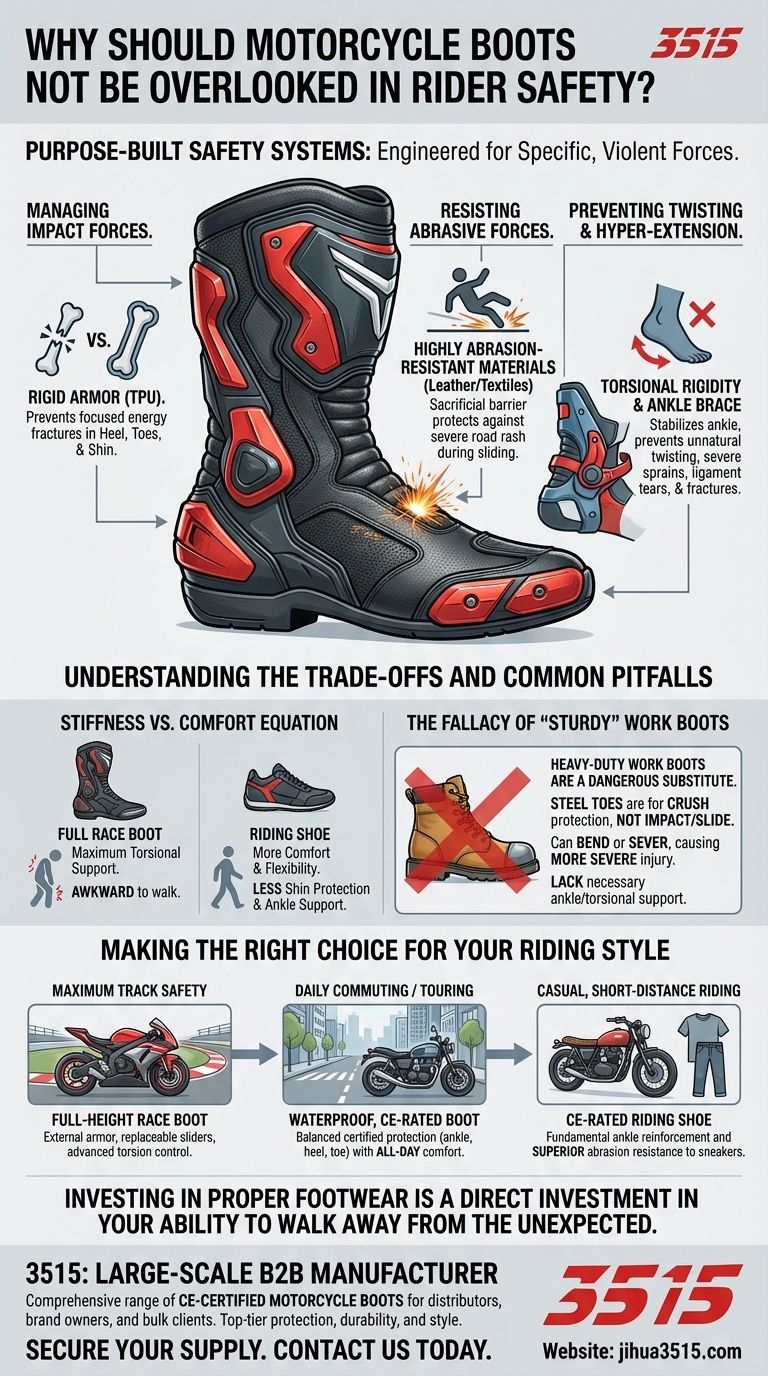
Visual Guide
Related Products
- Wholesale Tactical Boots High-Traction & Reflective for Bulk & Brand Orders
- High Performance Fire-Retardant Waterproof Safety Boots
- Durable Goodyear Welt Leather Work Boots for Wholesale & Private Label
- Wholesale High-Traction Camo Boots - Custom Manufacturer for Brands
- Heavy-Duty Waterproof Nubuck Safety Boots Safety Shoes for Bulk Supply
People Also Ask
- How do tactical boots protect against injuries? Discover the Integrated Safety System
- Why is the footwear standardization essential in ambient temperature studies? Ensure Scientific Data Accuracy
- What are the structural advantages of durable tactical boots? Elevate Performance in Rugged & Non-Standard Terrains
- What is the role of professional 3D medical imaging software in optimizing tactical boot design and performance?
- What factors should be considered when choosing between tactical boots and sneakers for daily activities? Find Your Perfect Fit



















