
The primary reasons to choose a Blake Stitch over a Goodyear welt are its immediate flexibility and more accessible price point. This construction method creates a shoe that requires virtually no break-in period and often features a sleeker, more refined silhouette than its Goodyear-welted counterpart.
The decision between Blake Stitch and Goodyear Welt is not about which is "better," but about a fundamental trade-off. You are choosing between the sleek, flexible, and cost-effective design of a Blake Stitch and the robust, water-resistant, and easily resoleable nature of a Goodyear Welt.
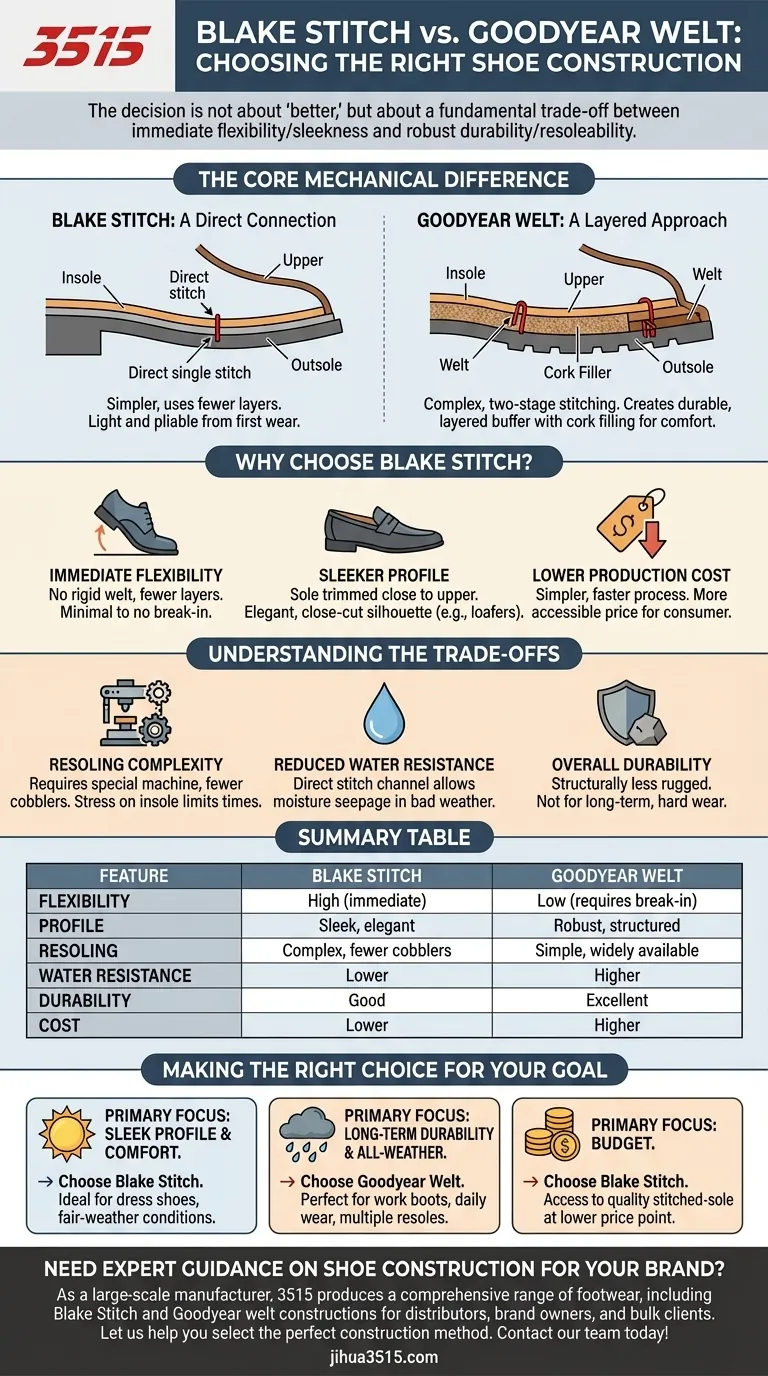
The Core Mechanical Difference
To understand the trade-offs, you must first understand how each shoe is built. The entire difference comes down to how the sole is attached to the upper part of the shoe.
Blake Stitch: A Direct Connection
In a Blake Stitch construction, a single stitch runs directly from the shoe's insole, through the upper, and into the outsole.
This direct, single-stitch method is simpler and uses fewer layers, resulting in a shoe that is light and pliable from the very first wear.
Goodyear Welt: A Layered Approach
A Goodyear welt uses a more complex, two-stage stitching process. First, a strip of leather called the "welt" is stitched to the upper and the insole. Then, in a separate stitch, that welt is stitched to the outsole.
This creates a durable, layered buffer between the insole and the outsole, which is often filled with cork for added comfort and support over time.
Why Choose Blake Stitch?
Despite the reputation of the Goodyear welt, the Blake Stitch offers distinct advantages for specific needs and styles.
Immediate Flexibility
Because there is no rigid welt and fewer layers, a Blake-stitched shoe is significantly more flexible out of the box. The break-in period is minimal to non-existent.
A Sleeker Profile
The direct interior stitch allows the sole to be trimmed very close to the upper. This creates a more elegant, close-cut silhouette, making it a popular choice for dress shoes like loafers and Italian-style footwear.
Lower Production Cost
The Blake Stitch process is simpler and faster than the more labor-intensive Goodyear welt. This efficiency translates directly into a more accessible price for the consumer.
Understanding the Trade-offs
The advantages of the Blake Stitch come with inherent compromises that are critical to understand.
Resoling Complexity
While a Blake-stitched shoe can be resoled, it requires a special Blake stitching machine to reach inside the shoe. Fewer cobblers have this equipment, making repairs more difficult and costly. The process also puts stress on the insole, limiting the number of times it can be done.
In contrast, a Goodyear welt is designed for easy resoling. A cobbler simply cuts the stitch connecting the welt to the outsole and attaches a new one without ever disturbing the shoe's core structure.
Reduced Water Resistance
The single stitch on a Blake-stitched shoe creates a direct channel from the wet outsole to the insole. This makes the shoe more susceptible to water seeping in during inclement weather.
The Goodyear welt provides a superior barrier against moisture, keeping your feet drier in wet conditions.
Overall Durability
The robust, multi-layered construction of a Goodyear welt is inherently more durable and built to withstand harder wear over many years. While a quality Blake-stitched shoe is not fragile, it is structurally less rugged.
Making the Right Choice for Your Goal
Select your construction method based on how you intend to use the footwear.
- If your primary focus is a sleek profile and out-of-the-box comfort: A Blake-stitched shoe is the ideal choice, especially for dress shoes worn in fair-weather conditions.
- If your primary focus is long-term durability and all-weather wear: The Goodyear welt is the superior option, perfect for work boots or daily shoes that must endure the elements and be resoled multiple times.
- If your primary focus is budget: Blake Stitch provides access to a quality, stitched-sole construction at a significantly lower price point than a Goodyear welt.
Understanding the engineering behind your footwear empowers you to invest in the pair that perfectly serves your needs.
Summary Table:
| Feature | Blake Stitch | Goodyear Welt |
|---|---|---|
| Flexibility | High (immediate) | Low (requires break-in) |
| Profile | Sleek, elegant | Robust, structured |
| Resoling | Complex, fewer cobblers | Simple, widely available |
| Water Resistance | Lower | Higher |
| Durability | Good | Excellent |
| Cost | Lower | Higher |
Need Expert Guidance on Shoe Construction for Your Brand?
As a large-scale manufacturer, 3515 produces a comprehensive range of footwear for distributors, brand owners, and bulk clients. Our production capabilities encompass all types of shoes and boots, including both Blake Stitch and Goodyear welt constructions.
We can help you select the perfect construction method for your target market, balancing style, comfort, durability, and cost.
Let's discuss your next project. Contact our team today to get started!
Visual Guide
Related Products
- Wholesale Breathable Training Shoes Custom Athletic Footwear Manufacturer
- Wholesale Durable & Breathable Training Shoes for Custom Brands
- Classic Leather Derby Dress Shoes Wholesale & Custom Manufacturing
- Lightweight Breathable Training Shoes for Wholesale & Custom OEM Manufacturing
- Wholesale Leather Derby Shoes Manufacturer | Customizable Business & Dress Footwear
People Also Ask
- Why are the slip-resistance and stability performance of training shoes critical in gait analysis? Ensure Data Accuracy
- What is the primary role of specialized training or orthopedic shoes? Enhance Safety in Elderly Balance Training
- Why are professional-grade training shoes essential for physical therapy? Ensure Patient Safety and Gait Stability
- Why is sole stiffness testing using a force gauge necessary? Build Superior Training Shoes with Precision
- Why is specialized athletic footwear necessary for ankle rehab? Unlock Safety and Stability in Recovery




