
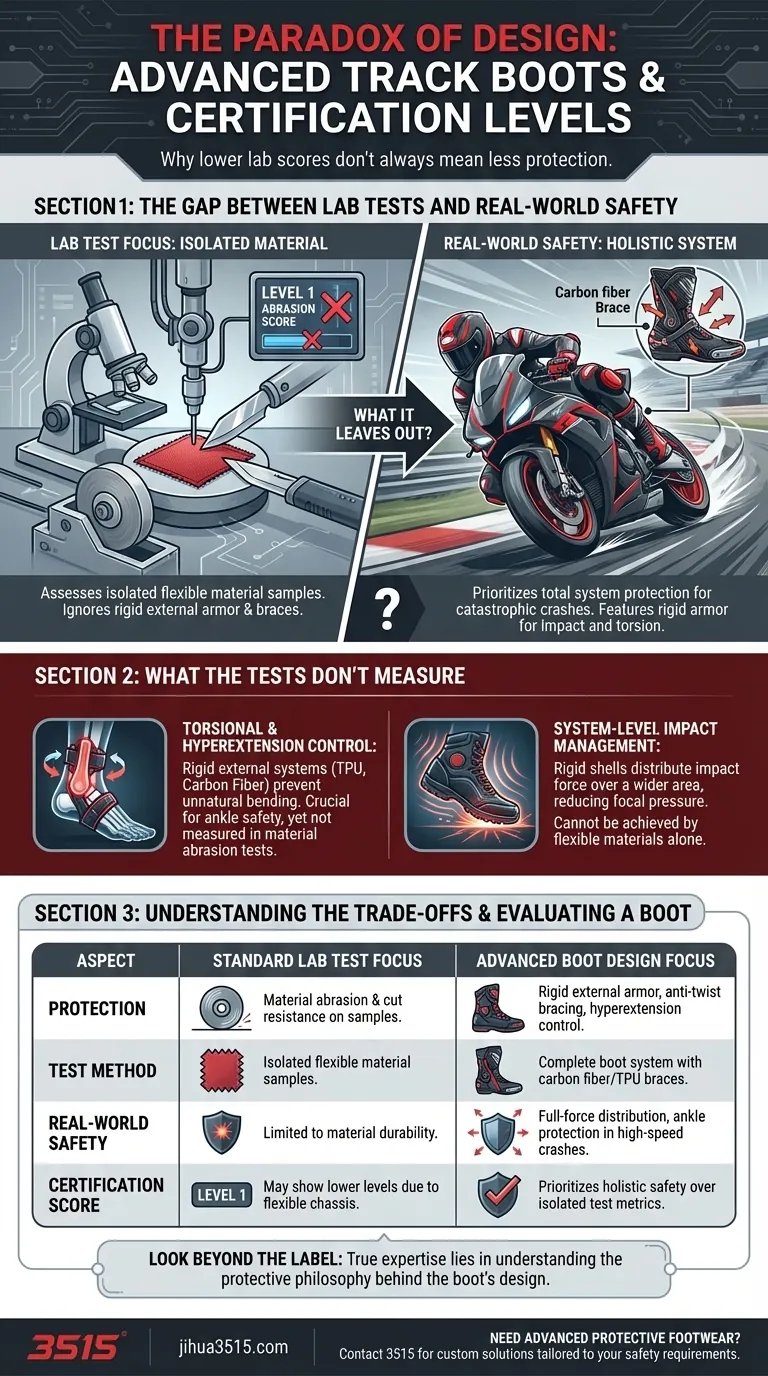
It's a paradox of design: advanced track boots can have lower certification levels in some specific tests precisely because their most advanced protective features are not measured by those tests. Standardized lab tests for abrasion or cutting often assess isolated samples of the boot's flexible upper material, completely ignoring the rigid external structures like carbon fiber braces that provide the highest level of protection in a real-world crash.
The core issue is the gap between standardized material testing and holistic, real-world performance. A lower score on a specific lab test for a boot's fabric does not mean the boot's overall protective system—including its rigid armor—is inferior.
The Gap Between Lab Tests and Rider Safety
To make an informed choice, you must understand what a certification label truly represents and, more importantly, what it leaves out. The numbers tell a part of the story, not the whole story.
How Certification Tests Are Designed
The prevailing standard for motorcycle boots, EN 13634, is designed to create a repeatable, fair benchmark. It breaks down protection into key categories, such as impact abrasion, cut resistance, and transverse rigidity.
To ensure consistency, some of these tests must be performed on standardized samples of a material, not the fully constructed, multi-layered boot.
The "Material Sample" Limitation
This is the central reason for the discrepancy. Tests for impact abrasion and cut resistance are often conducted on the primary material used in the boot's upper.
This method effectively measures the quality of the microfiber, leather, or textile itself. It completely disregards the protective value of any external armor or bracing layered on top of it.
Why Rigid Structures Are Ignored
Think of it like testing the strength of a single brick instead of the entire reinforced wall. The test is valid for the brick, but it tells you nothing about the performance of the complete system.
A high-end race boot might use a more flexible, comfortable material for the main chassis and then overlay a massive carbon fiber anti-torsion brace. The test only grades the flexible material, leading to a potentially lower score, while ignoring the feature that will actually save your ankle from shattering.
What the Tests Don't Measure
Advanced boots prioritize protection against the catastrophic injuries common in high-speed crashes. These protective systems are complex and not easily captured by simple material tests.
Torsional and Hyperextension Control
The most critical function of a top-tier track boot is to prevent the ankle from twisting, breaking, or bending in unnatural directions.
This is achieved with rigid external bracing systems, often made of TPU and carbon fiber. These structures are the boot's most important safety feature, yet they have no bearing on the abrasion score of the underlying material.
System-Level Impact Management
A rigid external shell does more than just block impacts. It distributes the force of an impact over a much wider area, reducing the focal pressure on your foot and ankle.
A boot that relies solely on a thick, abrasion-resistant material cannot offer this same level of impact force distribution.
Understanding the Trade-offs
Choosing the right gear is about understanding the design philosophy and its associated compromises. No single product can be perfect in every isolated metric.
Test Optimization vs. Real-World Safety
A manufacturer could easily design a boot that achieves the highest possible score (Level 2) in the abrasion test by using a single, thick, and stiff material throughout its construction.
However, this boot would likely be extremely uncomfortable, offer poor control feedback, and lack the advanced anti-twist systems needed for track riding. The truly advanced boot prioritizes the complete safety system over excelling in a single material test.
The Role of Comfort and Control
Advanced boots use a strategy of zonal protection. They place the most robust materials and rigid structures in high-risk areas while using more flexible materials elsewhere to allow for the fine motor control needed to operate the motorcycle at its limit. This intelligent design is not always reflected in a simple certification score.
How to Evaluate a Boot Beyond the Label
Use the certification as a baseline, but apply your critical understanding to see the full picture. Your goal should guide your interpretation of the data.
- If your primary focus is maximum track safety: Prioritize boots with robust, external anti-torsion and hyperextension brace systems, even if their abrasion score is Level 1 instead of 2.
- If your primary focus is all-around road and touring use: A boot that achieves a consistent Level 2 rating across all categories may be a more balanced choice, as it indicates high material durability throughout.
- When reading any certification label: Look beyond the single number and investigate the features that the tests do not and cannot measure.
True expertise lies in understanding not just the test score, but the protective philosophy behind the boot's design.
Summary Table:
| Aspect | Standard Lab Test Focus | Advanced Boot Design Focus |
|---|---|---|
| Protection | Material abrasion & cut resistance on isolated samples | Rigid external armor, anti-twist bracing, hyperextension control |
| Test Method | Isolated flexible material samples | Complete boot system with carbon fiber/TPU braces |
| Real-World Safety | Limited to material durability | Full-force distribution, ankle protection in high-speed crashes |
| Certification Score | May show lower levels due to flexible chassis | Prioritizes holistic safety over isolated test metrics |
Need advanced protective footwear designed for real-world safety, not just lab scores?
As a large-scale manufacturer, 3515 produces a comprehensive range of high-performance footwear for distributors, brand owners, and bulk clients. Our production capabilities include track boots with advanced anti-torsion bracing, carbon fiber reinforcement, and zonal protection systems—engineered for maximum safety and control.
Contact us today to discuss custom solutions tailored to your safety requirements.
Visual Guide
Related Products
- Wholesale High-Traction Camo Boots - Custom Manufacturer for Brands
- High-Traction Suede Tactical Boots Wholesale & Custom Manufacturing
- Wholesale Tactical Boots High-Traction & Reflective for Bulk & Brand Orders
- Wholesale Lightweight Tactical Boots Custom Manufacturer for Desert & Combat Use
- Durable Leather Tactical Boots Wholesale & Custom Manufacturing for Brands
People Also Ask
- What are the key features of the new line of camo boots? Built for Extreme Cold & Rugged Terrain
- Are camo boots necessary for hunting success? Prioritize Performance Over Pattern
- How does the Rank Score Test identify the primary causes of premature failure in tactical and work boots? Key Insights
- What is the technical logic behind using closed-eye testing for tactical boots? Unlocking Peak Footwear Stability
- What shoes to wear for a security job? Durable, Protective Footwear for Long Shifts


















