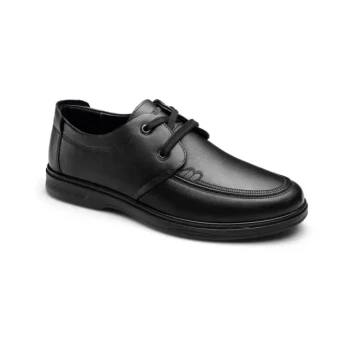
Data integrity begins at the ground level. Flat training shoes with secure fastening straps are required to eliminate relative motion between the foot and the footwear. This equipment specification ensures that the shoe acts as a seamless extension of the body, preventing slippage that would otherwise corrupt the recording of the heel strike moment.
The mechanical stability provided by secure straps prevents the shoe from detaching or sliding during movement. This ensures that spatial calculations—specifically step length, step width, and stride length—reflect the subject's actual physiology rather than equipment malfunction.
The Mechanics of Measurement Stability
Preventing Footwear Slippage
For gait analysis to be valid, the sensor system must track the foot, not just the shoe.
If a shoe is loose, it introduces a "lag" or spatial discrepancy between the foot's movement and the shoe's contact with the ground. Secure fastening straps lock the foot in place, ensuring the footwear does not slip or detach during the swing or stance phases.
Capturing the True Heel Strike
The moment of heel strike is the foundational event for the gait cycle.
Loose footwear can cause the shoe to hit the ground slightly before or after the actual heel, or in a slightly different location. By using straps to secure the shoe, you guarantee that every footprint recorded accurately reflects the precise timing and location of the biological heel strike.
Impact on Spatial Parameters
Precision in Step Length
Step length is calculated based on the distance between initial contact points of opposite feet.
If the shoe slides forward inside the footwear or the footwear slides on the floor upon contact, this distance becomes artificial. Flat, strapped shoes minimize this variance, providing a true measurement of forward progression.
Consistency in Step Width and Stride Length
Lateral stability is just as important as forward motion.
Step width measures the mediolateral distance between heels; without secure fixation, the shoe may twist or shift sideways. Secure straps ensure the shoe remains aligned with the foot’s axis, preserving the accuracy of both step width and overall stride length data.
Common Pitfalls in Footwear Selection
The Risk of Motion Artifacts
Failing to use secure straps introduces "motion artifacts"—data points that look real but are actually errors.
In gait analysis, a slipping shoe can mimic pathology, such as a shuffle or drag, that does not actually exist. This can lead to misdiagnosis or incorrect biomechanical assessments.
Inconsistent Fastening
Even with the correct shoes, inconsistent application creates variables.
If straps are tight on one trial and loose on the next, the variance in step length may be attributed to the subject rather than the equipment. Uniform tightness is essential for repeatability.
Ensuring Data Fidelity in Your Protocol
To maximize the reliability of your gait assessments, standardizing footwear is a non-negotiable step in your protocol.
- If your primary focus is Clinical Diagnosis: Ensure straps are tightened sufficiently to prevent any heel lift inside the shoe, as this directly alters heel strike detection.
- If your primary focus is Longitudinal Research: mandate the use of the exact same flat, strapped footwear model for all sessions to eliminate equipment-based variables.
Secure the foot to secure the data.
Summary Table:
| Key Benefit | Impact on Data Accuracy |
|---|---|
| Prevents Footwear Slippage | Eliminates relative motion; shoe acts as body extension. |
| Captures True Heel Strike | Guarantees precise timing & location of initial contact. |
| Ensures Spatial Precision | Provides accurate step length, width, and stride length. |
| Avoids Motion Artifacts | Prevents false data that mimics pathology or errors. |
| Enhances Data Fidelity | Standardizes measurements for reliable assessments. |
Seeking high-performance training shoes or specialized footwear solutions for your brand or distribution network? As a large-scale manufacturer serving distributors and brand owners, 3515 offers comprehensive production capabilities for all footwear types, anchored by our flagship Safety Shoes series. Our extensive portfolio covers work and tactical boots, outdoor shoes, training shoes, and sneakers, as well as Dress & Formal shoes to meet diverse bulk requirements. Ensure precision and quality in every pair—contact us today to discuss your specific needs!
References
- Abdulhamid U. Maje, Aminu A. Ibrahim. Effectiveness of an 8-week overground walking with paretic lower limb loading on spatiotemporal gait parameters and motor function among chronic stroke survivors: a study protocol for a randomised controlled trial. DOI: 10.1186/s13063-022-07057-3
This article is also based on technical information from 3515 Knowledge Base .
Related Products
- Lightweight Breathable Training Shoes for Wholesale & Custom OEM Manufacturing
- Custom OEM Training Shoes Wholesale Manufacturer Durable & Breathable
- Wholesale Breathable & Cushioned Training Shoes Custom Factory Production
- Wholesale Durable & Breathable Training Shoes for Custom Brands
- Wholesale Training Shoes with Dial Lacing System Custom OEM Manufacturing
People Also Ask
- Why are lightweight training shoes often preferred over professional hiking boots in urban walking? Maximize City Comfort
- What is the primary role of specialized training or orthopedic shoes? Enhance Safety in Elderly Balance Training
- Why are professional-grade training shoes essential for physical therapy? Ensure Patient Safety and Gait Stability
- Why are the slip-resistance and stability performance of training shoes critical in gait analysis? Ensure Data Accuracy
- Why is the use of flat-soled or professional training shoes essential for WBV? Maximize Vibration Energy Transfer