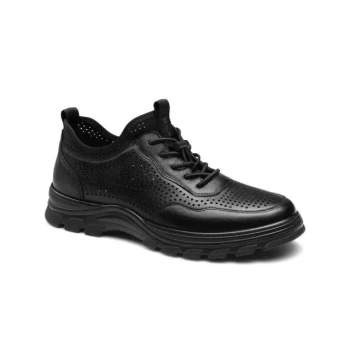
The primary role of specialized training or orthopedic shoes in lateral side-stepping intervention is to provide the essential plantar support and grip necessary to prevent side-slipping during rapid movements. These shoes ensure biomechanical consistency, allowing elderly participants to maintain balance and stability even when training on uneven or unstable surfaces.
Specialized footwear functions as a fundamental safety interface, mitigating the risk of falls by anchoring the participant to the ground while stabilizing the foot internally to ensure precise, consistent movement.
Mechanisms of Stability and Safety
Prevention of External Side-Slipping
Lateral side-stepping involves rapid displacement that places unique shearing forces on footwear. Specialized shoes are designed with enhanced grip to handle these forces.
This specific traction prevents the shoe from sliding across the floor surface. For elderly participants, eliminating this "side-slip" risk is the first line of defense against falls during dynamic training.
Ensuring Biomechanical Consistency
Effective intervention training often utilizes uneven or unstable surfaces to challenge the user's balance. Specialized shoes act as a stabilizing constant in this variable environment.
By maintaining biomechanical consistency, the footwear ensures that the foot remains aligned and supported. This allows the participant to focus on muscular engagement and coordination without fighting against irregular foot placement.
The Role of Internal Foot Stability
Addressing Fit Discrepancies
A common challenge with mass-produced industrial footwear is the disconnect between foot width and shoe length. Users often purchase larger sizes to accommodate wider feet, creating dangerous empty space.
Specialized orthopedic setups, often utilizing high-quality insoles, fill this excess space. This serves to "lock" the foot in place, ensuring the shoe moves exactly when the foot moves.
Reducing Internal Slippage
Stability is not just about the shoe gripping the floor; it is also about the foot gripping the shoe. If the foot slides inside the footwear, reaction times are delayed and friction injuries occur.
Orthopedic elements provide necessary arch support and pressure redistribution. This internal structure prevents foot slippage within the shoe, which is a common cause of injury and instability during lateral drills.
Understanding the Trade-offs
The Limitation of "Standard" Footwear
It is critical to recognize that standard, off-the-shelf athletic shoes often lack the structural integrity required for therapeutic lateral training.
While mass-produced shoes are accessible, they frequently fail to account for spatial discrepancies in elderly feet. Relying on them without modification (such as specialized insoles) can introduce instability, counteracting the benefits of the intervention training.
Making the Right Choice for Your Goal
To maximize the safety and efficacy of lateral side-stepping interventions, consider the specific needs of the participant:
- If your primary focus is preventing immediate falls: Prioritize shoes with specialized outsoles designed to provide maximum grip and prevent side-slipping on your specific training surface.
- If your primary focus is injury prevention and comfort: Ensure the use of orthopedic insoles to compensate for spatial discrepancies, providing arch support and preventing internal foot slippage.
The correct footwear acts as a seamless extension of the body, transforming training intent into safe, functional improvement.
Summary Table:
| Feature | Primary Function | Benefit for Elderly Users |
|---|---|---|
| Enhanced Grip | Prevents external side-slipping | Reduces fall risk during rapid lateral movements |
| Internal Stability | Addresses fit & spatial discrepancies | Locks the foot in place to prevent internal slippage |
| Biomechanical Consistency | Stabilizes the foot on uneven surfaces | Ensures precise movement and consistent alignment |
| Orthopedic Support | Arch support & pressure redistribution | Minimizes friction injuries and improves reaction time |
Partner with 3515 for High-Performance Safety and Orthopedic Footwear
As a large-scale manufacturer serving distributors and brand owners, 3515 offers comprehensive production capabilities for all footwear types, anchored by our flagship Safety Shoes series. Our extensive portfolio covers work and tactical boots, outdoor shoes, training shoes, and sneakers, as well as Dress & Formal shoes to meet diverse bulk requirements.
Whether you are looking to source high-traction training shoes for elderly rehabilitation or robust safety boots for industrial use, 3515 delivers the biomechanical precision and structural integrity your customers demand. Contact us today to discuss your bulk manufacturing needs and discover how our expertise can add value to your brand!
References
- Frédéric Dierick, Fabien Buisseret. Quasi-experimental pilot study to improve mobility and balance in recurrently falling nursing home residents by voluntary non-targeted side-stepping exercise intervention. DOI: 10.1186/s12877-022-03696-y
This article is also based on technical information from 3515 Knowledge Base .
Related Products
- Lightweight Breathable Training Shoes for Wholesale & Custom OEM Manufacturing
- Custom OEM Training Shoes Wholesale Manufacturer Durable & Breathable
- Wholesale Breathable & Cushioned Training Shoes Custom Factory Production
- Wholesale Durable & Breathable Training Shoes for Custom Brands
- Wholesale Breathable Training Shoes Custom Athletic Footwear Manufacturer
People Also Ask
- Why are lightweight training shoes often preferred over professional hiking boots in urban walking? Maximize City Comfort
- Why are professional-grade training shoes essential for physical therapy? Ensure Patient Safety and Gait Stability
- Why are the slip-resistance and stability performance of training shoes critical in gait analysis? Ensure Data Accuracy
- Why is the use of flat-soled or professional training shoes essential for WBV? Maximize Vibration Energy Transfer
- Why is the integration of advanced cushioning in training shoes necessary for athletes? Boost Recovery and Performance