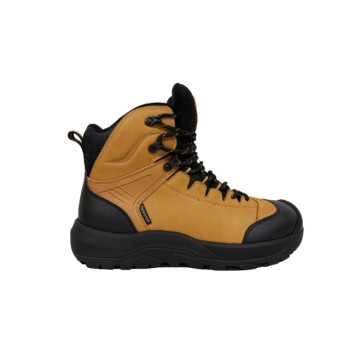
Operator safety in industrial printing relies on interrupting the circuit. These environments combine high-voltage machinery with conductive moisture and chemicals, creating a high-risk scenario for electric shock. Electrical insulating shoes and gloves are essential because they serve as a critical electrolyte barrier, blocking current pathways through the operator's body in the event of equipment leakage or accidental contact.
Industrial printing environments often expose operators to both high voltage and conductive liquids. Insulating gear provides the necessary dielectric resistance to break the electrical circuit, ensuring that a human operator never becomes the path of least resistance for stray current.
The High-Stakes Environment of Industrial Printing
High Voltage and Large Machinery
Industrial printing operations are distinct from standard office environments. They utilize large high-voltage electrical equipment to drive heavy mechanical processes.
The sheer power required to operate these machines increases the potential severity of any electrical fault. A minor operational error or equipment failure can result in life-threatening energy releases.
The Threat of Moisture and Chemicals
The printing floor is rarely dry or sterile. The process inherently involves various chemical media and often requires moisture management.
These substances can act as electrolytes. If spilled or pooled, they turn the floor and equipment surfaces into highly conductive paths, drastically increasing the risk of electric shock compared to dry environments.
How Insulating Gear Protects the Operator
Creating a Critical Barrier
The primary function of insulating shoes and gloves is to establish a critical electrolyte barrier.
This barrier acts as an insulator between the operator and the electrical potential. By increasing the electrical resistance at the points of contact (hands and feet), the gear prevents the flow of electricity.
Blocking Current Pathways
For an electric shock to occur, current must flow through the body. This usually happens when an operator touches a live component while grounded.
Insulating shoes break the connection to the ground, while insulating gloves break the connection to the live part. Together, they effectively block current pathways through the human body.
Mitigating Equipment Leakage
Even when machinery is operating correctly, insulation can degrade over time. This can lead to equipment leakage, where the chassis of the machine becomes electrically live.
Without protective gear, an operator leaning against a machine could suffer a shock. Insulating gear ensures that these invisible faults do not result in injury.
Protection Against Accidental Contact
Operators are human, and slips or inadvertent movements occur. Accidental contact with live parts is a constant risk during adjustment or maintenance.
Insulating gloves provide the "last line of defense" during these moments, ensuring that a momentary lapse in attention does not become a fatality.
Understanding the Limitations
Gear Must Be Maintained
Insulating gear is not a "buy once, use forever" solution. The physical integrity of the rubber or synthetic material is what provides safety.
Cuts, punctures, or chemical degradation can compromise the electrolyte barrier. If the gear is damaged, it offers zero protection and may give the operator a false sense of security.
Not a Substitute for Lockout/Tagout
While this gear minimizes risk, it does not replace proper energy isolation procedures.
Insulating shoes and gloves are protective measures for residual or accidental risk. They should never be used as an excuse to work on energized equipment without following strict safety protocols.
Making the Right Choice for Your Goal
To ensure fundamental safety, operators must select and use gear appropriate for their specific environment.
- If your primary focus is Routine Operation: Prioritize shoes with high traction and chemical resistance to handle the moisture and media on the printing floor while maintaining electrical isolation.
- If your primary focus is Maintenance and Repair: Ensure gloves are rated specifically for the maximum voltage of your equipment to provide a robust barrier against direct contact with live parts.
Safety in industrial printing is not just about avoiding accidents; it is about ensuring that when equipment fails, the operator remains isolated from the danger.
Summary Table:
| Hazard Factor | Impact on Safety | Role of Insulating Gear |
|---|---|---|
| High-Voltage Machinery | Severe energy release during faults | Blocks current pathways through the body |
| Conductive Chemicals | Turns floors into electrolytes | Creates a critical dielectric barrier |
| Equipment Leakage | Machinery chassis becomes live | Prevents shock from degraded insulation |
| Accidental Contact | Human error during maintenance | Provides the last line of defense for limbs |
| Moisture/Media | Increases surface conductivity | Maintains resistance in wet environments |
Secure Your Workforce with Certified Protective Gear
As a large-scale manufacturer serving distributors and brand owners, 3515 offers comprehensive production capabilities for all footwear types, anchored by our flagship Safety Shoes series. In high-risk industrial printing environments, our specialized insulating footwear provides the critical electrolyte barrier needed to keep operators safe.
Our extensive portfolio covers work and tactical boots, outdoor shoes, training shoes, and sneakers, as well as Dress & Formal shoes to meet diverse bulk requirements. Ensure your team is protected by the industry's best—contact us today to discuss your bulk procurement needs!
References
- Esmail Badoozadeh, Amin Babaei Pouya. Evaluating Critical Safety and Health Risks by Job Safety Analysis and Analytic Hierarchy Process in Industrial Printing. DOI: 10.32598/hdq.8.3.472.1
This article is also based on technical information from 3515 Knowledge Base .
Related Products
- Premium Insulated Safety Boots and Shoes for Wholesale & Bulk Orders
- Durable Rubber-Soled Utility Shoes for Wholesale & Custom Brand Manufacturing
- Premium KPU Athletic Safety Shoes for Wholesale
- Premium Lightweight Safety Shoes for Wholesale & Bulk Orders
- Wholesale Modern Comfort Shoes with Dial Closure for Private Label & Bulk Orders
People Also Ask
- What are the recommended insulation ratings for mild winter conditions? A Guide for Active & Stationary Workers
- How does insulation thickness correlate with temperature ranges? A Guide to Choosing the Right Warmth
- What insulation level is needed for severe cold and stationary work? 1200g or Higher is Essential
- What safety advantages do insulated boots offer beyond warmth? Dielectric Protection & Superior Grip
- How does fleece lining contribute to the warmth of insulated boots? Trapping Air for Superior Cold Protection