
In motorcycle boots, shaft height is fundamentally about protection. The primary purpose of a taller shaft is to shield your ankle and lower shin from the two most common dangers in a crash: impact and abrasion. A boot that sits below the ankle offers almost no meaningful protection against the severe twisting forces and road rash that can cause debilitating injuries.
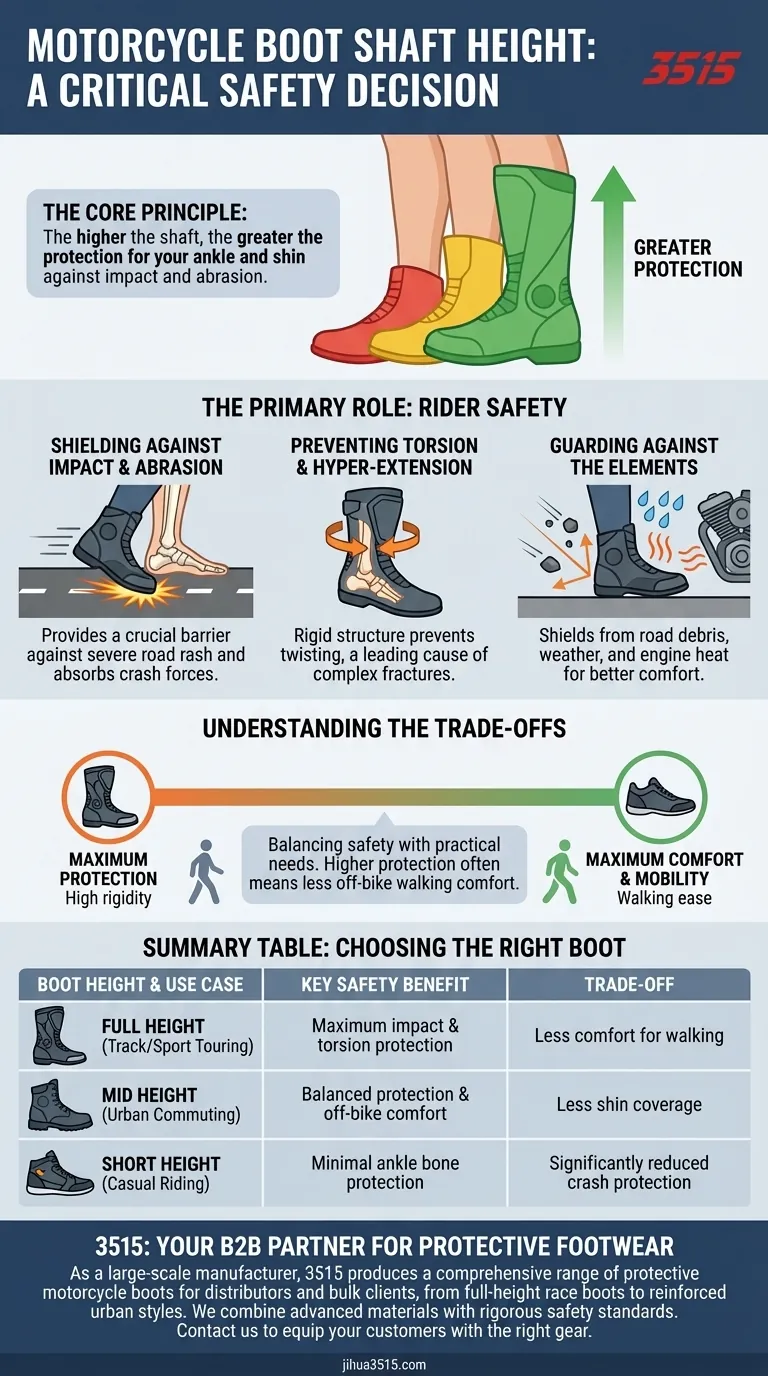
The core principle is simple: the higher the shaft, the greater the protection for your ankle and shin. The choice isn't just about style or convenience; it's a critical decision about how you manage the inherent risks of riding.

The Primary Role of Shaft Height: Rider Safety
Understanding why a taller boot is safer requires looking at the specific forces involved in a motorcycle accident. The ankle is a complex and relatively fragile joint that is highly exposed during a crash.
Shielding Against Impact and Abrasion
A taller shaft provides a crucial physical barrier between your skin and the asphalt. In a slide, it prevents severe road rash, which can be both painful and a source of serious infection.
It also absorbs and distributes the force of an impact, whether from hitting the ground, another vehicle, or even your own motorcycle landing on top of you.
Preventing Torsion and Hyper-Extension
This is arguably the most critical function of a tall motorcycle boot. The rigid structure of the shaft works to prevent your ankle from twisting, rotating, or bending in ways it was never meant to.
These torsional forces are a leading cause of complex fractures and ligament damage. A simple riding shoe offers no defense against this type of injury.
Guarding Against the Elements
Beyond crash protection, a higher shaft provides practical benefits. It shields your lower leg from flying road debris like rocks and gravel kicked up by other vehicles.
It also offers better protection from weather and heat radiating from the engine and exhaust pipes, reducing fatigue and improving comfort on longer rides.
Understanding the Trade-offs
While maximum height often equals maximum protection, it is not the only factor to consider. Choosing the right boot involves balancing safety with the practical needs of your specific riding style.
Protection vs. Comfort and Mobility
There is a direct trade-off between rigidity and comfort. A full-height race boot offers incredible protection on a track but is often stiff and awkward to walk in.
Shorter boots or reinforced riding shoes are far more comfortable for walking around off the bike, but this convenience comes at the cost of significantly less ankle support and abrasion resistance.
Suitability for Different Riding Styles
The "best" boot height depends entirely on the context. A track day rider requires a different level of protection than a city commuter.
Adventure touring, for example, demands a boot that is both highly protective for off-road spills and flexible enough for hiking or walking around a campsite. This leads to specialized designs that balance these competing needs.
Making the Right Choice for Your Goal
Always start by assessing the level of risk you are willing to accept for your type of riding. From there, you can make an informed decision.
- If your primary focus is maximum track or sport-touring protection: Choose a full-height boot that extends well up the shin for the best possible defense against impact and torsion.
- If your primary focus is daily commuting or urban riding: A mid-height boot that fully and securely covers the ankle provides a strong balance of essential protection and off-bike comfort.
- If your primary focus is casual riding with an emphasis on style: Ensure any "riding shoe" you choose has a reinforced structure and explicitly covers and protects the ankle bones as a bare minimum.
Ultimately, choosing the right boot height is an informed decision about how you protect one of the most vulnerable parts of your body every time you ride.
Summary Table:
| Boot Height | Primary Use Case | Key Safety Benefit | Trade-off |
|---|---|---|---|
| Full Height | Track/Sport Touring | Maximum impact & torsion protection | Less comfort for walking |
| Mid Height | Urban Commuting | Balanced protection & off-bike comfort | Less shin coverage |
| Short Height (Reinforced) | Casual Riding | Minimal ankle bone protection | Significantly reduced crash protection |
As a large-scale manufacturer, 3515 produces a comprehensive range of protective motorcycle boots for distributors, brand owners, and bulk clients. Our production capabilities encompass all types of riding footwear, from full-height race boots to reinforced urban styles. We combine advanced materials with rigorous safety standards to deliver boots that protect riders without compromising on quality or comfort. Let us help you equip your customers with the right gear for their ride. Contact us today to discuss your specific requirements and explore our full catalog.
Visual Guide
Related Products
- Wholesale Tactical Boots High-Traction & Reflective for Bulk & Brand Orders
- High Performance Fire-Retardant Waterproof Safety Boots
- Durable Goodyear Welt Leather Work Boots for Wholesale & Private Label
- Wholesale High-Traction Camo Boots - Custom Manufacturer for Brands
- Heavy-Duty Waterproof Nubuck Safety Boots Safety Shoes for Bulk Supply
People Also Ask
- How do tactical boots protect against injuries? Discover the Integrated Safety System
- What are the important features of tactical boots for military operators? A Guide to Mission-Critical Footwear
- How does the comparative gait analysis between grass and asphalt guide safety shoe R&D? Optimize Tactical Performance
- Importance of Professional Tactical Boots in Loess Gully Regions: Ensure Safety and Precision for Field Monitoring
- How do manufacturing processes for electronic textiles balance durability with wearing comfort? Innovation in Footwear



















