
Ultimately, the proper fitting of military boots is a matter of operational readiness. Ill-fitting boots directly lead to discomfort, serious foot injuries, and decreased physical performance, which can compromise a service member's effectiveness and safety during critical moments.
A military boot is not simply footwear; it is a critical piece of equipment. A proper fit is the absolute foundation for a service member's mobility, endurance, and overall ability to perform under the most demanding conditions imaginable.
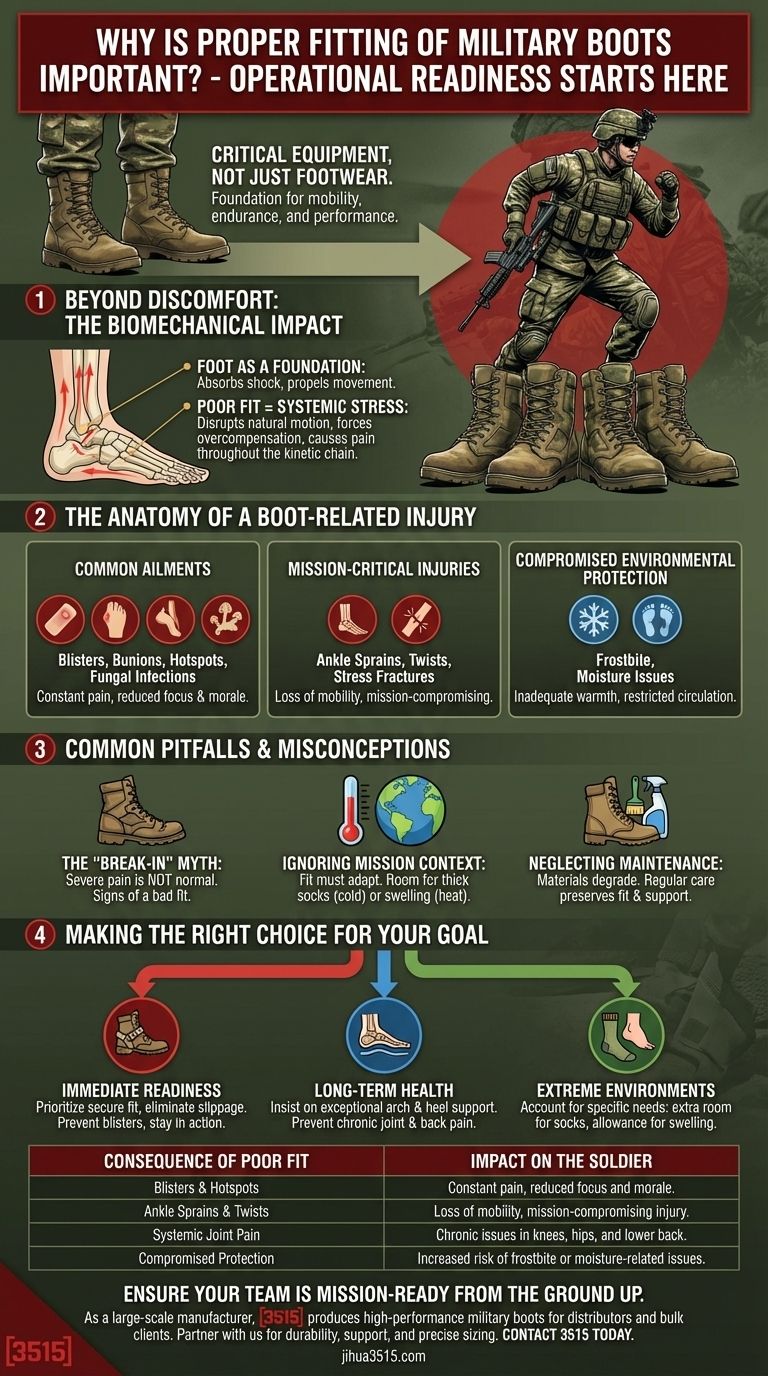
Beyond Discomfort: The Biomechanical Impact
A poorly fitted boot creates a chain reaction that extends far beyond the foot itself. Understanding this biomechanical impact reveals the true importance of getting the fit right.
The Foot as a Foundation
Your feet are the foundation for every movement you make. They are engineered to absorb shock, adapt to uneven terrain, and provide the propulsive force for walking, running, and climbing.
How a Poor Fit Creates Systemic Stress
When a boot lacks proper arch and heel support or fits incorrectly, it disrupts the foot's natural motion. This forces the body to overcompensate with every step.
This compensation creates unnatural stress that travels up the kinetic chain, leading to pain not just in the feet but also in the ankles, knees, hips, and lower back.
The Anatomy of a Boot-Related Injury
The consequences of a bad fit range from nagging ailments to mission-compromising injuries. These issues are almost entirely preventable with the correct fit.
Common but Damaging Ailments
Blisters, bunions, and hotspots are the most immediate results of a poor fit. While seemingly minor, they cause constant pain that degrades focus and morale. An improper fit can also trap moisture, leading to fungal infections.
Mission-Critical Injuries
A boot that is too loose fails to provide adequate ankle support, drastically increasing the risk of sprains and twists on unstable ground. Conversely, a boot that is too tight can lead to pressure-related injuries and even stress fractures over time.
Compromised Environmental Protection
The protective qualities of a boot depend on a correct fit. A loose boot will fail to keep feet warm and dry in cold or wet conditions. A boot that is too tight can restrict blood flow, accelerating the onset of frostbite.
Common Pitfalls and Misconceptions
Achieving the right fit requires avoiding common mistakes that can lead to significant problems down the line.
The "Break-In" Myth
While high-quality leather boots require a break-in period to conform to your foot, this should not be a painful process. Severe pain, rubbing, or pinching are not signs of a boot that needs "breaking in"—they are signs of a fundamentally bad fit.
Ignoring the Mission Context
The ideal fit can change based on the environment. A boot for cold weather operations must have enough room to accommodate thicker socks without restricting circulation. A boot for hot, humid climates may need to account for foot swelling.
Neglecting Proper Maintenance
Over time, leather and synthetic materials can stretch, shrink, or degrade. Regular cleaning and care ensure the boot retains its original shape and supportive structure, preserving its fit and protective qualities.
Making the Right Choice for Your Goal
Ensuring a proper fit is a deliberate process that pays dividends in performance and health.
- If your primary focus is immediate mission readiness: Prioritize a secure fit that locks your heel in place and eliminates any slippage to prevent blisters and injuries that could take you out of action.
- If your primary focus is long-term health: Insist on a fit that provides exceptional arch and heel support to prevent the chronic joint and back pain caused by poor biomechanics.
- If your primary focus is performance in extreme environments: Choose a fit that accounts for your specific needs, such as extra room for thermal socks or allowance for foot swelling in hot climates.
A properly fitted boot is a foundational tool that allows a service member to focus on the mission, not on their feet.
Summary Table:
| Consequence of Poor Fit | Impact on the Soldier |
|---|---|
| Blisters & Hotspots | Constant pain, reduced focus and morale. |
| Ankle Sprains & Twists | Loss of mobility, mission-compromising injury. |
| Systemic Joint Pain | Chronic issues in knees, hips, and lower back. |
| Compromised Protection | Increased risk of frostbite or moisture-related issues. |
Ensure Your Team is Mission-Ready from the Ground Up
As a large-scale manufacturer, 3515 produces a comprehensive range of high-performance military boots for distributors, brand owners, and bulk clients. We understand that a proper fit is non-negotiable for safety and performance. Our production capabilities encompass all types of tactical footwear engineered for durability, support, and precise sizing.
Partner with us to equip your personnel with boots that protect their health and enhance their capabilities.
Contact 3515 today to discuss your specific requirements and receive a quote.
Visual Guide
Related Products
- Durable Military Combat Boots with Water Drainage for Wholesale & OEM
- High-Traction Suede Tactical Boots Wholesale & Custom Manufacturing
- Durable High-Ankle Tactical Boots for Wholesale & Custom Manufacturing
- Durable Mid-Cut Tactical Boots for Wholesale & Private Label
- Wholesale Waterproof Tactical Boots Custom Suede & High-Traction Soles
People Also Ask
- Why must gait validation for military applications be conducted in combat boots? Ensure Data Accuracy for Soldiers
- What are the common types of combat boots? Find the Right Boot for Your Mission
- What factors should be considered when choosing military boots for hiking? Durability vs. Weight for Your Terrain
- What are the key considerations when choosing military boots? Prioritize Compliance, Environment & Fit
- How should the midfoot and heel fit in military boots? Achieve a Snug, Secure Fit for Blister Prevention



















