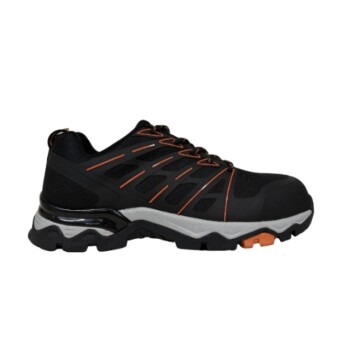
Professional footwear fundamentally alters pedestrian gait dynamics. Specific attributes such as shoe weight, sole hardness, and flexibility directly regulate gait variability, resulting in distinct changes to step frequency and foot impact forces. Including these parameters in bridge vibration models is essential to prevent the underestimation of structural response during specific loading scenarios.
The inclusion of professional footwear characteristics is a prerequisite for accurate probabilistic vibration assessments. By accounting for the mechanical differences introduced by heavy or stiff footwear, engineers can define a realistic load input range and avoid overlooking extreme vibration responses.
The Physics of Footwear and Gait
Impact on Step Frequency
The type of footwear worn acts as a regulator for step frequency distribution.
Unlike standard casual shoes, professional gear like tactical boots possesses specific mass and inertial properties.
These properties force the pedestrian to adjust their cadence, shifting the frequency at which footfalls excite the bridge structure.
Altering Force Magnitudes
Professional footwear is often characterized by increased weight and sole hardness.
These physical traits significantly modify the magnitude of the foot impact force transferred to the bridge deck.
A harder sole with specific friction properties creates a sharper, more distinct force profile compared to soft-soled athletic shoes.
The Role of Sole Flexibility
Sole flexibility is a key variable in how a step is executed.
Stiff soles, common in safety shoes, restrict the natural roll of the foot, altering the contact time and force distribution during the gait cycle.
This reduction in flexibility contributes to the variability of gait parameters that must be captured in the model.
Enhancing Probabilistic Assessments
Defining the Load Input Range
To create a robust model, you must accurately define the load input range for the population using the bridge.
Treating all pedestrians as wearing generic footwear fails to capture the individual differences present in real-world scenarios.
Incorporating specific footwear types allows for a precise definition of these inputs, moving beyond broad averages.
Preventing Underestimation
The primary risk of excluding footwear parameters is the underestimation of extreme vibration responses.
Certain footwear types can align pedestrian step frequencies closer to the bridge's natural frequency, causing resonance.
By modeling these specific wearing scenarios, you identify potential limit states that a generic model would miss.
Understanding the Trade-offs
Specificity vs. Generalization
While including footwear data increases accuracy, it requires more granular input data regarding the expected bridge users.
Relying on a standard, generalized population model is simpler but inherently less conservative.
The trade-off for this simplicity is a potential "blind spot" regarding how groups wearing specific gear (e.g., soldiers or construction crews) will affect the structure.
Making the Right Choice for Your Goal
When developing vibration response models, consider the expected traffic and safety margins required.
- If your primary focus is Modeling Accuracy: Incorporate specific footwear parameters (stiffness, weight) to capture the true variability of gait frequency and force magnitude.
- If your primary focus is Safety Assessment: explicitly model professional footwear scenarios to ensure you have not underestimated the extreme vibration response of the structure.
Accurate prediction relies on recognizing that the shoe is as critical to the load model as the pedestrian wearing it.
Summary Table:
| Footwear Attribute | Impact on Bridge Load Model | Influence on Structural Response |
|---|---|---|
| Shoe Weight/Mass | Alters step frequency distribution | Shifts resonance potential points |
| Sole Hardness | Modifies foot impact force magnitude | Increases sharpness of force profile |
| Sole Flexibility | Changes contact time during gait cycle | Increases variability of gait parameters |
| Gait Variability | Regulates pedestrian cadence | Prevents underestimation of extreme vibrations |
Partner with 3515 for High-Performance Professional Footwear
As a large-scale manufacturer serving global distributors and brand owners, 3515 offers comprehensive production capabilities for all footwear types. Our flagship Safety Shoes series and professional tactical boots are engineered with precise mechanical properties—including specific sole stiffness and weight—that define real-world loading scenarios.
Our extensive portfolio covers work and tactical boots, outdoor shoes, training shoes, sneakers, and Dress & Formal shoes to meet your diverse bulk requirements. By choosing 3515, you gain a partner committed to quality, durability, and technical excellence.
Ready to elevate your inventory or discuss specific technical requirements?
Contact us today to explore our bulk solutions
References
- Vincenzo Picozzi, Francesco Ricciardelli. Probabilistic assessment of footbridge response to single walkers. DOI: 10.1007/s00419-022-02156-8
This article is also based on technical information from 3515 Knowledge Base .
Related Products
- Premium Suede Sport Safety Shoes for Wholesale & Bulk Orders
- Premium Lightweight Safety Shoes for Wholesale & Bulk Orders
- Wholesale Anti-Smash & Puncture-Proof Safety Shoes Custom Manufacturing for Brands
- Premium KPU Injection Athletic Style Safety Shoes
- Premium Safety Shoes with Rotating Buckle Safety Sneakers
People Also Ask
- What are the primary functions of professional safety shoes? Maximize Safety in Water Supply Confined Spaces
- What industries have specific OSHA footwear requirements? Ensure Compliance & Protect Your Workforce
- What role do specialized safety shoes play in preventing falls? Engineering Stability in Industrial Environments
- What core functions do professional safety shoes serve? Enhance Construction & Industrial Safety Standards
- What are the main safety features of S1-S5 shoes? The 3 Essential Protections Explained