
Beyond simple cleaning, motorcycle boot maintenance is a critical safety practice that preserves the structural integrity and protective features of your gear. Proper care extends the boot's functional lifespan, ensures materials do not degrade prematurely, and allows for the early detection of wear that could otherwise lead to failure during an accident.
Neglecting your motorcycle boots isn't just a financial issue—it's a safety liability. Consistent maintenance ensures the materials and protective systems designed to save your feet and ankles can actually perform their job when you need them most.
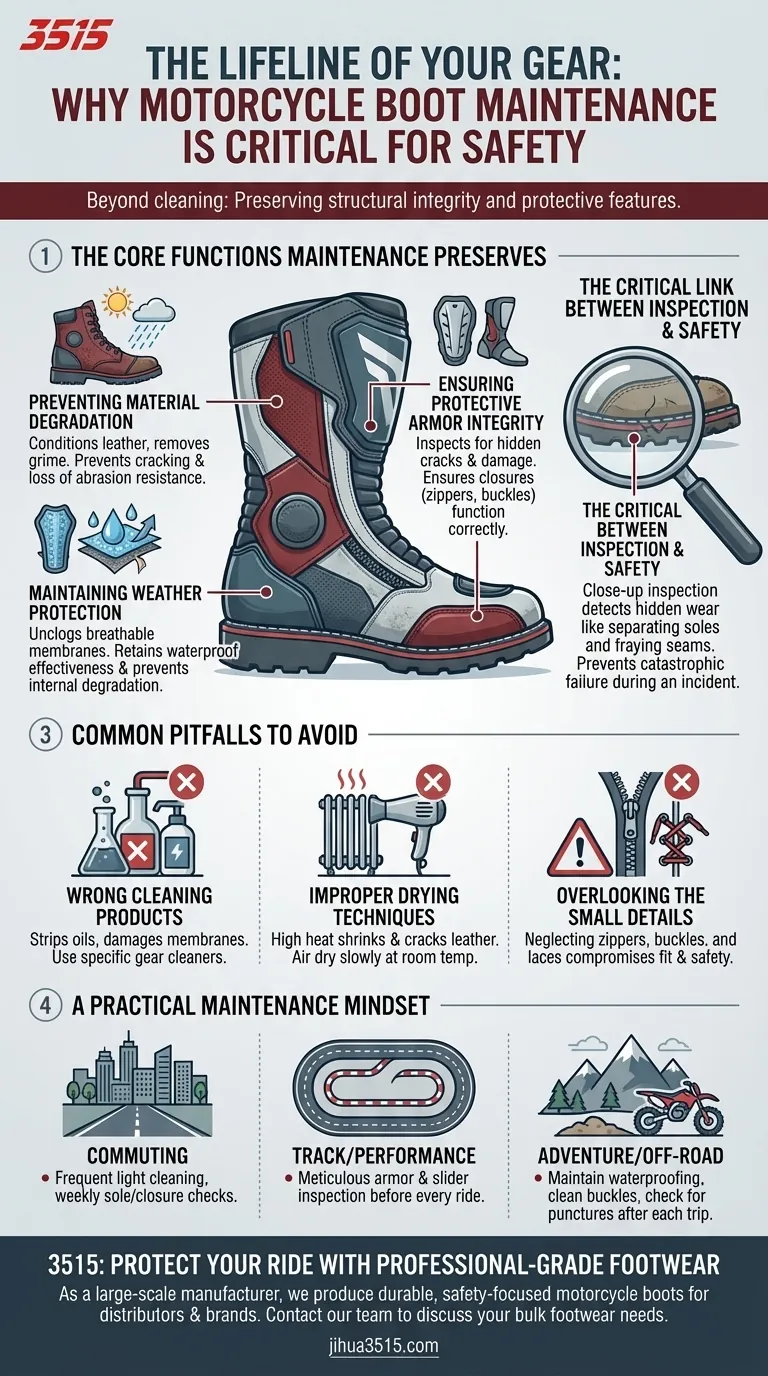
The Core Functions Maintenance Preserves
Your boots are a complex piece of engineered safety equipment. Maintenance is the process of ensuring every component of that system remains fully operational.
Preventing Material Degradation
The materials in your boots, whether leather or synthetic, are under constant attack from the elements. Road grime, water, and UV exposure break down these materials over time.
Regular cleaning removes abrasive dirt and contaminants. Conditioning leather prevents it from drying out, cracking, and losing its tensile strength, which is your primary defense against abrasion.
Ensuring Protective Armor Integrity
Modern boots feature integrated armor, such as TPU shin plates, heel counters, and ankle braces. This armor is your defense against impacts and torsion.
Maintenance involves inspecting these components for cracks or damage that might be hidden by dirt. It also means ensuring that closures like zippers, buckles, or Velcro are clean and function correctly, as a boot that won't stay closed offers compromised protection.
Maintaining Weather Protection
Many riding boots incorporate waterproof and breathable membranes. The effectiveness of these membranes depends on their cleanliness.
Dirt, mud, and oils can clog the membrane's pores, preventing it from breathing. This traps sweat, leading to discomfort, loss of focus, and over time, degradation of the boot's internal materials. Regular cleaning and occasional re-application of DWR (Durable Water Repellent) coatings keep this system working as intended.
The Critical Link Between Inspection and Safety
The most valuable part of a maintenance routine isn't the cleaning itself—it's the mandatory, close-up inspection it forces you to perform.
Detecting Hidden Wear and Tear
You are unlikely to notice a separating sole or a fraying seam during a casual glance. Actively cleaning your boots forces you to handle and examine every part of them.
This is when you spot the early signs of failure: worn soles that reduce grip on the pegs and pavement, stitching that is beginning to unravel, or delamination between the boot's layers.
The Failure Point of Neglected Components
Catching these issues early is not about aesthetics; it's about preventing catastrophic failure during an incident.
A worn-out sole can cause your foot to slip at a critical moment. A zipper clogged with grime can fail, allowing the boot to come off in a slide. A cracked but unconditioned leather panel offers almost no abrasion resistance compared to a healthy one.
Common Pitfalls to Avoid
Well-intentioned but improper maintenance can be as damaging as neglect. Understanding the key failure modes is essential for preserving your gear.
Using the Wrong Cleaning Products
Harsh household detergents or solvents can strip leather of its essential oils, causing it to become brittle and weak. They can also damage synthetic materials and destroy waterproof membranes.
Always use products specifically designed for motorcycle gear or the material in question (e.g., pH-neutral leather cleaner).
Improper Drying Techniques
After a wet ride or a thorough cleaning, the temptation is to speed up the drying process. Exposing boots, especially leather ones, to direct heat from a radiator, hairdryer, or open flame is a critical mistake.
High heat causes leather to shrink and crack, and it can delaminate the bonded layers and adhesives used in modern boot construction. Always let boots air dry slowly at room temperature.
Overlooking the Small Details
Riders often focus on the large leather or textile surfaces but completely ignore the mechanical components.
Zippers need to be kept clean and occasionally lubricated. Buckle systems must be cleared of mud and grit to ensure they latch securely. Laces should be inspected for fraying. These are the parts that ensure the boot stays on your foot.
A Practical Maintenance Mindset
Your maintenance approach should align with the type of riding you do and the conditions you face. A simple, consistent routine is far more effective than a rare, intensive overhaul.
- If your primary focus is daily commuting: Prioritize frequent light cleaning to remove corrosive road grime and perform weekly checks of soles and closure systems.
- If your primary focus is track days or performance riding: Concentrate on meticulously inspecting armor for cracks, sliders for wear, and ensuring all fastening systems are flawlessly functional before each ride.
- If your primary focus is adventure or off-road touring: Emphasize maintaining waterproofing, thoroughly cleaning mud from complex buckle systems, and checking for punctures or deep scuffs after every major off-road excursion.
Treating your boots as essential safety equipment, not just footwear, is the most important step you can take.
Summary Table:
| Maintenance Aspect | Key Benefit | Consequence of Neglect |
|---|---|---|
| Material Care | Prevents cracking & loss of abrasion resistance | Weakened leather/synthetics fail in a slide |
| Armor Inspection | Ensures impact protection integrity | Hidden cracks compromise ankle/shin safety |
| Weatherproofing | Maintains waterproof/breathable membranes | Discomfort, loss of focus, internal degradation |
| Sole & Closure Check | Guarantees grip and secure fit | Slippage on pegs or boot coming off in a crash |
Protect Your Ride with Professional-Grade Footwear
As a large-scale manufacturer, 3515 produces a comprehensive range of durable and safety-focused footwear for distributors, brand owners, and bulk clients. Our production capabilities encompass all types of motorcycle boots engineered for performance and longevity.
Let us help you equip riders with reliable gear. Contact our team today to discuss your footwear needs and discover how our manufacturing expertise can benefit your business.
Visual Guide
Related Products
- Wholesale Tactical Boots High-Traction & Reflective for Bulk & Brand Orders
- High Performance Fire-Retardant Waterproof Safety Boots
- Durable Goodyear Welt Leather Work Boots for Wholesale & Private Label
- Wholesale High-Traction Camo Boots - Custom Manufacturer for Brands
- Heavy-Duty Waterproof Nubuck Safety Boots Safety Shoes for Bulk Supply
People Also Ask
- How do tactical boots protect against injuries? Discover the Integrated Safety System
- Why is the footwear standardization essential in ambient temperature studies? Ensure Scientific Data Accuracy
- What are the primary benefits of wearing tactical boots for everyday use? Get All-Day Comfort & Durability
- What factors should be considered when choosing tactical boots for different terrains? Match Your Boot to the Mission.
- What are the different types of tactical boots available? Find the Right Boot for Your Mission



















