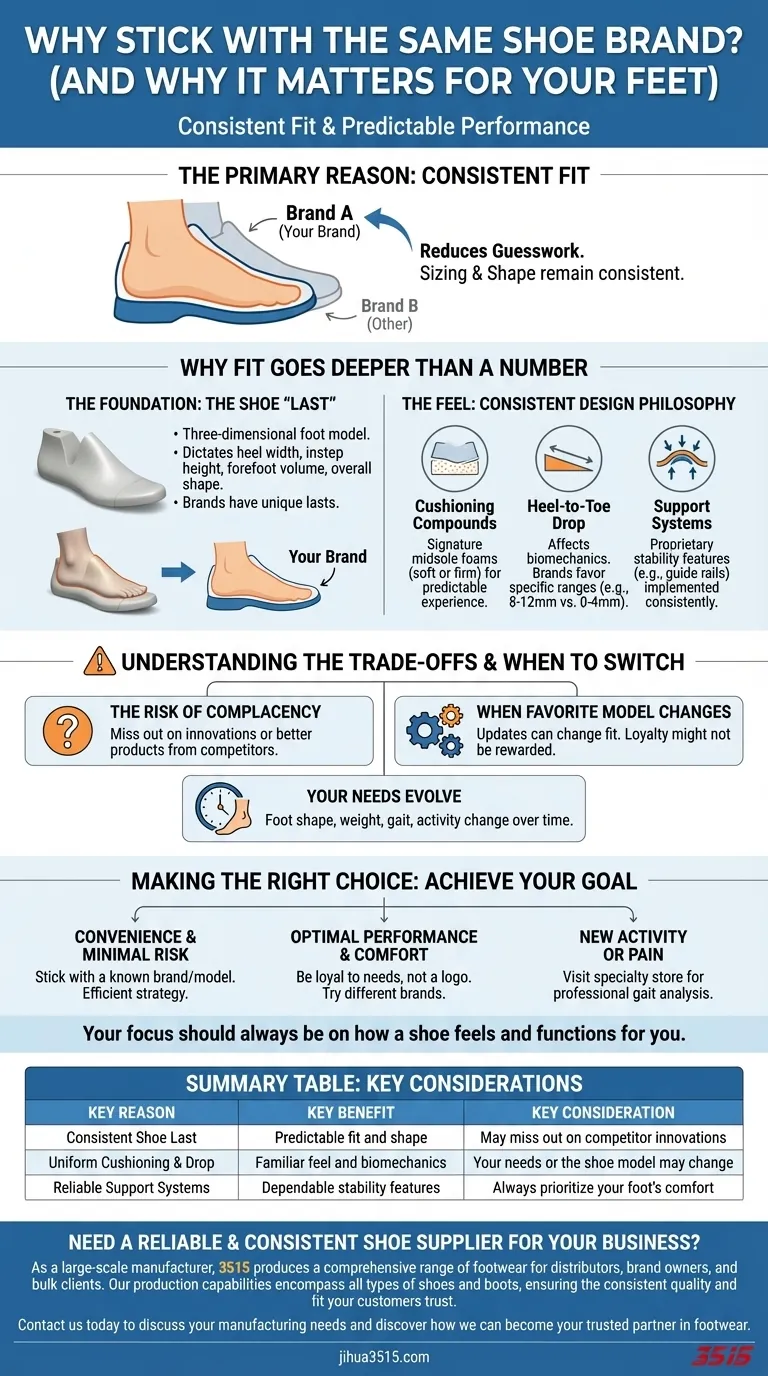
The primary reason it is often recommended to stick with the same shoe brand is for a consistent and predictable fit. Sizing is not standardized across the footwear industry, but an individual brand typically maintains consistent sizing and shaping across its various models, reducing the guesswork and hassle of finding the right shoe.
While brand loyalty can feel arbitrary, it's a practical strategy for minimizing risk. You are not just buying a size; you are buying into a consistent design philosophy, from the fundamental shape of the shoe to the feel of its cushioning.

Why Fit Goes Deeper Than Just a Number
The recommendation to stick with a brand is less about the logo and more about the complex variables that determine how a shoe actually fits and performs on your foot.
The Foundation: The Shoe "Last"
A shoe last is the three-dimensional foot model that a shoe is constructed around. It dictates the shoe's heel width, instep height, forefoot volume, and overall shape.
Brands develop and reuse their own unique lasts. This is why a size 10 from one brand can feel drastically different from a size 10 in another—they are built on fundamentally different shapes.
By sticking with a brand, you are often sticking with a last shape that you already know works for your foot's specific dimensions.
The Feel: Consistent Design Philosophy
Beyond the shape, brands maintain a consistent approach to the technology and feel of their shoes, which helps manage your expectations.
Cushioning Compounds: Brands have signature midsole foams (e.g., Brooks' DNA Loft, Hoka's ProFly, Saucony's PWRRUN). If you prefer a soft, plush feel or a firm, responsive one, staying with a brand gives you a predictable experience.
Heel-to-Toe Drop: This measurement—the height difference between the heel and the forefoot—affects your biomechanics. Brands tend to favor a certain range (e.g., many traditional running brands use a higher 8-12mm drop, while others specialize in a lower 0-4mm drop). Switching can be a jarring adjustment for your body.
Support Systems: The way a brand provides stability for overpronation is also proprietary. If your feet require a specific type of support, like guide rails or a medial post, you can depend on that brand to implement it similarly across its stability models.
Understanding the Trade-offs and When to Switch
While staying with a brand offers predictability, it is not a rule that should be followed blindly. This approach has clear limitations.
The Risk of Complacency
Sticking to one brand out of habit can cause you to miss out on innovations or a superior product from a competitor. The best shoe for your foot might be made by a brand you've never tried.
When Your Favorite Model Changes
Brands update their flagship shoes annually. Sometimes these "upgrades" involve significant changes to the last, foam, or geometry, making the new version feel completely different from the one you loved. In this case, your loyalty to the model is no longer rewarded with consistency.
Your Needs Evolve Over Time
Your foot shape, weight, gait, and activity type can all change. The brand that was a perfect match for you five years ago may no longer be the best choice for your current needs.
Making the Right Choice for Your Goal
Ultimately, the goal is to find the right shoe for your specific foot and purpose. Brand consistency is simply a tool to help you achieve that.
- If your primary focus is convenience and minimizing risk: Sticking with a brand and model you know works is an efficient and reliable strategy.
- If your primary focus is optimal performance and comfort: It is better to be loyal to your needs, not a logo, and be open to trying different brands, especially if your current shoe isn't feeling right.
- If you are new to an activity or experiencing pain: The best approach is to visit a specialty store for a professional gait analysis and fitting, which will prioritize your individual needs over any single brand.
Your focus should always be on how a shoe feels and functions for you, making brand familiarity a helpful guide rather than a strict rule.
Summary Table:
| Key Reason | Key Benefit | Key Consideration |
|---|---|---|
| Consistent Shoe Last | Predictable fit and shape | May miss out on competitor innovations |
| Uniform Cushioning & Drop | Familiar feel and biomechanics | Your needs or the shoe model may change |
| Reliable Support Systems | Dependable stability features | Always prioritize your foot's comfort over brand loyalty |
Need a reliable and consistent shoe supplier for your business?
As a large-scale manufacturer, 3515 produces a comprehensive range of footwear for distributors, brand owners, and bulk clients. Our production capabilities encompass all types of shoes and boots, ensuring the consistent quality and fit your customers trust.
Contact us today to discuss your manufacturing needs and discover how we can become your trusted partner in footwear.
Visual Guide
Related Products
- Wholesale Durable Camouflage Canvas Shoes with High-Traction Cleated Rubber Sole
- Wholesale Modern Perforated Leather Derby Shoes with Chunky Sole for Custom Branding
- Wholesale Breathable Training Shoes Custom Athletic Footwear Manufacturer
- Wholesale Breathable Perforated Leather Derby Shoes with Modern Comfort Sole
- Wholesale Durable & Breathable Training Shoes for Custom Brands
People Also Ask
- Why is the selection of high-strength fabric materials necessary in the production of canvas shoes and training shoes?
- What are the properties of canvas as a shoe material? A Guide to Lightweight Comfort & Style
- Can canvas shoes be worn in rainy conditions? The Truth About Water Resistance
- What are some examples of vulcanized shoes? Discover the Flexibility and Board Feel of Classic Sneakers
- What are the characteristics of canvas as a shoe material? A Guide to Lightweight, Breathable Footwear