
At its core, choosing riding boots based on your discipline is critical because each boot is a specialized piece of equipment designed to optimize safety, communication with the horse, and rider support for a specific set of movements. A boot designed for the precise leg cues of dressage offers poor support for the dynamic stress of jumping, and vice-versa. Using the wrong boot compromises your effectiveness and, most importantly, your safety.
The fundamental mistake is viewing riding boots as simple footwear. Instead, you must see them as a critical interface between you and your horse, with every design element—from ankle flexibility to sole stiffness—purpose-built to meet the unique physical demands of a specific riding discipline.

The Core Functions of a Riding Boot
Before comparing disciplines, it's essential to understand what a riding boot is engineered to do. Its purpose goes far beyond style, focusing on three non-negotiable functions.
Function 1: Safety
The most crucial role of any riding boot is to protect the rider.
A distinct one-inch heel is paramount. It prevents the rider's foot from accidentally slipping through the stirrup, a situation that can lead to being dragged in a fall.
The boot's structure also provides protection on the ground, guarding the foot against being stepped on by a horse.
Function 2: Rider-to-Horse Communication
Effective riding relies on subtle cues from your leg. Your boot is the final point of contact for this communication.
A close-fitting calf allows your leg to lie flat against the horse's side, enabling precise and quiet aids. Bulky or loose boots muddy these signals, creating confusion for the horse.
Function 3: Support and Stability
Riding is an athletic activity that places significant stress on the rider's lower leg, ankle, and foot.
A stiff, reinforced structure supports the ankle and prevents the heel from collapsing under pressure. This creates a stable foundation for the rest of your body, improving balance and reducing rider fatigue.
How Discipline Dictates Boot Design
Different disciplines prioritize the core functions in unique ways, leading to specialized designs. What provides stability in one discipline can create dangerous rigidity in another.
For Dressage: The Pursuit of Precision
Dressage demands exceptional stillness and precision in the lower leg.
The classic dressage boot features a very stiff, straight-cut outer leg to encourage a long, quiet leg position. The sole is typically thin to allow for a subtle feel on the stirrup.
For Jumping: The Need for Flexibility
Show jumpers and eventers require a boot that accommodates a shorter stirrup length and a flexed ankle position for jumping fences.
Field boots, identified by their laces over the instep, are designed with a more supple ankle. This built-in flexibility allows the rider's heel to drop down correctly over a fence without the boot's shaft interfering.
For Trail & Endurance: The Demand for Durability
Trail and endurance riders need a boot that is as functional on the ground as it is in the saddle.
Endurance or trail boots often prioritize all-day comfort and durability. They may feature thicker, treaded soles for traction and be made of more rugged materials to withstand varied terrain and weather.
Understanding the Trade-offs
Choosing a boot for one discipline often means sacrificing features that are optimal for another. This is not a flaw in design, but a necessary compromise.
Performance vs. Comfort
The stiff, formal structure of a high-level dressage boot provides unparalleled leg stability but is often uncomfortable for walking. Conversely, a comfortable trail boot lacks the refined fit needed for precise communication in the show ring.
Flexibility vs. Support
The forward flexion in a field boot is essential for a jumper's two-point position. However, that same flexibility can lead to ankle instability if used for disciplines requiring a perfectly still and straight leg.
Durability vs. Finesse
A rugged paddock boot and half-chap combination is excellent for daily schooling and chores. However, its construction may feel bulkier and less refined than a tall boot, slightly dulling the connection between the rider's leg and the horse's side.
Making the Right Choice for Your Goal
Your primary riding activity should be the deciding factor in your selection process. Be honest about where you will spend most of your time.
- If your primary focus is dressage or flatwork: Prioritize a boot with a stiffer shaft to support a long, elegant leg position.
- If your primary focus is jumping or eventing: Choose a field boot with ankle lacing to ensure the necessary flexibility for a secure position over fences.
- If your primary focus is trail riding or all-around use: Select a durable and comfortable boot, like a quality paddock boot or a specialized trail boot, that can handle hours in the saddle and on the ground.
Ultimately, the right boot enhances your ability and protects you, becoming an invisible partner in your ride.
Summary Table:
| Discipline | Primary Boot Type | Key Design Feature | Purpose |
|---|---|---|---|
| Dressage | Dressage Boot | Stiff, straight-cut shaft | Supports a long, quiet leg for precise cues |
| Jumping | Field Boot | Laces for ankle flexibility | Allows heel drop and stability over fences |
| Trail/Endurance | Trail Boot | Rugged, treaded sole | Provides durability and all-day comfort on varied terrain |
Need high-quality riding boots tailored to your discipline? As a large-scale manufacturer, 3515 produces a comprehensive range of equestrian footwear for distributors, brand owners, and bulk clients. Our production capabilities ensure boots that meet the precise demands of dressage, jumping, trail riding, and more—combining safety, support, and durability. Contact us today to discuss your specific needs and elevate your riding gear offerings!
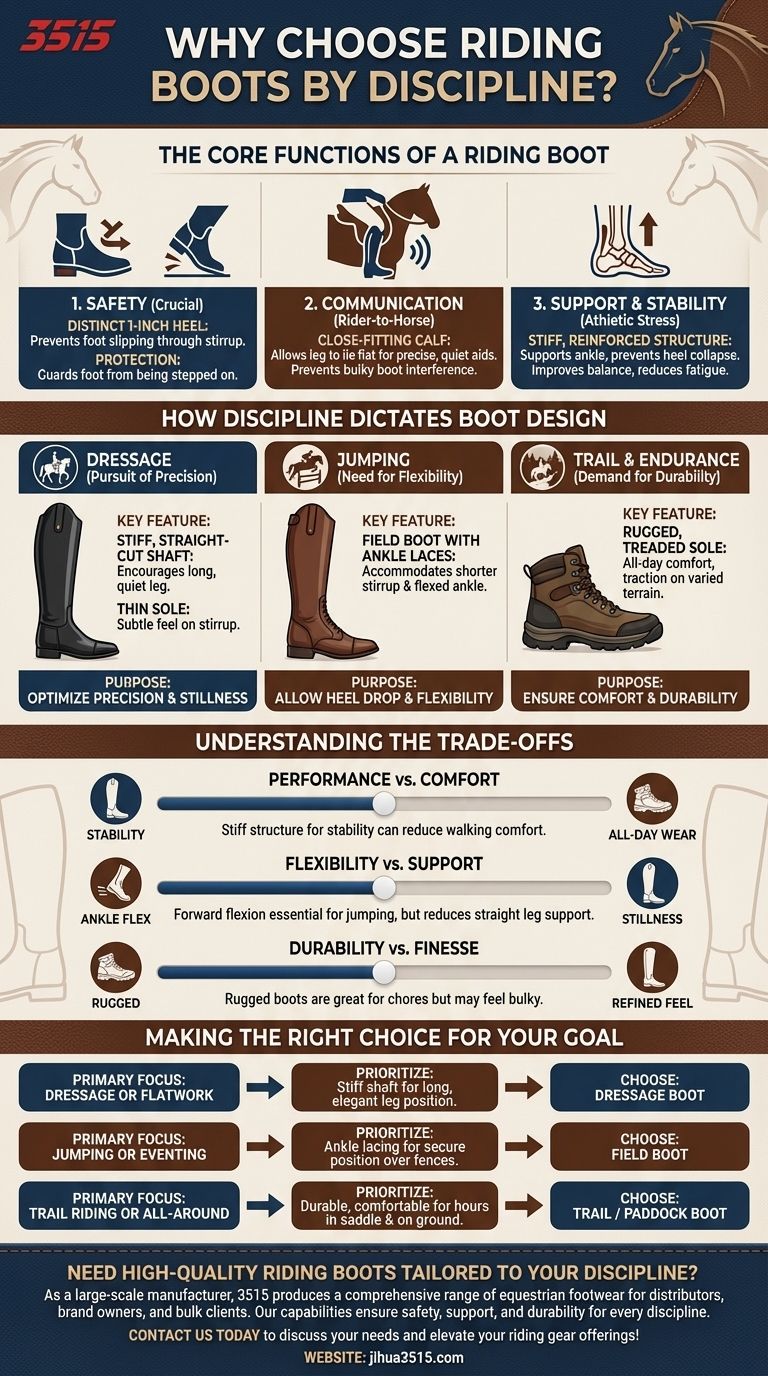
Visual Guide
Related Products
- Premium Wholesale Tactical Style Safety Shoes Boots with Quick Lacing
- Wholesale High-Traction Camo Boots - Custom Manufacturer for Brands
- Durable Goodyear Welt Leather Work Boots for Wholesale & Private Label
- Wholesale Tactical Boots High-Traction & Reflective for Bulk & Brand Orders
- High-Traction Suede Tactical Boots Wholesale & Custom Manufacturing
People Also Ask
- How are gait analysis research findings applied to the functional design of safety shoes and tactical boots?
- How can specialized footwear mitigate safety risks? High-Volume OEM/ODM Solutions since 1951
- How do quality certification standards for safety shoes reduce perceived risk? Buy Online with Technical Certainty
- Why is the synchronization of craftsmanship and UX development emphasized for bulk customization of safety shoes?
- How does anthropomorphic design influence material selection? Enhance Footwear Performance through Biological Alignment



















