For any operator, footwear is a mission-critical tool, not a uniform accessory. The choice is dictated entirely by the environment and objective, as a boot designed for a long march in rugged terrain is fundamentally different from one built for a rapid urban assault. The right footwear provides a direct advantage in mobility and safety, while the wrong choice can compromise the entire operation.
The core principle is that there is no single "best" boot. Instead, operator footwear must be viewed as a specialized system selected to provide the optimal balance of support, mobility, and protection for a specific mission profile.
The Mission Dictates the Design
The effectiveness of an operator's footwear is measured by how well its characteristics align with the immediate operational demands. The environment—from dense jungle to concrete corridors—is the primary factor driving design and selection.
High-Support for Unpredictable Terrain
For missions involving airborne insertions or extended movements over rugged, uneven ground, footwear selection prioritizes stability.
A parachute landing or a long march with a heavy pack places immense stress on the ankles. Sturdy, high-ankled boots are essential to prevent sprains and provide a stable platform on loose rock, mud, or steep inclines.
These boots are built for durability and protection, often featuring thick soles and robust materials to shield the feet from environmental hazards.
Lightweight Agility for Urban Environments
In contrast, a direct-action strike in an urban setting requires speed and maneuverability above all else.
Heavy, rigid boots become a liability, slowing movement and reducing the operator's ability to navigate tight spaces quietly and quickly. Here, lightweight footwear with low or mid-level support is superior.
This design allows for greater ankle flexion, enabling faster transitions and a better "feel" for the ground, which is crucial when moving across varied indoor and outdoor surfaces.
Understanding the Trade-offs
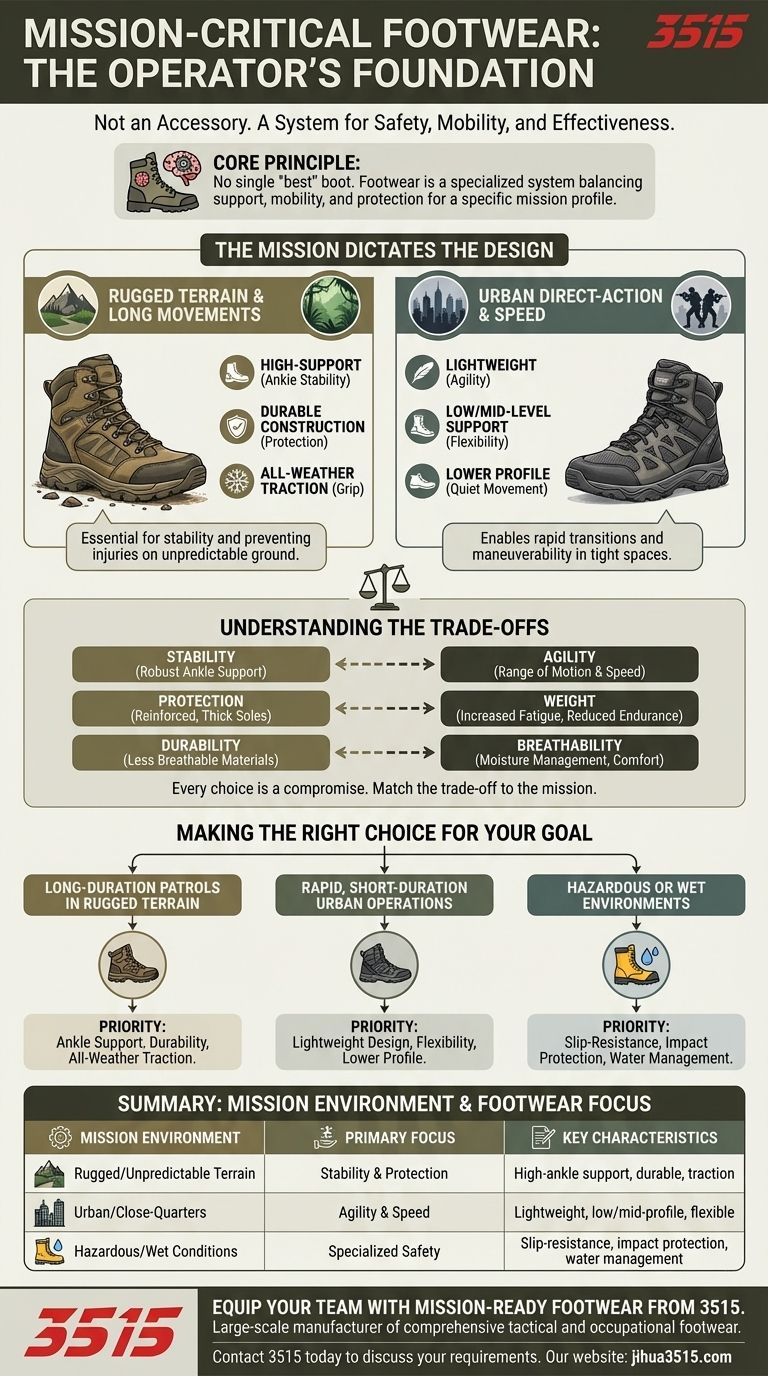
Every footwear choice involves a compromise. Understanding these trade-offs is key to selecting the right tool for the job. There is no boot that can do everything perfectly.
Stability vs. Agility
The most common trade-off is between robust ankle support and flexibility.
A high, stiff boot that protects the ankle on a mountain trail will inherently restrict the range of motion needed to sprint or change direction rapidly in a close-quarters environment.
Protection vs. Weight
Increased protection almost always comes with a weight penalty.
Heavier boots with reinforced toe caps or thick soles guard against falling objects and sharp terrain but also increase fatigue over distance. An operator must balance the anticipated threats with the need for endurance.
Durability vs. Breathability
The most durable materials are often less breathable, which can lead to moisture buildup, blisters, and foot degradation on long movements.
Selecting footwear requires matching its water resistance and breathability to the expected climate and duration of the mission.
Making the Right Choice for Your Goal
Your selection must be a deliberate decision based on a clear analysis of the operational environment and objective.
- If your primary focus is long-duration patrols in rugged terrain: Prioritize ankle support, durable construction, and all-weather traction to ensure stability and prevent injury.
- If your primary focus is rapid, short-duration urban operations: Prioritize lightweight design, flexibility, and a lower profile to maximize speed and agility.
- If your primary focus is operating in hazardous or wet environments: Prioritize specialized safety features like slip-resistance, impact protection, and water management.
Ultimately, choosing the correct footwear is a foundational element of an operator's safety and effectiveness.
Summary Table:
| Mission Environment | Primary Footwear Focus | Key Characteristics |
|---|---|---|
| Rugged, Unpredictable Terrain | Stability & Protection | High-ankle support, durable construction, all-weather traction |
| Urban, Close-Quarters | Agility & Speed | Lightweight, low/mid-profile, flexible for rapid movement |
| Hazardous/Wet Conditions | Specialized Safety | Slip-resistance, impact protection, superior water management |
Equip Your Team with Mission-Ready Footwear from 3515
As a large-scale manufacturer, 3515 produces a comprehensive range of tactical and occupational footwear for distributors, brand owners, and bulk clients. Our production capabilities encompass all types of boots designed for the specific demands of operators in any environment—from durable, high-support boots for rugged terrain to lightweight, agile designs for urban operations.
We provide the specialized footwear solutions your team needs to maximize safety, mobility, and mission effectiveness. Contact 3515 today to discuss your specific requirements and discover how our manufacturing expertise can support your operational goals.
Visual Guide
Related Products
- Lightweight Breathable Training Shoes for Wholesale & Custom OEM Manufacturing
- Wholesale Durable Camouflage Canvas Shoes with High-Traction Cleated Rubber Sole
- Wholesale Breathable Training Shoes Custom Athletic Footwear Manufacturer
- Durable Leather High-Ankle Tactical Boots for Wholesale & Custom Manufacturing
- Premium Lightweight Safety Shoes for Wholesale & Bulk Orders
People Also Ask
- Why are lightweight training shoes often preferred over professional hiking boots in urban walking? Maximize City Comfort
- What is the primary role of specialized training or orthopedic shoes? Enhance Safety in Elderly Balance Training
- Why are professional-grade training shoes essential for physical therapy? Ensure Patient Safety and Gait Stability
- Why are the slip-resistance and stability performance of training shoes critical in gait analysis? Ensure Data Accuracy
- Why is the use of flat-soled or professional training shoes essential for WBV? Maximize Vibration Energy Transfer