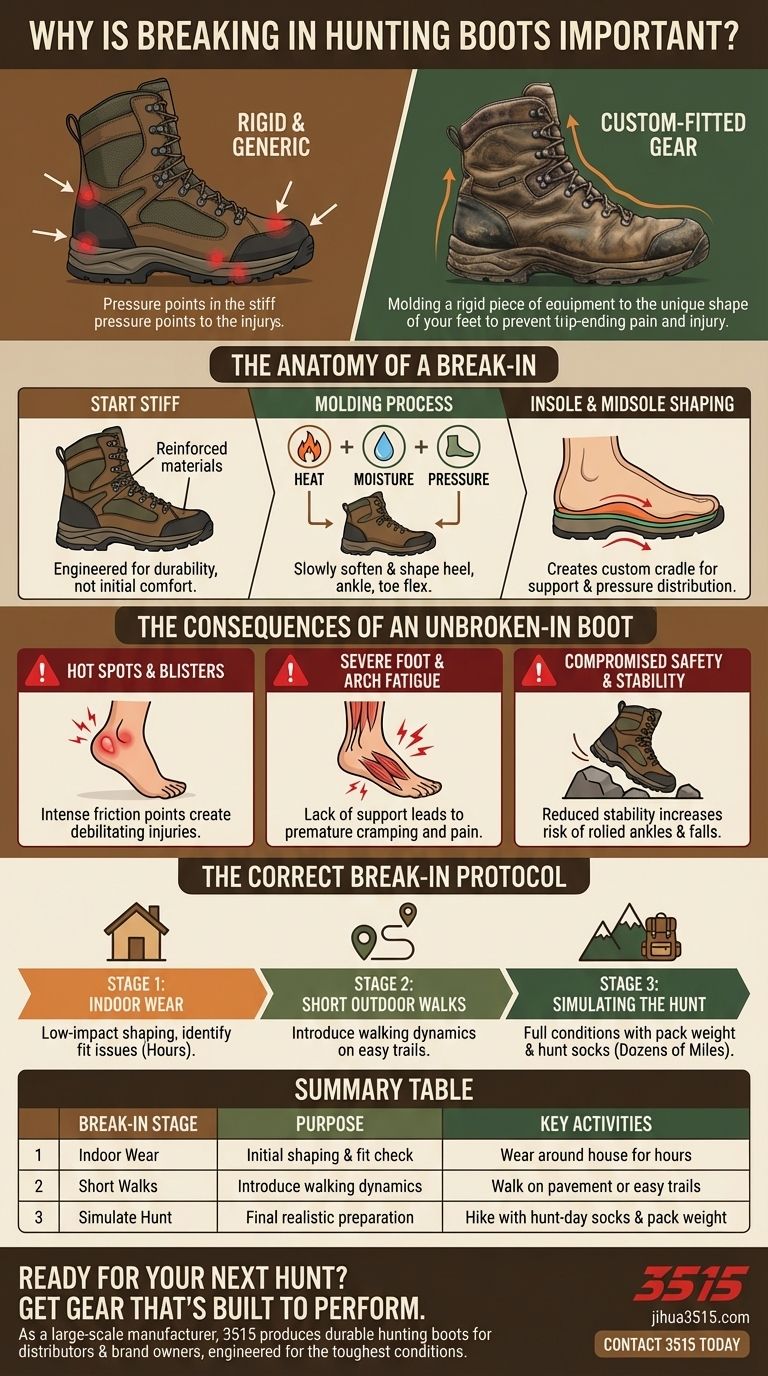
Breaking in your hunting boots is a critical, non-negotiable step in your hunt preparation. This process is not about making them look worn; it is the deliberate act of molding a rigid piece of equipment to the unique shape of your feet to prevent trip-ending pain and injury.
The purpose of breaking in hunting boots is to conform a rigidly constructed tool to your specific anatomy. You are transforming a generic product into a piece of custom-fitted gear that supports, rather than harms, your feet in the field.
The Anatomy of a Break-In
Why Hunting Boots Start Stiff
Modern hunting boots are engineered for durability and support, not out-of-the-box comfort. Their design heritage often stems from military applications where footwear had to withstand extreme conditions, prioritizing protection and longevity above all else.
This results in boots made from tough leather or stiff synthetic materials designed to protect your feet and ankles on treacherous terrain.
The Molding Process Explained
The break-in period uses a simple combination of heat, moisture, and pressure from walking to slowly soften and shape the boot. Key areas like the heel cup, ankle collar, and the flex point across your toes gradually conform to your foot's movement.
This process ensures the boot bends with your foot, not against it.
It's More Than Just the Uppers
Breaking in a boot also involves compressing and shaping the insole and midsole. Over miles of walking, the footbed molds to the specific contours of your arch and heel, creating a custom cradle that provides proper support and distributes pressure evenly.
The Consequences of an Unbroken-In Boot
Hot Spots and Blisters
This is the most common and immediate penalty for skipping the break-in period. A stiff, un-molded boot creates intense friction points against your skin. What starts as a minor "hot spot" can quickly develop into a debilitating blister that makes every step painful.
Severe Foot and Arch Fatigue
A boot that hasn't formed to your foot fails to provide proper support. This forces the small muscles in your feet and lower legs to work overtime to stabilize you, leading to premature fatigue, cramping, and arch pain.
Compromised Safety and Stability
An ill-fitting boot can be a safety hazard. If your heel is slipping or your foot is sliding internally, your stability on uneven or steep ground is significantly reduced, increasing the risk of a rolled ankle or a dangerous fall.
The Correct Break-In Protocol
Stage 1: Indoor Wear
Begin by simply wearing your new boots around the house for a few hours at a time. This initial stage allows the boots to begin shaping to your feet in a low-impact environment and helps you identify any immediate, obvious fit issues.
Stage 2: Short Outdoor Walks
Graduate to wearing the boots for short walks on pavement or easy trails. The goal here is to introduce the dynamics of walking on varied surfaces without the stress of significant elevation or a heavy pack.
Stage 3: Simulating the Hunt
This is the most critical phase. Begin wearing your boots on longer hikes with the same socks and pack weight you plan to use on your hunt. As the references state, stiff mountaineering-style boots may require dozens of miles in this stage to be considered fully field-ready.
Making the Right Choice for Your Hunt
- If your primary focus is a multi-day backcountry hunt: Your break-in process must be extensive, lasting weeks and culminating in hikes that fully simulate the weight and terrain of your actual hunt.
- If your primary focus is day hunting on moderate terrain: A shorter break-in may suffice, but you must complete several hikes to ensure no hot spots develop and that the boots feel supportive.
- If you are buying any new boot, regardless of material: Never take a brand-new pair of boots directly into the field; even minor friction points can ruin your entire trip.
Properly preparing your footwear is the foundational step toward ensuring a safe, successful, and comfortable hunt.
Summary Table:
| Break-In Stage | Purpose | Key Activities |
|---|---|---|
| Indoor Wear | Initial shaping & fit check | Wear boots around the house for a few hours. |
| Short Walks | Introduce walking dynamics | Walk on pavement or easy trails. |
| Simulate Hunt | Final preparation under realistic conditions | Hike with your hunt-day socks and pack weight. |
Ready for Your Next Hunt? Get Gear That's Built to Perform.
As a large-scale manufacturer, 3515 produces a comprehensive range of durable hunting boots for distributors, brand owners, and bulk clients. Our production capabilities ensure your footwear is engineered for the toughest conditions, providing the support and protection you need from day one.
Let us help you equip your customers or team with reliable footwear that supports their success in the field.
Contact 3515 today to discuss your hunting boot needs!
Visual Guide
Related Products
- Wholesale Lightweight Tactical Boots Custom Manufacturer for Desert & Combat Use
- High-Traction Suede Tactical Boots Wholesale & Custom Manufacturing
- Durable Leather Tactical Boots Wholesale & Custom Manufacturing for Brands
- Durable Military Combat Boots with Water Drainage for Wholesale & OEM
- Wholesale Waterproof Tactical Boots Custom Suede & High-Traction Soles
People Also Ask
- What are the common types of combat boots? Find the Right Boot for Your Mission
- What specialized protections do tactical boots offer? Maximize Endurance with High-Performance Footwear
- How is the compatibility of polymer materials demonstrated in smart footwear? Enhancing Tactical & Training Performance
- What are the main construction similarities between tactical boots and tactical sneakers? Built for Performance & Durability
- What are the different types of tactical boots available? Find the Right Boot for Your Mission