
To be direct, ankle support is critical in motorcycle boots to prevent catastrophic, life-altering injuries during a crash. When a rider loses control, the instinct is often to put a foot down, exposing the ankle to extreme twisting, crushing, and impact forces that a normal boot or shoe cannot withstand. Proper motorcycle boots are engineered as safety equipment to protect one of the most complex and vulnerable joints in your body.
The core purpose of ankle support in a motorcycle boot is not simply to prevent a sprain, but to provide an external, rigid structure that resists the violent torsional and impact forces of a crash, which can easily shatter bones and tear ligaments, leading to permanent disability.
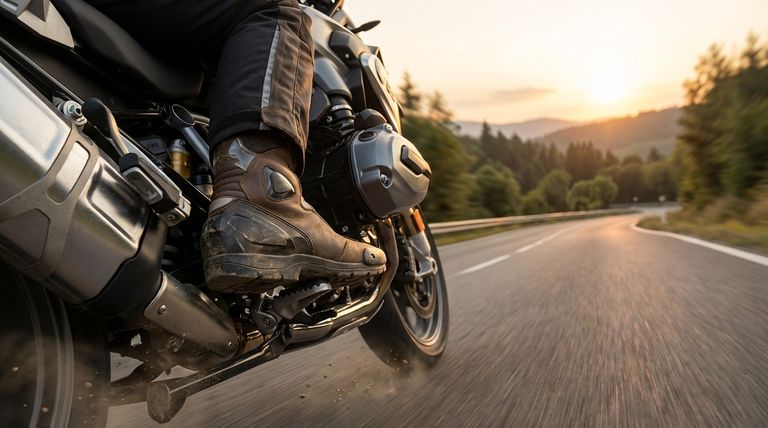
The Unique Forces Acting on an Ankle in a Crash
Unlike walking on uneven ground, a motorcycle accident exposes your ankles to a level of violence that demands specialized protection. The engineering behind motorcycle boots is a direct response to these specific dangers.
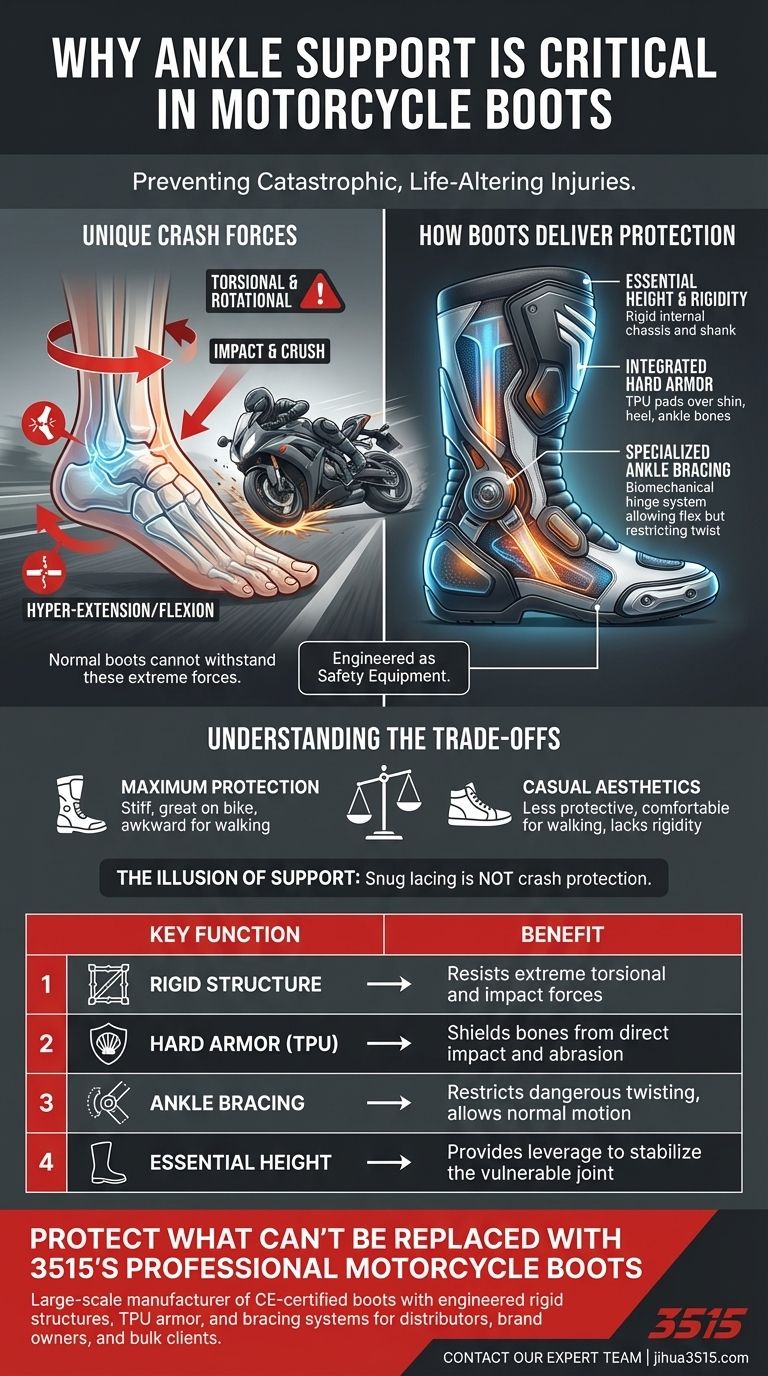
Torsional and Rotational Forces
The most common and dangerous force is torsion, or twisting. In a slide or a fall, your foot can easily get trapped under the motorcycle or against the pavement.
As the bike and your body continue to move, this leverage applies an extreme rotational force to your ankle joint, far beyond its natural range of motion.
Impact and Crush Forces
A motorcycle provides no protective cage. Your feet and ankles are often the first points of contact with the road, other vehicles, or fixed objects.
Motorcycle boots are designed with hardened armor and reinforced structures in the heel, toe, and around the ankle bones (malleolus) to absorb and distribute the energy from a direct impact, preventing bones from being crushed.
Hyper-extension and Hyper-flexion
These injuries occur when the ankle is forced to bend too far forward (hyper-flexion) or backward (hyper-extension).
A well-designed boot has a rigid structure that acts as a physical stop, preventing the joint from moving beyond its safe operational limits during the chaos of an accident.
How Motorcycle Boots Deliver Structural Protection
While a sturdy work boot might feel supportive, it lacks the specific features engineered to combat crash forces. True motorcycle boots integrate a system of protective elements.
Essential Height and Rigidity
The first line of defense is a design that extends well above the ankle. This height provides the leverage needed for the boot's structure to stabilize the joint.
This is combined with a stiff chassis, often reinforced with a steel or composite shank in the sole, which prevents the boot from simply folding or twisting under pressure.
Integrated Hard Armor
Unlike other types of footwear, motorcycle boots incorporate purpose-built armor, typically made from Thermoplastic Polyurethane (TPU) or carbon fiber.
This armor is placed strategically over the shin, heel, and ankle bones to shield them from direct impact and abrasion during a slide.
Specialized Ankle Bracing Systems
More advanced boots feature internal or external bracing systems. These are biomechanical hinges that connect the rigid lower part of the boot to the upper shin area.
This system allows for necessary forward and backward flex for shifting and braking but severely restricts the dangerous side-to-side and twisting motions that cause the worst injuries.
Understanding the Trade-offs
Choosing a boot always involves balancing absolute protection with practical usability. Understanding these compromises is key to selecting the right gear for your needs.
Protection vs. Off-Bike Comfort
The most protective boots, like those used for racing, are extremely rigid. This makes them exceptional on the bike but often stiff and awkward for walking.
This stiffness is a deliberate feature, not a flaw. It is the core of the protective system.
Casual Aesthetics vs. True Safety
Many products are marketed as "riding shoes" or short, sneaker-style boots. While better than nothing, they often lack the height and structural rigidity to prevent serious torsional ankle injuries.
True protection requires a boot that fully encases and supports the ankle joint.
The Illusion of Support
A boot can feel snug and supportive simply because it is laced tightly. However, this feeling does not equate to crash protection.
Without a rigid structure, reinforced materials, and purpose-built armor, a soft leather boot will offer little resistance to the forces of a motorcycle accident.
Making the Right Choice for Your Goal
Your choice of boot should directly reflect the type of riding you do. All reputable motorcycle boots should have a CE rating, which certifies they have passed standardized tests for safety.
- If your primary focus is maximum protection for track or aggressive canyon riding: Prioritize race boots with external bracing systems, extensive TPU armor, and a tall, non-negotiably rigid structure.
- If your primary focus is commuting or long-distance touring: Seek a CE-rated touring or adventure boot that balances robust ankle protection and integrated armor with features like waterproofing and enhanced walking flexibility.
- If your primary focus is casual urban riding: Insist on, at a minimum, over-the-ankle boots that are CE-rated and feature reinforced ankle cups, a stiff sole, and abrasion-resistant materials.
Your ankles are irreplaceable, and investing in a boot with engineered, certified support is one of the most critical safety decisions you will ever make.
Summary Table:
| Key Function | Benefit |
|---|---|
| Rigid Structure | Resists extreme torsional and impact forces |
| Hard Armor (TPU) | Shields ankle bones from direct impact and abrasion |
| Ankle Bracing Systems | Allows normal riding motion but restricts dangerous twisting |
| Essential Height | Provides leverage to stabilize the vulnerable ankle joint |
Protect What Can't Be Replaced with 3515's Professional Motorcycle Boots
As a large-scale manufacturer, 3515 produces a comprehensive range of CE-certified motorcycle boots for distributors, brand owners, and bulk clients. Our production capabilities encompass all types of protective footwear, engineered with the rigid structures, TPU armor, and bracing systems detailed in this article to provide life-saving ankle support.
Ready to equip your customers with boots that offer genuine protection? Contact our expert team today to discuss your requirements and leverage our manufacturing expertise to create or source the safest motorcycle footwear.
Visual Guide
Related Products
- Wholesale Tactical Boots High-Traction & Reflective for Bulk & Brand Orders
- High Performance Fire-Retardant Waterproof Safety Boots
- Durable Goodyear Welt Leather Work Boots for Wholesale & Private Label
- Wholesale High-Traction Camo Boots - Custom Manufacturer for Brands
- Heavy-Duty Waterproof Nubuck Safety Boots Safety Shoes for Bulk Supply
People Also Ask
- How do tactical boots protect against injuries? Discover the Integrated Safety System
- What features should law enforcement officers look for in tactical boots? Essential Guide for Safety & Performance
- What boots do navy SEALs run in? Discover the Mission-Driven Footwear Philosophy
- What are the key features to look for in the best tactical boots? A Guide to Peak Performance
- How should you break in and clean tactical boots? A Step-by-Step Guide for Peak Performance



















