
Okay, so the user wants to know why Western-style work boots have those high shafts. The real question is: is this design right for them? As a technical advisor, I need to go beyond the surface and get to the functional truth. It's about empowerment, not just a simple answer. The goal is clarity and providing actionable insight. Let's break it down.
The Answer in a Nutshell
Western work boots feature high shafts primarily to provide comprehensive protection and support for the lower leg.
The elevated design of these boots offers enhanced protection against a variety of hazards while also offering support for the ankle, a combination you rarely find in standard footwear.
The Dual Mandate: Protection and Support
The high shaft isn't just a style choice; it's a critical safety feature.
Comprehensive Shin and Leg Protection
The primary function of the high shaft is to act as a physical barrier.
- It guards against debris, keeping dirt, rocks, mud, and water out of the boot.
- It protects the shins and calves from impacts, scrapes, and brush.
- For specific industries, it offers essential protection: welders need protection from sparks, and ranchers need defense against snakes and thorny vegetation. This feature is tied to the "Western" heritage.
Enhanced Ankle Stability
The high shaft extends above the ankle, providing increased support and stability.
- This reduces the risk of twists, sprains, and other injuries, especially on uneven terrain.
- The extended support is crucial for workers who spend a lot of time on their feet in challenging environments.
The Legacy of Equestrian Design
The high shaft isn't a new idea.
- The design has roots in equestrian practices, where boots protected a rider's leg from the saddle and stirrup leathers.
- This design was adapted for rugged outdoor work, like on farms and ranches.
Understanding the Trade-offs of a High Shaft
While the high shaft offers advantages, it also comes with some trade-offs.
The Lack of Laces
A key design feature is the absence of laces.
- Pros: No laces to snag on equipment or become undone.
- Cons: Less adjustability for a perfect fit, which might be a problem for some foot shapes.
Heat and Breathability
A higher shaft can trap more heat.
- This can be a drawback in hot climates or during strenuous work.
- Breathability is a consideration.
Break-in Period and Flexibility
The taller shaft can make the boot stiffer.
- It usually takes longer to break them in compared to lower-cut boots.
- Flexibility and mobility can be affected initially.
Making the Right Choice for Your Work
Think about your specific needs. Here's a quick guide:
- If your primary focus is maximum protection in rugged environments, the high shaft is a clear advantage.
- If you work in hot climates, consider materials and construction that prioritize breathability.
- If you need a highly adjustable fit, look for options with laces or consider a lower-cut work boot.
- If you spend extended periods kneeling or crouching, consider the break-in period and flexibility.
I hope this helps you make an informed decision and gives you a more comprehensive understanding of this boot style. At its core, the high shaft on a Western-style work boot is a deliberate design choice that provides comprehensive protection and structural support for the lower leg. This feature extends far beyond aesthetics, serving critical functions for workers in demanding and unpredictable environments.
The high shaft is not a single-purpose feature; it is a multi-functional system designed to shield the wearer from environmental hazards while simultaneously reinforcing the ankle and lower leg against injury on uneven terrain.
The Dual Mandate: Protection and Support
The taller design of a Western work boot directly addresses the two most fundamental needs of demanding physical labor: shielding the body from external harm and supporting it against biomechanical stress. These two functions work in tandem.
Comprehensive Leg Protection
The most immediate benefit of a high shaft is its function as a physical barrier. It extends coverage well above the ankle, an area left exposed by standard-height boots.
This protects the shin and calf from a wide range of common workplace hazards, including impacts from tools or equipment, abrasions from brush and debris, and contact with hot surfaces or welding sparks. For those working outdoors, it also offers a crucial defense against snake bites and thorny plants.
Enhanced Ankle Stability
The reference to ankle support is critical. By encasing the ankle and lower leg, the rigid structure of the high shaft helps limit excessive lateral movement.
This is especially important when navigating uneven ground, loose gravel, or construction sites. The added stability significantly reduces the risk of common injuries like ankle twists, rolls, and sprains that can occur from a single misstep.
The Legacy of a Functional Design
The Western boot's design originates from equestrian needs, where a high, sturdy shaft protected the rider's leg from the saddle, stirrups, and the elements.
This heritage of pure function was then adapted for ranchers, farmers, and tradespeople. The laceless, pull-on design, made possible by the high shaft, also prevents snagging on equipment or undergrowth—a significant safety advantage.
Understanding the Trade-offs
While highly functional, the high-shaft design is not without its compromises. Acknowledging these trade-offs is key to determining if it is the right choice for your specific needs.
Fit vs. Adjustability
The primary trade-off is the lack of laces. While this creates a smooth, snag-free profile, it also removes the ability to fine-tune the fit across the instep and around the ankle.
Getting the correct size from the start is absolutely critical, as there is little room for adjustment. This can be a challenge for individuals with non-standard foot or ankle shapes.
Heat and Breathability
A taller shaft inherently covers more of the leg, which can lead to increased heat retention. In hot and humid climates, this can be a significant comfort issue.
While many modern boots incorporate breathable linings, the fundamental design traps more heat than a standard 6-inch or 8-inch boot.
Break-in Period
The stiff, supportive leather required for a high-quality Western work boot often comes with a longer and more demanding break-in period. The boot must mold to both your foot and your lower leg, which can take time and cause initial discomfort.
Making the Right Choice for Your Goal
To select the appropriate footwear, you must align the boot's design features with the primary demands of your work environment.
- If your primary focus is maximum protection in rugged, unpredictable environments: The superior coverage and stability of a Western-style work boot are a significant advantage.
- If your primary focus is working in hot climates or indoor settings: The reduced breathability of a high shaft may be a significant drawback, and a lower-cut boot might be more comfortable.
- If your primary focus is a highly customized and adjustable fit: A traditional lace-up work boot will offer you far more control over tightness and support.
Ultimately, understanding the purpose behind the design allows you to make an informed decision based on function, not just form.
Summary Table:
| Feature | Key Benefit | Ideal For |
|---|---|---|
| High Shaft | Shields shins/calves from impacts, debris, and brush | Welders, ranchers, construction workers |
| Laceless Design | Prevents snagging on equipment or vegetation | High-mobility, hazardous terrains |
| Ankle Support | Reduces risk of twists/sprains on uneven ground | Uneven surfaces, long hours on feet |
| Trade-offs | Longer break-in, less adjustability, more heat retention | Consider climate and fit needs |
Need durable, high-performance work boots tailored to your team's safety needs?
As a large-scale manufacturer, 3515 produces a comprehensive range of Western-style and other work footwear designed for maximum protection and support. We specialize in creating boots that meet the demands of distributors, brand owners, and bulk clients in rugged industries.
Let us help you equip your workforce with reliable footwear that combines safety, comfort, and durability. Contact us today to discuss your production requirements!
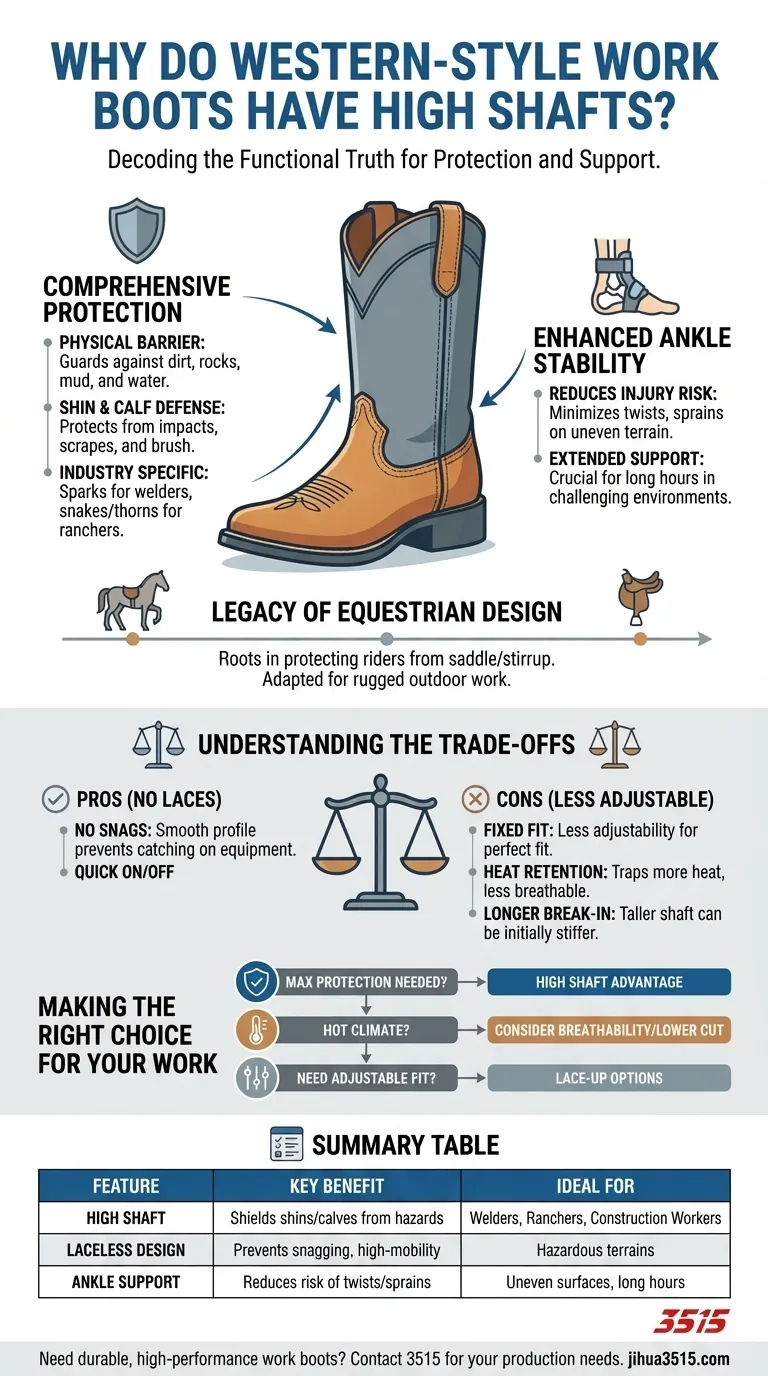
Visual Guide
Related Products
- Factory-Direct Wholesale Canvas Boots with High-Traction Rubber Soles
- Wholesale High-Traction Camo Boots - Custom Manufacturer for Brands
- Durable Moc-Toe Wedge Work Boots | Wholesale Manufacturing for Brands
- Durable Moc Toe Wedge Sole Work Boots for Wholesale and Private Label
- Wholesale Leather Work Boots with Customizable Wedge Sole for Brands
People Also Ask
- What types of jobs are canvas work boots suitable for? Ideal for Light-Duty, High-Mobility Roles
- What are the functional advantages of choosing rubber soles over leather soles for work boots? Superior Safety & Durability
- What are the advantages of rubber soles for work boots? Unbeatable Grip & Durability
- Why are slip-resistant soles important in work boots? Prevent Slips & Boost Safety
- What are the benefits and limitations of using canvas as a primary material for footwear? Key B2B Manufacturing Insights















