Okay, so the user wants to know why these specialized boots are considered essential PPE, and my job is to provide a complete explanation. I need to go beyond the surface-level answer and really dig into the core reasons why wildfire boots are non-negotiable in this dangerous environment.
First, I've got to understand the user's perspective. It's not just a casual question; they're likely looking for that fundamental difference between a regular work boot and this specialized equipment. They need to understand the extreme, life-or-death context of a wildfire, and how the boot design directly addresses those threats. The question really boils down to: Why are these boots so critically important?
I've taken a look at the references. The first two essentially say the boots protect against extreme heat, injuries, and mobility issues. It's a good starting point, but I need to go much deeper. Reference 3 is a general statement about work boots and their role, and I can use this to my advantage later, really contrast what's required in a wildfire situation versus a normal worksite. Reference 4 is the goldmine, though: flame and heat protection, keeping feet dry, guarding against sharp objects and debris, ankle support, traction, and balance in unpredictable environments. That's my blueprint.
Now, how to structure this to make it compelling? I'll start with a powerful statement, directly answering the question: wildfire boots are essential because they protect against extreme heat, physical hazards, and mobility challenges specific to wildland environments. This is just the hook.
I want to emphasize the fundamental difference in environment. I'll include a core takeaway: A wildfire environment is a uniquely hostile landscape that requires equipment built for survival and operational success in high-stakes situations. It's not a normal worksite, and the gear reflects that.
I'll break the boots down piece by piece, focusing on the specific threats and how the boots address them. The section titles will be key: "A System for Surviving Unpredictable Terrain," then diving into the specifics: heat and flame resistance, protection from physical hazards, stability and traction, and managing moisture.
And it's not all rainbows and sunshine, either. I'm going to have a section on the critical trade-offs. I'll explain that these boots are heavy and stiff for a reason. Protection comes at a cost of agility, and it's a trade-off that is essential for survival. This is where I can really demonstrate expertise and answer the potential "why not hiking boots?" question.
Finally, I want to leave the user with something actionable. I'll end with a section about purpose-built gear, and it's not a buying pitch. I'll have a short bulleted list that reinforces the point that when dealing with an environment this dangerous, these boots are non-negotiable. I want to convey that this is about fundamental safety and operational effectiveness, and that the right gear is at the heart of that. At its core, a wildfire boot is an essential piece of personal protective equipment because it is specifically engineered to shield a firefighter's feet from the unique and severe hazards of a wildland environment. These boots provide critical protection against extreme heat, sharp objects on the fireline, and the punishing, uneven terrain that can cause debilitating injuries.
The fundamental mistake is to view a wildfire boot as merely a heavy-duty work boot. It is a specialized survival system designed to ensure a firefighter remains mobile, protected, and effective in an environment where equipment failure can have life-threatening consequences.
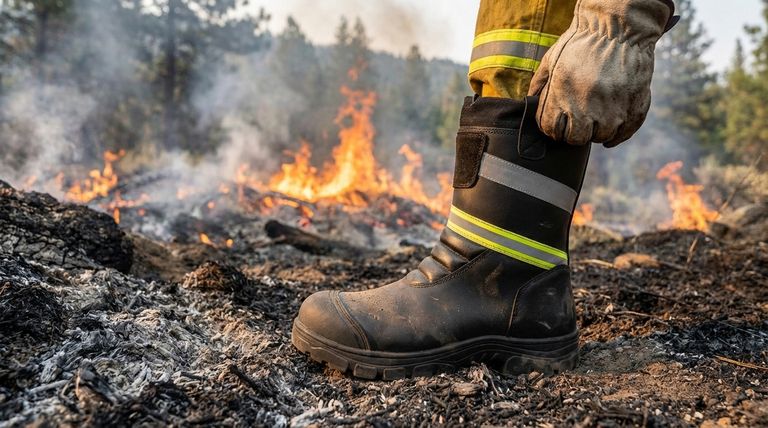
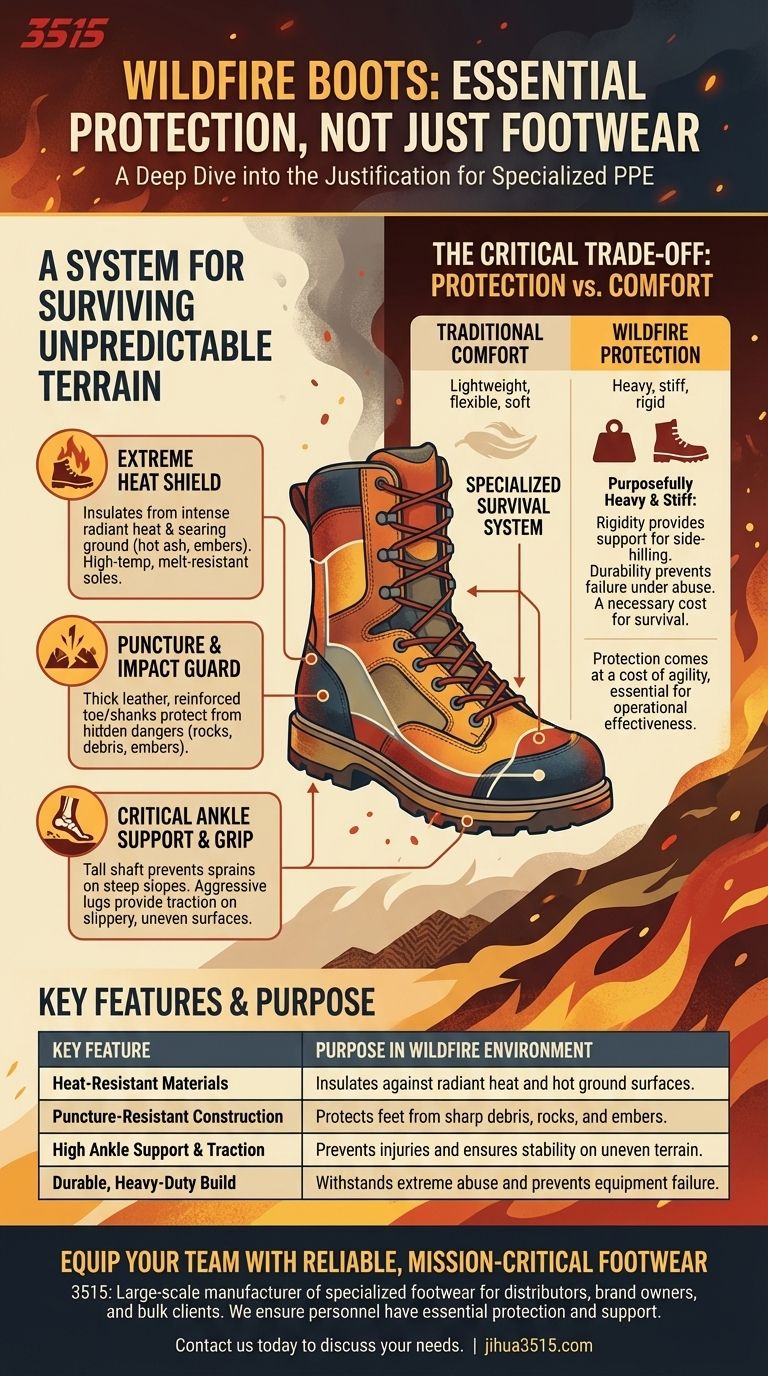
A System for Surviving Unpredictable Terrain
A firefighter's effectiveness is directly tied to their mobility. Wildfire boots are designed as a foundational system to maintain that mobility under the worst possible conditions, addressing multiple threats simultaneously.
Resisting Extreme Heat and Flame
The most obvious threat is the fire itself. Wildfire boots are constructed from thick, durable leather and feature soles made of high-temperature, melt-resistant rubber compounds. This construction is designed to insulate the foot from the intense radiant heat of the fire and the searing heat of the ground, which is often covered in hot ash and embers.
Guarding Against Physical Hazards
The fireline is a landscape of hidden dangers. Firefighters navigate through sharp rocks, fallen branches, and unseen debris left after vegetation has burned away. The rugged construction of these boots, often including reinforced toe boxes and shanks, protects the foot from punctures and impact injuries.
Ensuring Stability and Ankle Support
Wildland firefighters work on steep, unstable, and often slippery surfaces for extended periods. Wildfire boots are typically built with a taller shaft (8 inches or more) to provide crucial ankle support, preventing sprains and twists. Deep, aggressive lugs on the outsole provide superior traction on loose soil, ash, and uneven ground.
The Critical Trade-off: Protection vs. Weight
It is vital to understand that wildfire boots are not designed for maximum comfort in the traditional sense. They are heavy, stiff, and require a significant break-in period.
The Purpose of a Rigid Design
This stiffness is a feature, not a flaw. The rigidity provides the necessary support for side-hilling on steep slopes and protects the foot's structure from the constant stress of navigating rugged terrain. A softer, more flexible boot would fail to provide this critical protection, leading to fatigue and injury.
Weight as a Function of Durability
The boot's weight is a direct result of the materials required to withstand extreme abuse. Thicker leather, heavy-duty stitching, and dense rubber soles are necessary to resist heat, abrasion, and punctures. This durability ensures the boot will not fail during a critical moment on the fireline.
Making the Right Choice for the Mission
Understanding the purpose behind the design is key to appreciating why no substitute is acceptable. The boot is engineered for a specific, high-stakes mission.
- If your primary focus is operational safety: Recognize that wildfire boots are a non-negotiable component of PPE, designed to mitigate the specific, life-threatening hazards of the fireline.
- If your primary focus is equipment compliance: Acknowledge that standard work or hiking boots lack the critical heat-resistant materials and structural integrity mandated for wildland firefighting.
Properly engineered footwear is the foundation upon which a firefighter’s safety and effectiveness are built.
Summary Table:
| Key Feature | Purpose in Wildfire Environment |
|---|---|
| Heat-Resistant Materials | Insulates against radiant heat and hot ground surfaces. |
| Puncture-Resistant Construction | Protects feet from sharp debris, rocks, and embers. |
| High Ankle Support & Traction | Prevents injuries and ensures stability on uneven terrain. |
| Durable, Heavy-Duty Build | Withstands extreme abuse and prevents equipment failure. |
Equip Your Team with Reliable, Mission-Critical Footwear
As a large-scale manufacturer, 3515 produces a comprehensive range of specialized footwear for distributors, brand owners, and bulk clients. Our production capabilities encompass all types of safety boots, including those built to the demanding specifications required for wildland firefighting.
We ensure your personnel are equipped with boots that provide the essential protection, durability, and support needed to operate safely and effectively in the most hazardous conditions. Let us help you source or develop the right protective footwear for your specific requirements.
Contact us today to discuss your needs and learn how we can support your operations.
Visual Guide
Related Products
- Premium Flame-Retardant Waterproof Safety Boots and Shoes
- High Performance Fire-Retardant Waterproof Safety Boots
- Wholesale Lightweight Tactical Boots Custom Manufacturer for Desert & Combat Use
- Durable Military Combat Boots with Water Drainage for Wholesale & OEM
- Durable Spiked Camouflage Boots Wholesale & Factory Production
People Also Ask
- Why are waterproof safety boots recommended for certain work environments? Essential Protection for Wet & Hazardous Jobs
- What materials are commonly used in waterproof boots? The Complete Guide to Durable, Breathable Protection
- How does boot construction affect waterproofing? The Science Behind Truly Dry Feet
- What should you look for to ensure boots are fully waterproof? The Essential 2-Part System
- What is the advantage of one-piece construction in waterproof boots? Unbeatable Seamless Protection