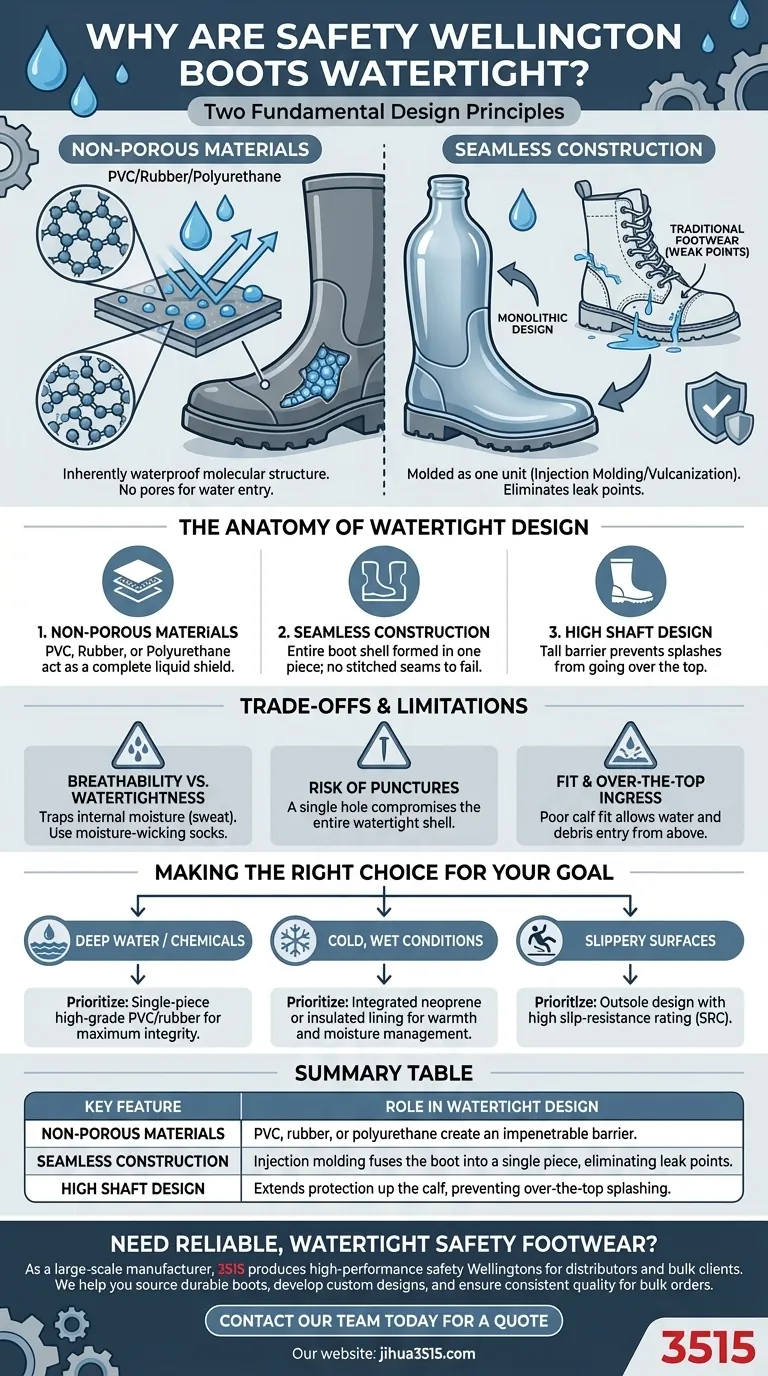
At their core, safety Wellington boots are considered watertight because of two fundamental design principles: they are constructed from inherently non-porous materials and are manufactured as a single, seamless unit. This monolithic design eliminates stitched seams, which are the most common points of water entry in traditional footwear, creating an impenetrable barrier against moisture.
The true genius of a Wellington boot's watertight design lies not just in the material itself, but in the manufacturing process that molds the upper, sole, and shaft into one continuous piece, effectively engineering out the possibility of leaks.
The Anatomy of a Watertight Design
To understand why these boots are so effective, we must look at how their material and construction work in tandem. It's a system where each component reinforces the other to create a completely sealed environment for the foot.
The Role of Non-Porous Materials
The primary materials used—PVC (Polyvinyl Chloride), rubber, or polyurethane—are naturally waterproof. Unlike leather or fabric, their molecular structure has no pores for water to penetrate.
This means water cannot seep through the material itself. The boot's surface forms an unbroken shield against liquids, from standing water to mud and chemical splashes.
The Power of Seamless Construction
The most critical feature is the manufacturing method, typically injection molding or vulcanization. This process creates the entire boot shell as a single piece.
Think of it like a glass bottle versus a wooden box. The bottle is a single, continuous piece and cannot leak. The box, made of multiple pieces joined at the seams, has inherent weak points where water can get in. Traditional boots are like the box; Wellingtons are like the bottle.
The Importance of the High Shaft
The tall design of a Wellington boot is a simple but crucial element of its watertight system. It provides a physical barrier that extends well up the calf.
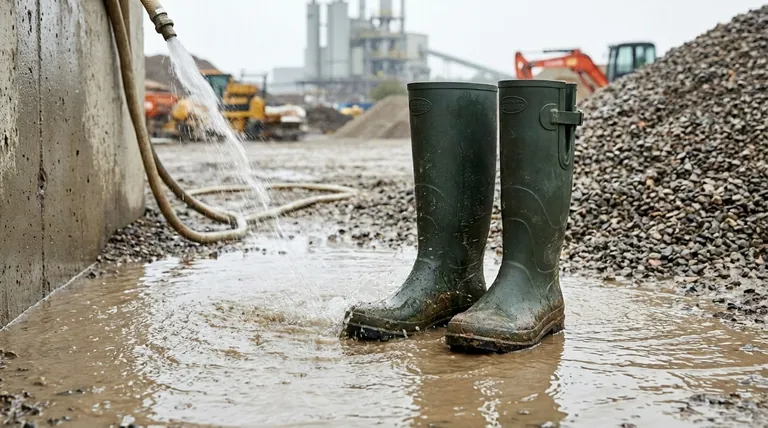
This height protects against water splashing over the top of the boot, a common issue with lower-cut footwear when walking through puddles, deep mud, or hosing down a work area.
Understanding the Trade-offs and Limitations
While highly effective, the design of a safety Wellington boot presents a few inherent compromises. Acknowledging these limitations is key to using them correctly and comfortably.
Breathability vs. Watertightness
The same non-porous materials that block external moisture also trap internal moisture. Your feet sweat, and this vapor has nowhere to escape.
This can lead to a feeling of dampness inside the boot, even with no external leaks. Using moisture-wicking socks is essential to manage this effect during long periods of wear.
The Risk of Punctures
The boot's integrity relies on its unbroken shell. A single puncture from a sharp nail or piece of metal can completely compromise its watertight function.
Unlike a stitched boot where damage might be localized, a hole in a Wellington creates a direct channel for water to enter the entire footbed.
The Fit and "Over-the-Top" Ingress
A poor fit around the calf can negate the benefit of the high shaft. A wide gap at the top of the boot allows water, debris, and other contaminants to splash inside.
Ensuring a snug—but not restrictive—fit around the leg is critical for maintaining a dry and safe internal environment, especially in messy conditions.
Making the Right Choice for Your Goal
Selecting the correct Wellington requires matching its features to the specific hazards and conditions of your work.
- If your primary focus is working in deep water or with aggressive chemicals: Prioritize a one-piece, seamless boot made from high-grade PVC or specialized rubber for maximum material and construction integrity.
- If your primary focus is all-day comfort in cold, wet conditions: Look for boots with an integrated neoprene or insulated lining to manage temperature and wick some moisture away from your skin.
- If your primary focus is preventing slips on slick surfaces: Pay close attention to the outsole design and its official slip-resistance rating (SRC is the highest standard), as this is just as critical as its watertightness.
Ultimately, understanding that a safety Wellington is a specialized tool empowers you to select the precise protection needed to keep you safe and dry.
Summary Table:
| Key Feature | Role in Watertight Design |
|---|---|
| Non-Porous Materials | PVC, rubber, or polyurethane create an impenetrable barrier; water cannot seep through the material itself. |
| Seamless Construction | Injection molding fuses the boot into a single piece, eliminating stitched seams—the most common leak points. |
| High Shaft Design | Extends protection up the calf to prevent water and debris from splashing over the top of the boot. |
Need Reliable, Watertight Safety Footwear for Your Team?
As a large-scale manufacturer, 3515 produces a comprehensive range of high-performance safety Wellington boots for distributors, brand owners, and bulk clients. Our production capabilities encompass all types of seamless, watertight footwear designed to meet the highest safety standards.
We can help you:
- Source durable boots with superior watertight integrity for harsh conditions.
- Develop custom designs tailored to your specific market needs and safety requirements.
- Ensure consistent quality and reliable supply for your bulk orders.
Let's discuss your requirements → Contact our team today for a quote and expert consultation.
Visual Guide
Related Products
- Durable Waterproof Rain Boots | Custom Manufacturer for Wholesale & Brands
- Puncture-Resistant Velcro Safety Boots for Wholesale & Custom Manufacturing
- Wholesale Durable Safety Boots | Custom Steel Toe & Puncture-Resistant Manufacturing
- Premium Wholesale Tactical Style Safety Shoes Boots with Quick Lacing
- Premium High-Cut Waterproof Safety Boots Manufacturing & Wholesale Solutions
People Also Ask
- What are the main materials for waterproof rain boots? Choose the Right Material for Durability & Comfort
- What is the overall recommendation for choosing rain boot materials? A Guide to Rubber vs. PVC
- How does boot height affect waterproofing? Choose the Right Height for Ultimate Protection
- Why are rain boots more flexible and comfortable than snow boots? The Key Differences Explained
- What are the best types of shoes for different gardening conditions? Find Your Perfect Match.