In short, motorcycle boots are necessary because they are purpose-built safety equipment designed to protect your feet and ankles from impact, abrasion, and twisting forces in a crash. Unlike regular shoes, they also provide the specific grip, support, and heat protection required to operate a motorcycle safely and comfortably.
The core reason for wearing dedicated motorcycle boots is risk management. While they enhance comfort and control, their fundamental purpose is to function as a critical piece of armor for your feet and ankles—two of the most vulnerable and frequently injured body parts in a motorcycle incident.
The Functional Anatomy of a Riding Boot
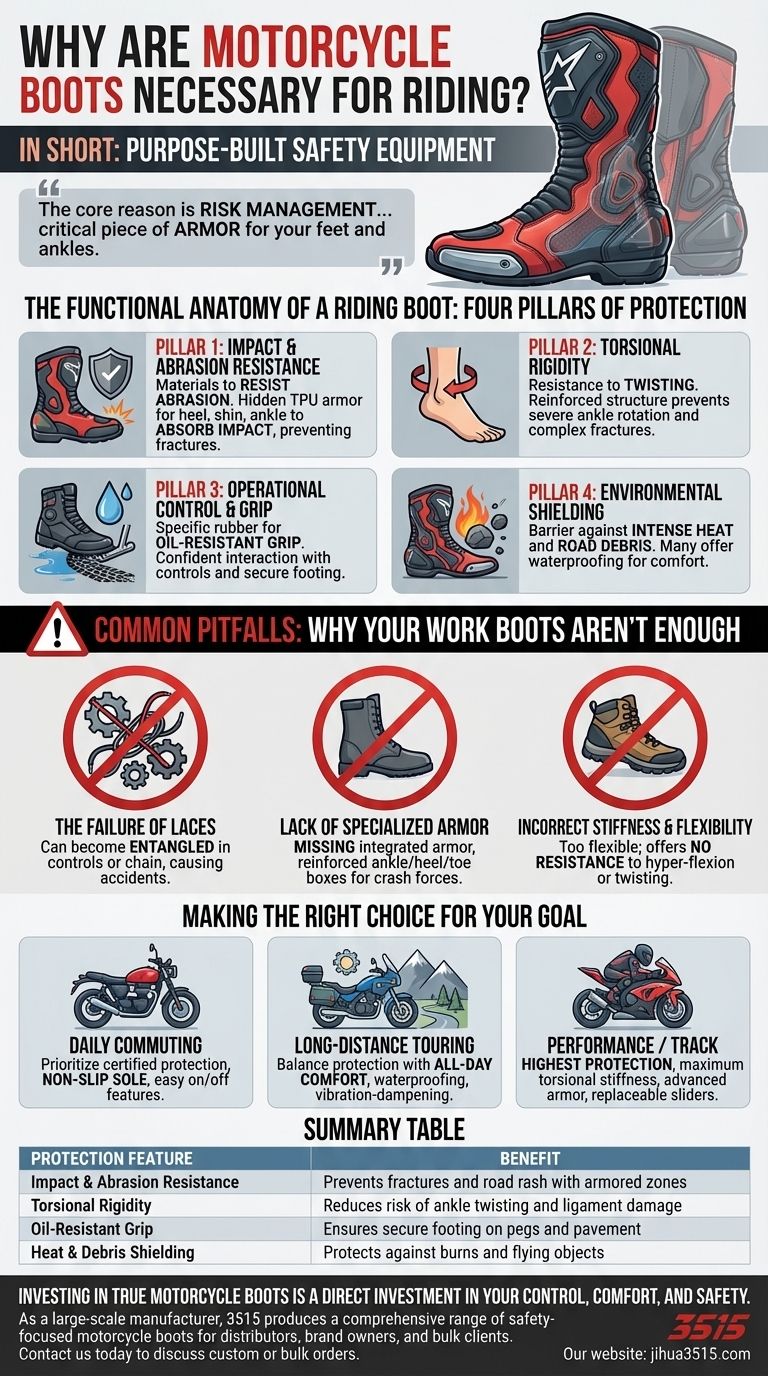
To understand their necessity, you must see a riding boot not as footwear, but as a piece of engineered equipment. Its value is built on four distinct pillars of protection that standard boots or shoes cannot offer.
Pillar 1: Impact and Abrasion Resistance
In any fall, your feet will likely make high-speed contact with the pavement. Motorcycle boots are constructed from materials like thick leather or advanced textiles specifically chosen for their ability to resist abrasion.
They also incorporate hidden armor, often made of thermoplastic polyurethane (TPU), over the heel, shin, and ankle bones. This reinforcement is designed to absorb and distribute impact forces, preventing fractures.
Pillar 2: Torsional Rigidity
One of the most critical and least understood functions of a riding boot is providing torsional rigidity. This is the boot's resistance to twisting.
During a crash, your foot can be trapped or twisted by the weight of the motorcycle. A proper boot is built with a reinforced structure to prevent your ankle from bending or rotating in ways that cause severe ligament damage or complex fractures.
Pillar 3: Operational Control and Grip
Safe riding requires precise control. Motorcycle boot soles are made from specific rubber compounds that are oil-resistant and provide exceptional grip on asphalt, even at a wet or oily intersection.
This ensures a secure footing when you stop and allows for confident interaction with the footpegs, shifter, and rear brake without the risk of your foot slipping.
Pillar 4: Environmental Shielding
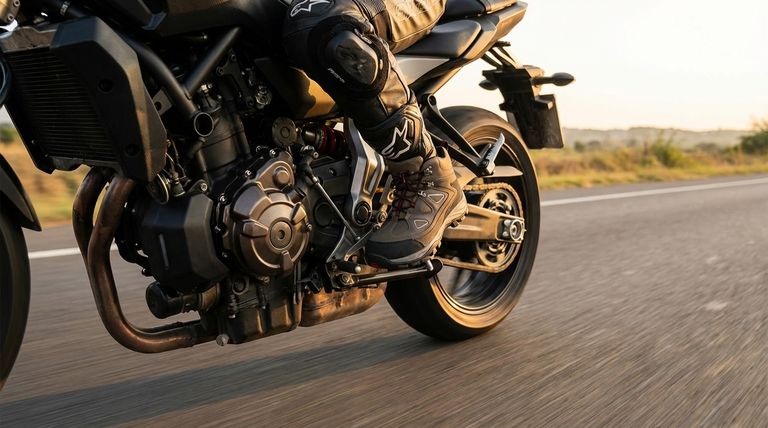
Riding exposes your feet to a unique set of hazards. Boots provide a crucial barrier against intense heat radiating from the engine and exhaust pipes, which can cause serious burns.
They also protect you from road debris, such as rocks and small objects kicked up by other vehicles, that can strike with enough force to cause injury. Many boots also offer waterproofing for comfort in adverse weather.
Common Pitfalls: Why Your Work Boots Aren't Enough
A frequent mistake is assuming that any sturdy, over-the-ankle boot, like a work or hiking boot, is a sufficient substitute. This is a dangerous misconception.
The Failure of Laces
Most work and hiking boots use long laces. In a riding scenario, these can easily become entangled in the foot controls or chain, creating a direct risk of causing an accident.
Lack of Specialized Armor
While they may feel tough, work boots lack the integrated armor and reinforced ankle, heel, and toe boxes necessary to withstand the specific impact forces of a motorcycle crash.
Incorrect Stiffness and Flexibility
Hiking boots are designed to be flexible for walking. This flexibility becomes a liability on a motorcycle, as it offers no resistance to the hyper-flexion or twisting that breaks ankles in an accident. They simply are not built for the right kind of stress.
Making the Right Choice for Your Goal
Selecting the right boot depends entirely on your primary type of riding.
- If your primary focus is daily commuting: Prioritize certified protection that covers the ankle, a non-slip sole, and features that make them easy to put on and take off.
- If your primary focus is long-distance touring: Look for a balance of robust protection with features that enhance all-day comfort, such as waterproofing and vibration-dampening soles.
- If your primary focus is performance or track riding: You need the highest level of protection available, with maximum torsional stiffness, advanced armor, and replaceable sliders.
Ultimately, investing in true motorcycle boots is a direct investment in your control, your comfort, and your ability to walk away from an otherwise debilitating incident.
Summary Table:
| Protection Feature | Benefit |
|---|---|
| Impact & Abrasion Resistance | Prevents fractures and road rash with armored zones |
| Torsional Rigidity | Reduces risk of ankle twisting and ligament damage |
| Oil-Resistant Grip | Ensures secure footing on pegs and pavement |
| Heat & Debris Shielding | Protects against burns and flying objects |
As a large-scale manufacturer, 3515 produces a comprehensive range of safety-focused motorcycle boots for distributors, brand owners, and bulk clients. Our advanced production capabilities ensure boots with superior abrasion resistance, torsional support, and grip—tailored to commuter, touring, or performance riding needs. Contact us today to discuss custom or bulk orders designed to protect riders worldwide.
Visual Guide
Related Products
- High Performance Fire-Retardant Waterproof Safety Boots
- Premium High-Cut Waterproof Safety Boots Manufacturing & Wholesale Solutions
- Wholesale Tactical Boots High-Traction & Reflective for Bulk & Brand Orders
- Durable Goodyear Welt Leather Work Boots for Wholesale & Private Label
- Wholesale High-Traction Camo Boots - Custom Manufacturer for Brands
People Also Ask
- Why are waterproof safety boots recommended for certain work environments? Essential Protection for Wet & Hazardous Jobs
- What roles do 3D vision systems and industrial robots play in the manufacturing of fire safety boots? Smart Automation
- What is the difference between waterproof and water-resistant boots? Choose the Right Footwear for Any Condition
- What are the drawbacks of waterproof boots? The Breathability vs. Protection Trade-Off
- How can you ensure your feet stay dry during winter walks? A Two-Part Defense System for Total Comfort