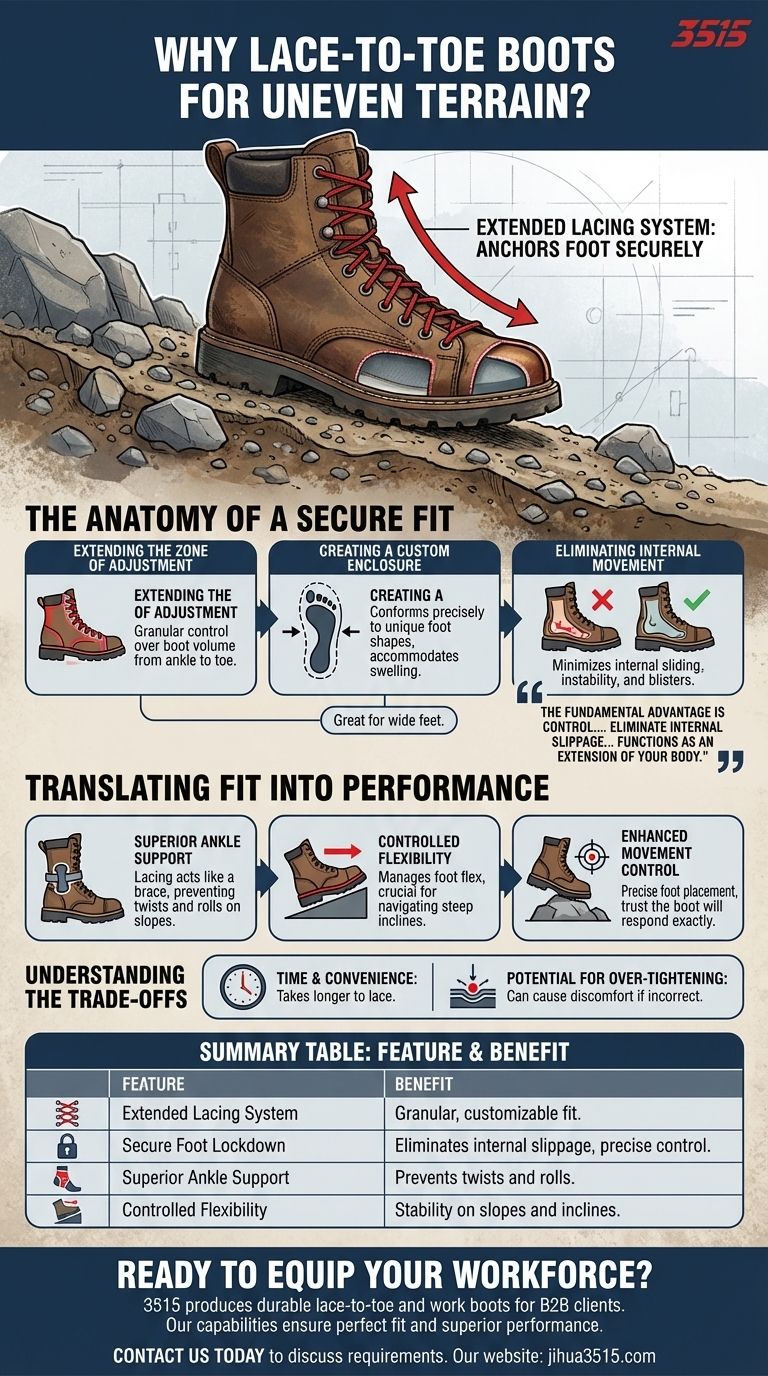
At its core, a lace-to-toe boot is recommended for uneven terrain because its extended lacing system provides a superior, highly customizable fit. This design anchors your entire foot securely within the boot, which translates directly into enhanced stability, better movement control, and robust ankle support on unpredictable surfaces.
The fundamental advantage of the lace-to-toe design is control. By allowing you to adjust the fit all the way down to the ball of your foot, you eliminate internal slippage and create a secure enclosure that functions as an extension of your body.

The Anatomy of a Secure Fit
The defining feature of a lace-to-toe boot is how far the laces extend down the front, or "vamp," of the boot, often stopping just short of the toe box. This seemingly simple design choice has significant functional implications.
Extending the Zone of Adjustment
Unlike standard boots where the lacing stops higher up near the ankle, the lace-to-toe system provides a much larger area for adjustment. This gives you granular control over the boot's volume from the ankle down to the forefoot.
Creating a Custom Enclosure
This extended adjustability allows the boot to conform precisely to the unique shape of your foot. It's especially beneficial for individuals whose feet don't fit standard boot dimensions.
For example, you can maintain a tight, secure fit around the ankle while allowing more room in the toe box for wider feet. This also accommodates for natural foot swelling that occurs during a long workday.
Eliminating Internal Movement
The primary goal of a good fit is to minimize your foot sliding inside the boot. On uneven ground, this internal movement is a direct cause of instability, blisters, and loss of control. A lace-to-toe boot locks your foot in place, ensuring the boot and your foot move as a single, stable unit.
Translating Fit into Performance
A secure fit is the foundation, but its true value is realized in how it enhances performance and safety on challenging worksites.
Superior Ankle Support
A boot that is properly secured all the way down the foot provides exceptional ankle support. When combined with a taller boot shaft (6 to 8 inches or more), the lacing system acts like a brace, helping to prevent the twists and rolls common on rocky or sloped ground.
Controlled Flexibility
The lacing across the top of the foot helps manage how much your foot can bend. It prevents excessive and uncontrolled flexing of the toes and forefoot, which is crucial when navigating steep inclines or declines. This provides stability without making the boot feel rigid or unnatural.
Enhanced Movement Control
When your foot is locked in, your ankle is supported, and your flex is controlled, the result is more precise foot placement. You can trust that the boot will respond exactly as you intend, giving you the confidence to move safely and efficiently across any terrain.
Understanding the Trade-offs
While highly effective, the lace-to-toe design is a specific solution for a specific problem. It's important to recognize its practical trade-offs.
Time and Convenience
Lacing and unlacing a boot with an extended system naturally takes more time and effort than a standard boot or a slip-on design. For workers who frequently take their boots on and off, this can be a daily inconvenience.
Potential for Over-Tightening
The high degree of adjustability can also be a downside. It is possible to lace the boots too tightly across the forefoot, which can lead to discomfort, pressure points, or restricted circulation if not adjusted correctly.
Not a Universal Solution
For individuals working primarily on flat, predictable surfaces like concrete floors or warehouse settings, the advanced stability of a lace-to-toe boot may be unnecessary. A simpler, more comfortable design might be a better choice in those environments.
Making the Right Choice for Your Work
To decide if a lace-to-toe boot is right for you, consider your primary daily challenge.
- If your primary focus is maximum stability on varied terrain: The lace-to-toe design provides unparalleled control and ankle support for jobs on uneven ground, slopes, or loose surfaces.
- If your primary focus is achieving a perfect fit: The granular adjustability is the best solution for accommodating wide feet, high arches, or feet that swell throughout the day.
- If your primary focus is convenience for work on flat surfaces: A standard lace-up or pull-on boot is likely a more practical choice, as the benefits of the lace-to-toe system will be less impactful.
Choosing a lace-to-toe boot is an investment in stability and a precise fit for the most demanding environments.
Summary Table:
| Feature | Benefit for Uneven Terrain |
|---|---|
| Extended Lacing System | Provides a granular, customizable fit from ankle to toe. |
| Secure Foot Lockdown | Eliminates internal slippage for precise movement control. |
| Superior Ankle Support | Acts like a brace to prevent twists and rolls. |
| Controlled Flexibility | Manages foot bend for stability on slopes and inclines. |
Ready to equip your workforce with boots built for stability?
As a large-scale manufacturer, 3515 produces a comprehensive range of durable lace-to-toe and other work boots for distributors, brand owners, and bulk clients. Our production capabilities ensure the perfect fit and superior performance your teams need for demanding environments.
Contact us today to discuss your specific requirements and discover how we can support your business.
Visual Guide
Related Products
- Durable Goodyear Welt Leather Work Boots for Wholesale & Private Label
- Durable Leather Moc Toe Work Boots for Wholesale & Custom Manufacturing
- Durable Moc-Toe Wedge Work Boots | Wholesale Manufacturing for Brands
- Premium Wholesale Wheat Nubuck Safety Boot with Rapid Lacing System
- Wholesale Durable Safety Boots Manufacturer Customizable Steel Toe Work Boots
People Also Ask
- What is the difference between full-grain and top-grain leather? Premium Material Guide for Boot Manufacturers
- What are the advantages of leather as an upper material for work boots? Unmatched Durability & Custom Comfort
- Why is it important to waterproof leather work boots? Protect Your Investment and Performance
- How should new leather work boots be broken in? A Guide to Comfort and Durability
- What are the advantages of leather uppers in work boots? Unmatched Durability & Protection