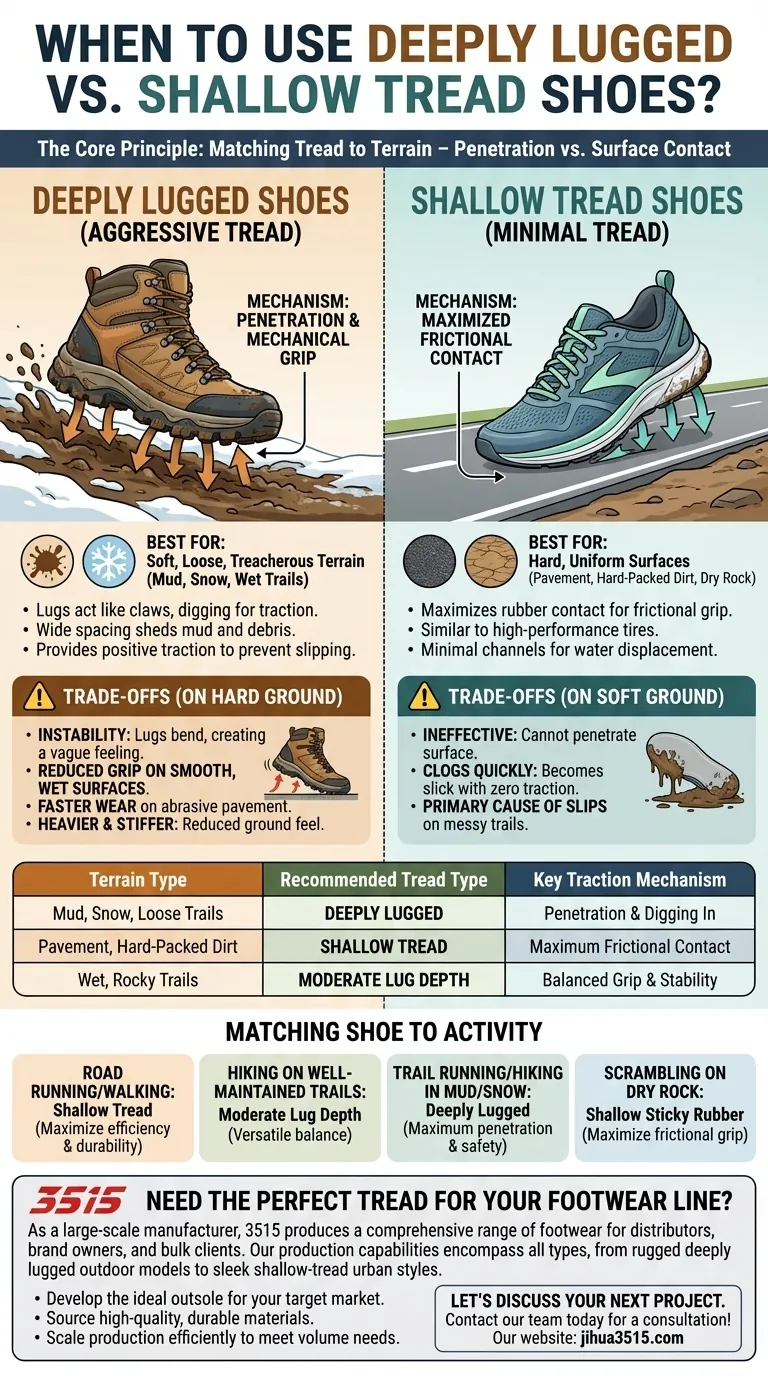
In the simplest terms, you should use deeply lugged shoes for soft, loose, or treacherous terrain like mud, snow, and wet trails. Their aggressive tread is designed to bite into the ground for grip. Conversely, shallow tread shoes are best for hard, uniform surfaces like pavement or dry, hard-packed dirt where maximizing surface contact is more important.
The core principle is not about which tread is "better," but which is correctly matched to the terrain. Deep lugs provide grip by penetrating soft surfaces, while shallow treads provide grip by maximizing frictional contact with hard surfaces.
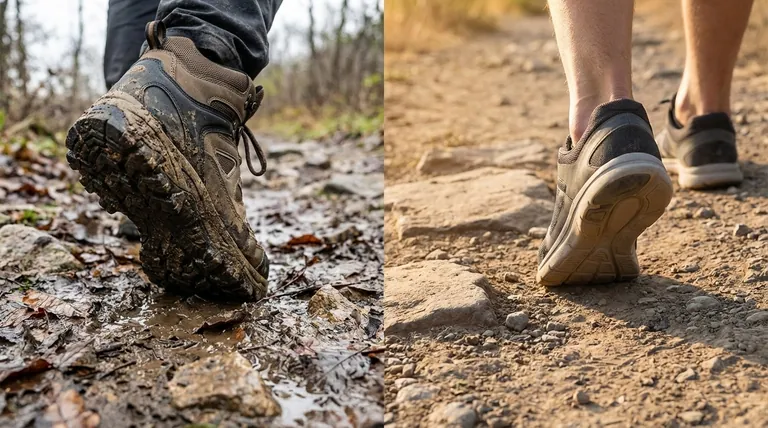
The Principle: Penetration vs. Surface Contact
To make the right choice, you must understand the two different ways a shoe's outsole can generate traction. These two mechanisms are fundamentally opposed.
How Deep Lugs Generate Traction
Deep, widely spaced lugs act like claws. They are designed to dig into soft, deformable surfaces such as mud, snow, or loose gravel.
This "mechanical grip" comes from the lugs physically hooking into the ground, providing positive traction to prevent you from slipping. The wide spacing helps shed mud and debris so the lugs can continue to do their job.
How Shallow Treads Generate Traction
Shallow, closely-packed treads work on the principle of friction. They are designed to maximize the amount of rubber in contact with a firm, predictable surface.
Think of them like the slick tires on a race car. On pavement, hard-packed dirt, or smooth rock, more surface contact equals more frictional grip. The minimal channels are primarily for displacing small amounts of water.
The Vehicle Tire Analogy
An easy way to visualize this is to compare a mud-terrain truck tire with a high-performance summer tire for a sports car. The truck tire has massive, deep lugs to bite through mud, while the sports car tire has a wide, flat profile to stick to the pavement. You wouldn't use one for the other's job.
Understanding the Trade-offs
Choosing the wrong type of tread for the terrain is not just inefficient—it can be unstable and unsafe. Each design comes with a clear set of compromises.
The Downside of Deep Lugs on Hard Ground
Using a deeply lugged shoe on pavement or hard rock introduces instability. The tall lugs can bend or "squirm" under pressure, creating a vague and disconnected feeling.
Furthermore, the reduced surface area can actually decrease grip on smooth, wet surfaces like rock slabs. The aggressive rubber also wears down extremely quickly on abrasive pavement.
The Failure of Shallow Treads on Soft Ground
A shallow tread is entirely ineffective on soft ground. It cannot penetrate the surface to find purchase.
Mud, snow, or wet dirt will quickly pack into the shallow channels, creating a perfectly smooth, slick outsole with virtually zero traction. This is a primary cause of slips and falls on messy trails.
Weight and Ground Feel
Deeper, more aggressive lugs require more rubber. This generally makes the shoe heavier and stiffer, reducing your tactile sense of the ground beneath your feet. Lighter, shallower treads often provide more flexibility and a better "ground feel."
Matching Your Shoe to Your Primary Activity
Your decision should be based on where you spend the majority of your time. Assess your most common terrain honestly to select the right tool for the job.
- If your primary focus is road running or walking: Choose a shoe with a minimal, shallow tread to maximize surface contact, durability, and efficiency on pavement.
- If your primary focus is hiking on well-maintained, hard-packed trails: A moderate lug depth offers a versatile balance of grip for loose sections and stability for firm ground.
- If your primary focus is trail running or hiking in wet, muddy, or snowy conditions: Select a shoe with aggressive, deep lugs to ensure maximum penetration and safety on treacherous ground.
- If your primary focus is scrambling on dry rock: Look for a shallower tread made of a specialized "sticky" rubber compound to maximize frictional grip on the rock's surface.
Choosing the right tread is the foundational step to ensuring confident and safe footing on any terrain.
Summary Table:
| Terrain Type | Recommended Tread Type | Key Traction Mechanism |
|---|---|---|
| Mud, Snow, Loose Trails | Deeply Lugged | Penetration & Digging In |
| Pavement, Hard-Packed Dirt | Shallow Tread | Maximum Frictional Contact |
| Wet, Rocky Trails | Moderate Lug Depth | Balanced Grip & Stability |
Need the Perfect Tread for Your Footwear Line?
As a large-scale manufacturer, 3515 produces a comprehensive range of footwear for distributors, brand owners, and bulk clients. Our production capabilities encompass all types of shoes and boots, from rugged, deeply lugged outdoor models to sleek, shallow-tread urban styles.
We can help you:
- Develop the ideal outsole for your target market and terrain.
- Source high-quality, durable materials for superior performance.
- Scale production efficiently to meet your volume needs.
Let's discuss your next project. Contact our team today for a consultation!
Visual Guide
Related Products
- Wholesale Breathable Perforated Leather Derby Shoes with Modern Comfort Sole
- Wholesale Modern Perforated Leather Derby Shoes with Chunky Sole for Custom Branding
- Custom Breathable Perforated Leather Derby Shoes for Wholesale & Brands
- Durable Rubber Sole Outdoor Shoes Wholesale & Custom Manufacturing
- Wholesale Perforated Comfort Dress Shoes | Custom Derby Shoe Manufacturer
People Also Ask
- What are the features and appropriate occasions for wearing derby shoes? A Guide to Versatile Style
- What is the main difference between Derby Shoes and Oxford Shoes? It's All in the Lacing.
- How do Derby shoes fit into business casual attire? Master the Perfect Balance of Professional Style
- What historical figure is associated with the Derby shoe? The Earl of Derby's Comfort Revolution
- What is the difference between Derby and Oxford shoes? A Guide to Choosing the Right Shoe