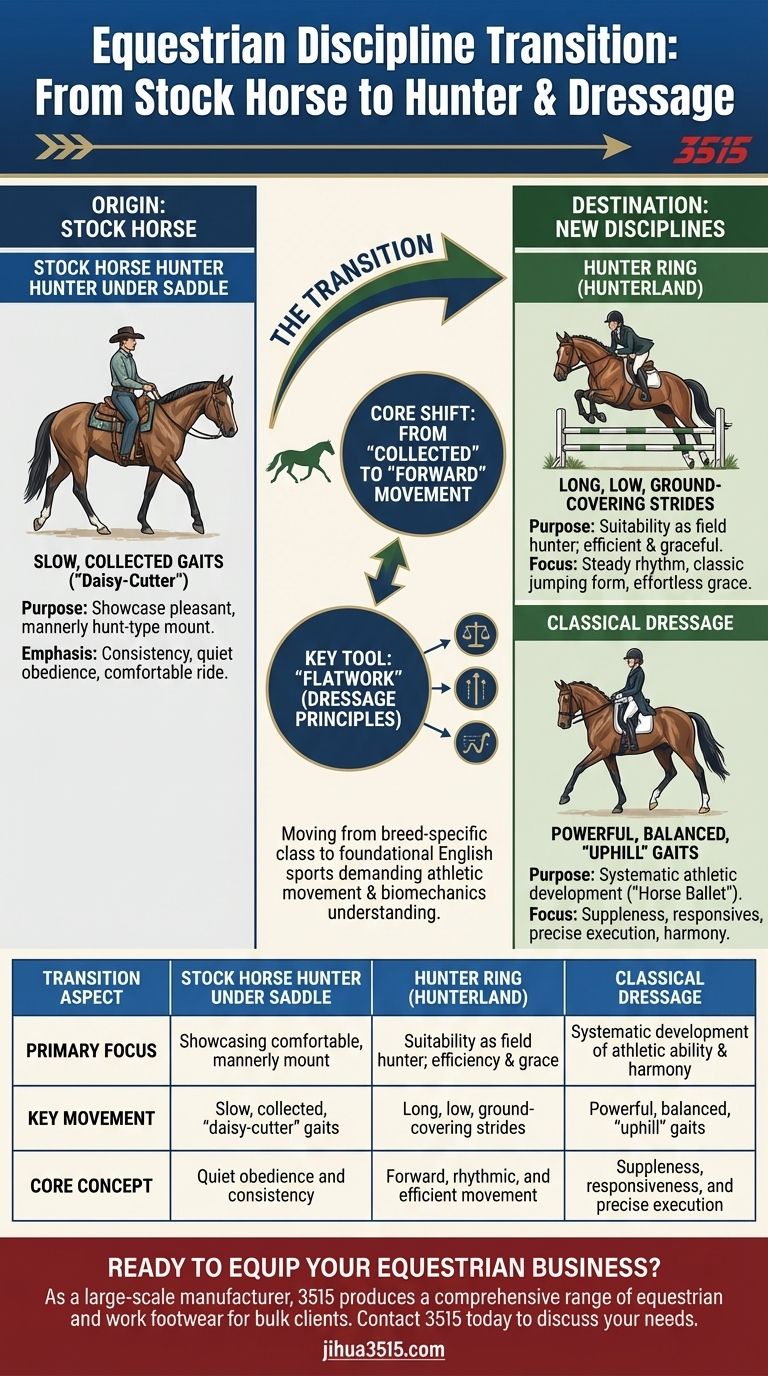
Based on the information provided, the rider is transitioning from the world of stock horse hunter under saddle into two distinct English disciplines: the hunter ring (often called "hunterland") and classical dressage. This represents a significant shift from a breed-specific class to two of the most foundational and widely practiced English riding sports.
The core of this transition is a move from a discipline that values a slow, comfortable gait on a specific type of horse to two disciplines that demand more forward, athletic movement and a deep understanding of biomechanics and training principles.
Deconstructing the Rider's Background: Stock Horse Hunter Under Saddle
The Purpose of the Class
Stock horse hunter under saddle is a specific class found at breed shows for stock horses like the American Quarter Horse (AQHA) or American Paint Horse (APHA). It is designed to showcase the horse's potential to be a pleasant and mannerly hunt-type mount.
Key Characteristics
The ideal in this class is a horse that moves with very quiet, smooth, and collected gaits. The trot is often a slow, flat-kneed movement sometimes called a "daisy-cutter." The emphasis is on consistency, obedience, and creating the picture of an exceptionally comfortable ride.
The New Disciplines: Hunters and Dressage
The World of "Hunterland"
The hunter discipline (or "hunterland") evaluates a horse on its suitability to be a field hunter. This means the horse must exhibit a safe, comfortable, and efficient style both on the flat and over fences.
Judges look for long, low, ground-covering strides that would be efficient for crossing large fields. Over fences, the horse should maintain a steady rhythm and display a classic, quiet jumping form. The overall impression should be one of effortless grace.
The Foundation of Dressage
Dressage is a French term meaning "training" and is often described as "horse ballet." It is the systematic development of the horse's natural athletic ability and its willingness to perform in harmony with its rider.
This discipline is non-jumping and is judged on the precise execution of a series of prescribed movements in a rectangular arena. The goal is to develop a horse that is supple, balanced, and responsive, moving with power and elegance from its hindquarters into the rider's hand.
Understanding the Key Transitions and Challenges
From "Collected" to "Forward"
The most significant change for the rider and horse will be the concept of forward movement. Stock horse hunter under saddle prioritizes a slower, more contained pace. Both hunters and dressage require the horse to move actively forward from the rider's leg into a steady contact with the bit.
The Role of "Flatwork"
In the hunter world, the work done on the flat (not jumping) is often referred to as flatwork. This is where dressage becomes an invaluable tool. The principles of dressage—balance, straightness, rhythm, and responsiveness—are precisely what create a more "rideable" and adjustable hunter over fences.
Different Ideals in Movement
While both new disciplines value more energy than the rider's previous class, their ideal expressions differ. The hunter seeks an efficient, ground-covering stride. Dressage, especially at the higher levels, develops more "uphill" balance and expressive, powerful gaits that are not always the goal in the hunter ring.
Making the Right Choice for Your Goal
This transition into two synergistic disciplines provides a fantastic education for both horse and rider. The key is to understand how they complement each other.
- If the primary focus is excelling in the hunter ring: Use dressage as the foundational tool to improve the horse's balance, adjustability, and straightness, which will directly translate to better jumping rounds.
- If the primary focus is advancing in dressage: View the hunter work as an excellent way to keep the horse's mind fresh and develop its confidence in a different environment.
- If the goal is to be a versatile equestrian: Embrace both disciplines equally, recognizing that success lies in understanding the subtle but critical differences required in the horse's frame and way of going for each.
By pursuing both hunters and dressage, the rider is building a truly versatile and well-trained equine partner.
Summary Table:
| Transition Aspect | Stock Horse Hunter Under Saddle | Hunter Ring (Hunterland) | Classical Dressage |
|---|---|---|---|
| Primary Focus | Showcasing a comfortable, mannerly mount | Suitability as a field hunter; efficiency & grace | Systematic development of athletic ability & harmony |
| Key Movement | Slow, collected, "daisy-cutter" gaits | Long, low, ground-covering strides | Powerful, balanced, "uphill" gaits |
| Core Concept | Quiet obedience and consistency | Forward, rhythmic, and efficient movement | Suppleness, responsiveness, and precise execution |
Ready to Equip Your Equestrian Business?
As a large-scale manufacturer, 3515 produces a comprehensive range of equestrian and work footwear for distributors, brand owners, and bulk clients. Whether your customers need durable paddock boots for training or specialized riding boots for competition, our production capabilities cover all types of boots to support every discipline.
Contact 3515 today to discuss your bulk footwear needs and leverage our manufacturing expertise.
Visual Guide