
Choosing the right shoelace length is a simple process that relies on three primary methods: measuring your existing laces, counting the number of eyelet pairs on your shoe, or selecting a length based on the shoe's general style. While all three can work, they offer different levels of accuracy.
While counting eyelets is the most common method, measuring your old laces is the only guaranteed way to get a perfect replacement. Choosing a length based on shoe type should only be used as a last-resort estimate.
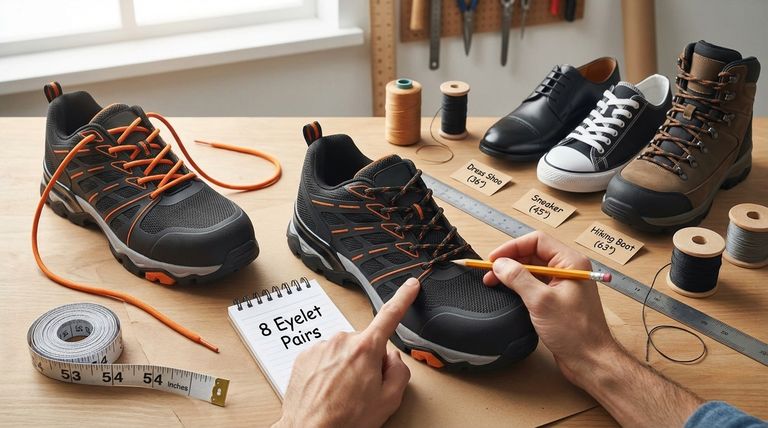
Method 1: Measure Your Existing Laces (The Gold Standard)
This approach is the most straightforward and accurate way to find a replacement lace. It eliminates all guesswork by using the original lace, which was specifically chosen by the manufacturer for that shoe's design and your lacing style.
Why This is the Most Accurate Method
A direct measurement accounts for unique variables like the specific distance between eyelets, the width of the shoe, and the amount of lace you prefer for your bow.
How to Measure Correctly
Simply remove one of the old laces from your shoe. Pull it straight to remove any kinks and measure it from tip to tip with a measuring tape or ruler.
When This Method Isn't an Option
The obvious limitation is when your original laces are missing or have snapped into multiple pieces, making a direct measurement impossible.
Method 2: Count the Eyelet Pairs (The Practical Alternative)
When you can't measure the old lace, counting the number of eyelet pairs is the most reliable estimation method. An "eyelet pair" is the set of two eyelets (left and right) at the same level on your shoe.
The Principle Behind Eyelet Counting
This method works because there is a strong correlation between the number of eyelets and the length of lace required to thread them. It's a standardized system used by most lace manufacturers.
Standard Sizing Chart
Use this chart as a highly reliable starting point.
- 2-3 Eyelet Pairs: ~27 inches / 69 cm
- 4-5 Eyelet Pairs: ~36 inches / 91 cm
- 5-6 Eyelet Pairs: ~45 inches / 114 cm
- 7-8 Eyelet Pairs: ~54 inches / 137 cm
- 8-9 Eyelet Pairs: ~63 inches / 160 cm
- 9-10+ Eyelet Pairs: ~72 inches / 183 cm
The Caveat: Eyelet Spacing
This method assumes standard eyelet spacing. Boots with very wide-set eyelets may require a slightly longer lace than a dress shoe with the same number of eyelets.
Method 3: Choose by Shoe Type (The Quick Estimate)
This is the least precise method and should be used when you cannot measure your old laces or count the eyelets. It relies on broad generalizations about common shoe styles.
A General Guideline
Use this method for a rough idea when you are shopping and don't have your shoes with you.
Common Examples
- Dress Shoes (Oxfords, Derbies): Typically 4-5 eyelet pairs, requiring 36-inch laces.
- Ankle Boots (Chukkas, Desert Boots): Often 5-6 eyelet pairs, needing 45-inch laces.
- Standard Sneakers & Trainers: Usually 6-8 eyelet pairs, best suited for 45- to 54-inch laces.
- High-Tops & Hiking Boots: Can have 8+ eyelet pairs, often requiring 63- to 72-inch laces.
Understanding the Trade-offs
Selecting the right method involves balancing precision with convenience.
Accuracy vs. Convenience
Measuring is the most accurate but requires you to have the original lace. Counting eyelets is extremely convenient and nearly as accurate. Choosing by shoe type is convenient but offers the lowest accuracy.
The Impact of Lacing Style
Your personal lacing technique matters. A "bar" or "straight" lacing style uses slightly less lace than a traditional "criss-cross" pattern. If you prefer very large bows, consider going one size up from the chart's recommendation.
Making the Right Choice for Your Goal
Use your situation to determine the best approach.
- If your primary focus is a perfect replacement: Always measure your old laces. It removes all guesswork.
- If you don't have the old laces: Count the eyelet pairs and use the standard sizing chart as your most reliable guide.
- If you need a longer lace for custom tying: Count the eyelets and deliberately choose the next size up from the recommendation.
- If you are shopping without your shoes: Use the shoe type method for a rough estimate, but be aware it's the least precise option.
By understanding these three methods and their trade-offs, you can confidently select the perfect shoelace length every time.
Summary Table:
| Method | Best For | Accuracy | Key Insight |
|---|---|---|---|
| Measure Old Laces | Perfect replacements | Highest | Guarantees exact fit; accounts for unique shoe design |
| Count Eyelet Pairs | When old laces are missing | High | Use the standard sizing chart for reliable results |
| Choose by Shoe Type | Quick estimates | Lowest | A last-resort option based on general style guidelines |
Need the perfect shoelaces in bulk?
As a large-scale manufacturer, 3515 produces a comprehensive range of high-quality shoelaces and footwear for distributors, brand owners, and bulk clients. Our production capabilities ensure you get the exact length, material, and style you need for any shoe or boot.
Contact us today for a quote and let us provide the reliable supply chain solution your business needs.
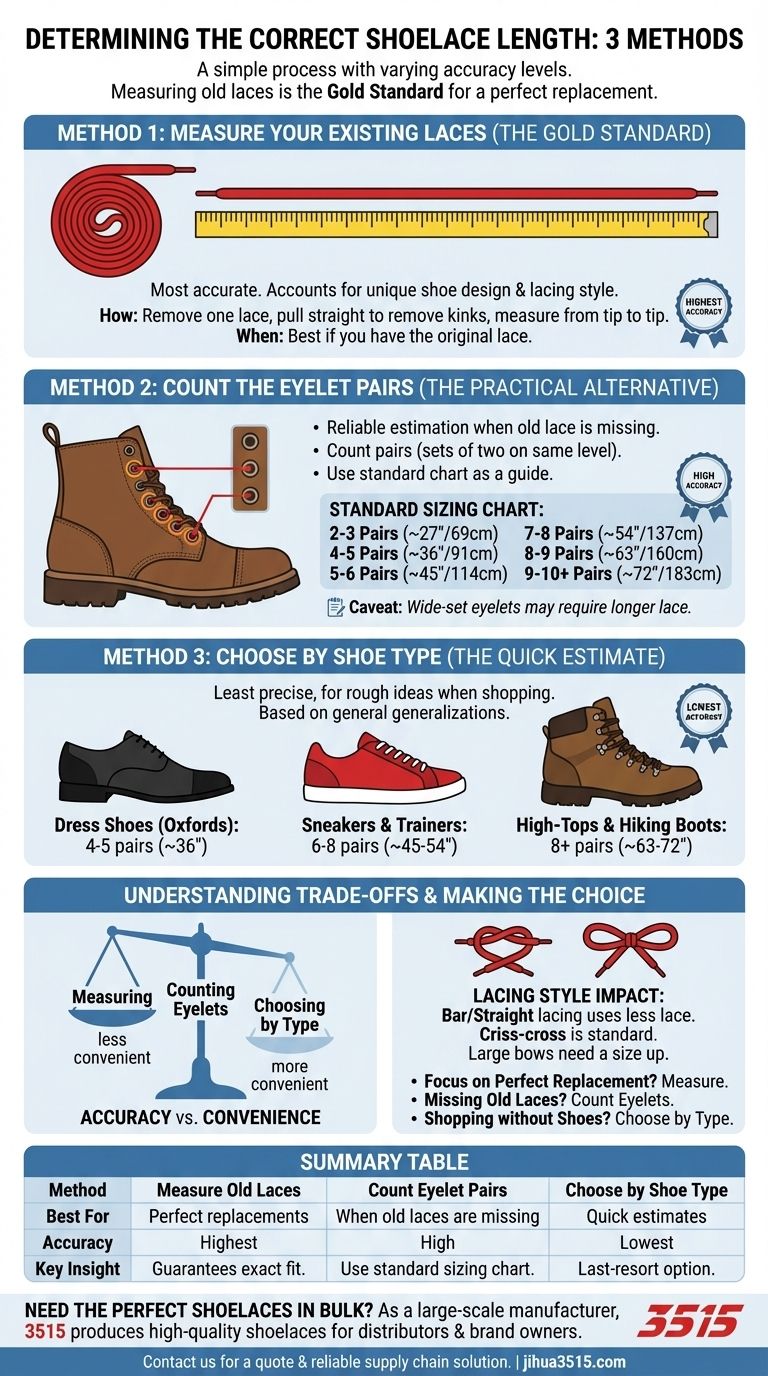
Visual Guide
Related Products
- Premium Wholesale Tactical Style Safety Shoes Boots with Quick Lacing
- Wholesale Classic Leather Lace-Up Ankle Boots for Brand Manufacturing
- Wholesale Training Shoes with Dial Lacing System Custom OEM Manufacturing
- Wholesale Lightweight Tactical Boots with Dial Closure OEM & Bulk Orders
People Also Ask
- How are gait analysis research findings applied to the functional design of safety shoes and tactical boots?
- How do quality certification standards for safety shoes reduce perceived risk? Buy Online with Technical Certainty
- How does anthropomorphic design influence material selection? Enhance Footwear Performance through Biological Alignment
- Why is the synchronization of craftsmanship and UX development emphasized for bulk customization of safety shoes?
- How can specialized footwear mitigate safety risks? High-Volume OEM/ODM Solutions since 1951



