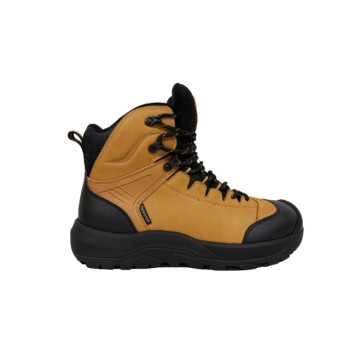
When choosing snow boots for wet snow, your primary considerations must be advanced waterproofing, appropriate insulation that doesn't cause overheating, and an outsole with deep, aggressive treads for traction on slushy, slippery surfaces. Unlike dry powder, wet snow’s main threat is moisture infiltration, which can quickly lead to cold and dangerous conditions for your feet.
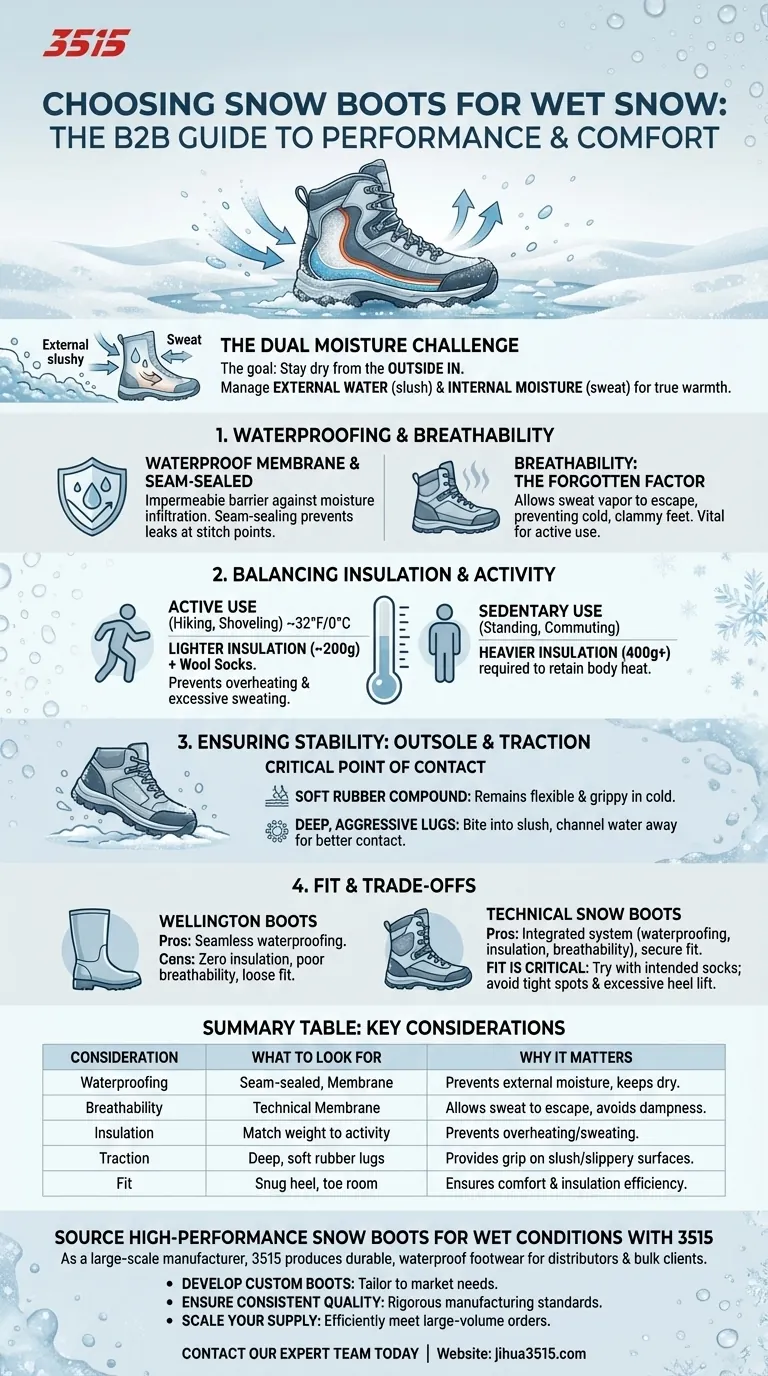
The central challenge with wet snow is managing two distinct types of moisture: external water from slush and internal moisture from sweat. The ideal boot creates an impenetrable barrier against the first while allowing the second to escape, ensuring your feet stay genuinely dry and therefore warm.
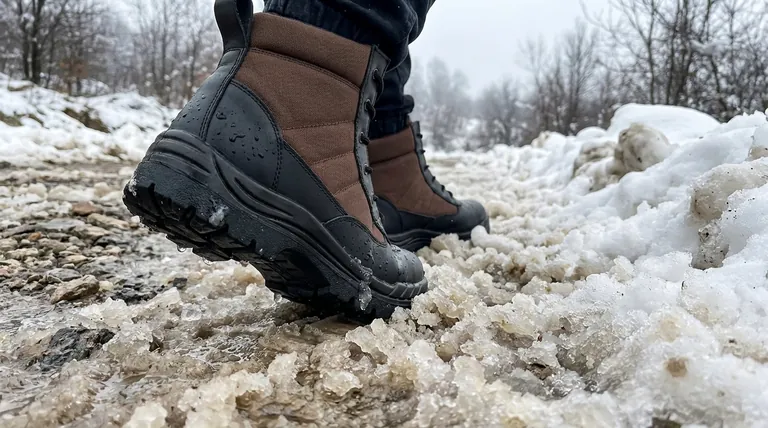
The Unique Challenge of Wet Snow
Wet snow, slush, and freezing rain present a fundamentally different problem than cold, dry powder. The goal is not just to stay warm, but to stay dry from the outside in.
The Primacy of Waterproofing
Water is a highly effective conductor of heat, pulling warmth away from your body 25 times faster than air. Once your socks and feet get wet, insulation becomes nearly useless.
Look for boots with a waterproof membrane, such as Gore-Tex or a similar proprietary technology. These are built into the boot's lining to block external water molecules from entering.
Equally important is seam-sealed construction. This means every stitch hole in the boot's upper has been sealed from the inside to prevent water from seeping through, a common failure point in lesser boots.
Breathability: The Forgotten Factor
A boot that is completely waterproof but not breathable (like a simple rubber wellington) traps sweat. This internal moisture will make your socks damp, eventually leading to the same cold, clammy feeling you were trying to avoid.
Technical waterproof membranes are designed to be breathable. Their pores are too small for liquid water droplets to pass through from the outside but large enough for water vapor (sweat) to escape from the inside.
Balancing Insulation and Activity Level
Keeping your feet warm is critical, but the type and amount of insulation must match your intended use to prevent overheating.
Why More Isn't Always Better
Insulation is often measured in grams (e.g., 200g, 400g of 3M Thinsulate). For active use like hiking or shoveling in wet snow—which often occurs near the freezing point (32°F / 0°C)—excessive insulation can cause your feet to sweat profusely.
As discussed, this sweat can get trapped, making you colder in the long run. A boot with a -40°F rating is often overkill for typical slushy conditions.
Matching Insulation to Your Use Case
For high-exertion activities, a lighter insulation package (around 200g) combined with a good wool sock is often sufficient.
For more sedentary activities, like commuting or standing outdoors for long periods, a heavier insulation package (400g or more) may be necessary to retain heat.
Ensuring Stability on Treacherous Surfaces
Wet snow and slush create unpredictable, slippery surfaces. The boot's outsole is your only point of contact and is critical for safety.
The Role of Outsole Material
Look for outsoles made from a soft rubber compound. These materials are engineered to stay flexible and grippy in cold temperatures, whereas cheaper plastics can become hard and slick.
Analyzing Tread and Lug Depth
Traction comes from the tread pattern. Seek out deep, widely-spaced lugs (the bumps on the sole). This design aggressively bites into slush and snow while also channeling water away to maintain contact with the ground.
Understanding the Trade-offs
No single boot is perfect for every situation. You must choose based on a realistic assessment of your needs.
Wellington Boots vs. Technical Snow Boots
Standard wellington or rubber boots offer excellent, seamless waterproofing. However, they typically provide zero insulation, poor breathability, and a loose fit that is unsuitable for walking long distances.
A technical snow boot is purpose-built to integrate waterproofing, insulation, breathability, and a secure, comfortable fit into one system.
The Critical Importance of Fit
Even the most technologically advanced boot will fail if it doesn't fit properly. A boot that is too tight creates cold spots by compressing insulation and restricting blood flow. A boot that is too loose can cause blisters and instability.
Always try on boots with the type of socks you intend to wear. Ensure you have enough room to wiggle your toes, but that your heel does not lift excessively when you walk.
Making the Right Choice for Your Goal
Select your boot based on its most likely application.
- If your primary focus is daily commuting on cleared, slushy sidewalks: Prioritize a fully waterproof boot with moderate insulation (200g) and a lower-profile, grippy sole.
- If your primary focus is hiking or working in deep, wet snow: Choose a taller boot with robust, seam-sealed waterproofing and an aggressive, deep-lugged outsole for maximum traction.
- If your primary focus is low-activity use like watching outdoor sports: Opt for maximum waterproofing combined with a higher insulation rating (400g+) to conserve heat while you are stationary.
Choosing the right boot is about understanding that in wet snow, dryness is the true foundation of warmth and comfort.
Summary Table:
| Key Consideration | What to Look For | Why It Matters |
|---|---|---|
| Waterproofing | Seam-sealed construction, waterproof membrane (e.g., Gore-Tex) | Prevents external moisture from entering, keeping feet dry and warm. |
| Breathability | Breathable, technical waterproof membrane | Allows sweat vapor to escape, preventing internal dampness. |
| Insulation | Match insulation weight (e.g., 200g vs. 400g) to your activity level | Prevents overheating and sweating during exertion. |
| Traction | Deep, widely-spaced lugs made of soft, flexible rubber | Provides grip and stability on slippery, slushy surfaces. |
| Fit | Snug heel, room for toes, tried on with intended socks | Ensures comfort, prevents blisters, and maintains insulation efficiency. |
Ready to Source High-Performance Snow Boots for Wet Conditions?
As a large-scale manufacturer, 3515 produces a comprehensive range of durable, waterproof footwear for distributors, brand owners, and bulk clients. Our production capabilities encompass all types of boots designed to meet the exacting demands of wet snow environments.
We can help you:
- Develop Custom Boots: Tailor waterproofing, insulation, and sole design to your specific market needs.
- Ensure Consistent Quality: Benefit from our rigorous manufacturing standards for reliable, high-performance products.
- Scale Your Supply: Meet large-volume orders efficiently with our extensive production capacity.
Contact our expert team today to discuss your requirements and discover how 3515 can be your trusted partner for high-quality, market-ready snow boots.
Visual Guide
Related Products
- Premium Insulated Safety Boots and Shoes for Wholesale & Bulk Orders
- Durable Waterproof Rain Boots | Custom Manufacturer for Wholesale & Brands
- Factory Direct Wholesale Rain Boots Durable Waterproof & Fully Customizable
- Wholesale Waterproof Tactical Boots Custom Suede & High-Traction Soles
- Wholesale Lightweight Tactical Boots Custom Manufacturer for Desert & Combat Use
People Also Ask
- What are the recommended insulation ratings for mild winter conditions? A Guide for Active & Stationary Workers
- How does insulation thickness correlate with temperature ranges? A Guide to Choosing the Right Warmth
- What insulation level is needed for severe cold and stationary work? 1200g or Higher is Essential
- What safety advantages do insulated boots offer beyond warmth? Dielectric Protection & Superior Grip
- How does fleece lining contribute to the warmth of insulated boots? Trapping Air for Superior Cold Protection