
When purchasing equestrian boots, the essential priorities are a precise fit, function tailored to your discipline, and quality materials. These three factors are not independent; they work together to ensure your safety, comfort, and ability to communicate effectively with your horse. The wrong boot can compromise your position, create painful distractions, and wear out prematurely.
The ideal equestrian boot is not defined by its brand or price, but by how perfectly it balances a secure, anatomical fit with the specific functional demands of your riding discipline. Get this balance right, and the boot becomes a natural extension of your leg.

Deconstructing the "Perfect Fit"
The term "fit" in tall boots goes far beyond your standard shoe size. It is a three-dimensional measurement that is critical for both performance and the longevity of the boot itself.
Beyond Your Shoe Size
Your footbed should be snug but not cramped. You need enough room to wiggle your toes slightly, but your heel should not slip or lift excessively as you walk. This ensures comfort and prevents blisters.
The Critical Calf and Height Measurements
This is where most riders get it wrong. The boot's calf must be skin-tight without cutting off circulation, often requiring a second person to help zip it up initially. The height should hit just behind the bend of your knee, as the boot will "drop" up to an inch as the ankle leather breaks in.
The "Break-In" Factor
New leather boots, especially high-quality ones, will be stiff and often uncomfortable at first. This is normal. The break-in period allows the leather to mold to the unique shape of your leg, resulting in a custom-like fit that provides stability and support.
Aligning Boot Function with Your Discipline
The type of riding you do dictates the specific features your boot needs. A boot designed for one discipline can be a significant disadvantage in another.
The Demands of Jumping and Eventing
Riders in these disciplines require significant ankle flexion to maintain a deep heel position over fences. Field boots are designed for this, featuring lacing at the ankle to provide this necessary flexibility.
The Rigidity of Dressage
Dressage requires a still, elongated leg to give subtle aids. Dress boots are much more rigid, particularly on the outside of the calf, to support this quiet leg position. They do not have laces at the ankle, presenting a more formal and streamlined look.
The Practicality of Paddock Boots
For daily schooling, barn chores, and general riding, a combination of paddock boots (ankle boots) and half chaps is the most practical and economical solution. This setup offers excellent comfort, support, and versatility.
Material Science: Leather vs. Synthetics
The material of your boot directly impacts its breathability, break-in period, durability, and maintenance requirements.
The Case for Traditional Leather
High-quality leather offers unparalleled durability, a custom-molded fit after breaking in, and superior breathability. It is the traditional choice for its performance and classic aesthetic in the show ring.
The Advantages of Modern Synthetics
Modern synthetic materials offer an excellent alternative. They require virtually no break-in period, are often waterproof and easier to clean, and come at a more accessible price point. Many high-end brands now use technical synthetic fabrics for enhanced comfort and athletic performance.
Understanding the Trade-offs
Choosing the right boot always involves balancing competing priorities. Understanding these trade-offs is key to making an informed decision.
Comfort vs. Protective Rigidity
A highly supportive, rigid dressage boot will offer less "walk-around" comfort than a flexible field boot or paddock boot. You must choose based on what you need most in the saddle, not on the ground.
Durability vs. Cost
While a premium, full-grain leather boot is a significant upfront investment, its durability and potential to be resoled can make it more economical over many years of use compared to less expensive boots that need frequent replacement.
Off-the-Rack vs. Custom
Off-the-rack boots offer a wide range of size combinations that fit most riders well. However, if you have a unique leg shape, investing in custom or semi-custom boots can be the only way to achieve a truly perfect fit, preventing the pain and rapid breakdown of an ill-fitting boot.
Making the Right Choice for Your Goal
Ultimately, your primary riding activity should guide your decision.
- If your primary focus is competitive showing (Jumping/Eventing): Prioritize traditional leather field boots with a snug calf fit and ankle flexibility for proper heel position over fences.
- If your primary focus is competitive Dressage: Seek a stiff, formal dress boot that promotes a still and elongated leg, ensuring a polished look and effective communication.
- If your primary focus is daily training and versatility: A quality pair of paddock boots and well-fitting half chaps offers the best balance of comfort, function, and long-term value.
- If your primary focus is budget and low maintenance: Modern synthetic tall boots provide excellent performance and easy care without the lengthy break-in period of traditional leather.
A well-chosen boot is a fundamental tool that enhances your connection with your horse and your confidence in the saddle.
Summary Table:
| Priority | Key Consideration | Why It Matters |
|---|---|---|
| Fit | Snug footbed, tight calf, correct height | Ensures stability, prevents blisters, and allows proper communication with the horse. |
| Function | Matches your discipline (e.g., Field boot for jumping, Dress boot for dressage) | Provides the necessary ankle support or flexibility for optimal performance and safety. |
| Material | Leather (durable, molds to leg) vs. Synthetic (easy care, quick break-in) | Impacts breathability, break-in period, durability, and long-term cost of ownership. |
Ready to Find Your Perfect Equestrian Boot?
As a large-scale manufacturer, 3515 produces a comprehensive range of high-quality equestrian footwear for distributors, brand owners, and bulk clients. Whether you need durable leather field boots for jumping, rigid dress boots for the show ring, or versatile paddock boots, our production capabilities cover all types of equestrian footwear.
Partner with us to:
- Access a wide variety of styles tailored to every discipline.
- Benefit from consistent quality and competitive pricing thanks to our large-scale manufacturing.
- Get reliable supply for your business needs.
Contact our team today to discuss your equestrian footwear requirements and discover how we can support your business.
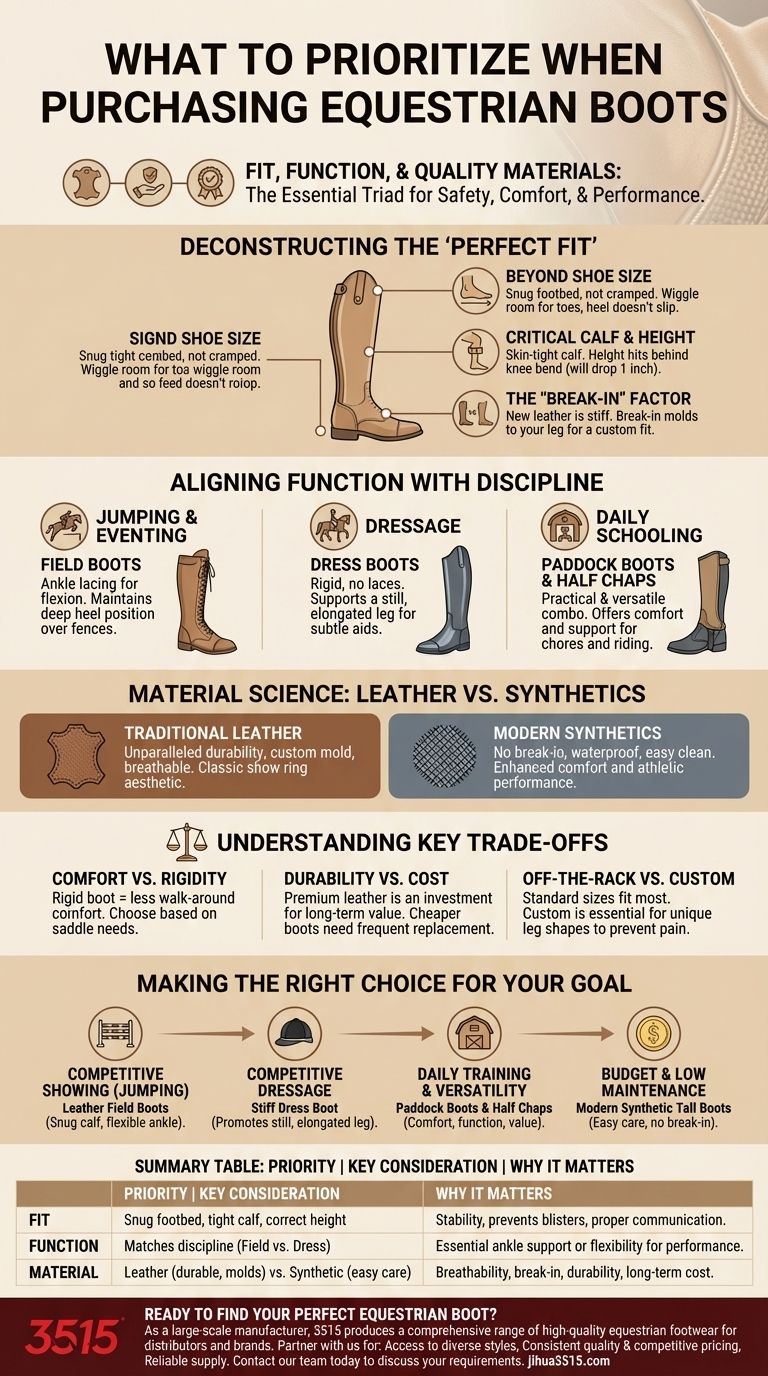
Visual Guide
Related Products
- Wholesale Lightweight Tactical Boots Custom Manufacturer for Desert & Combat Use
- Wholesale Tactical Boots High-Traction & Reflective for Bulk & Brand Orders
- Wholesale High-Traction Camo Boots - Custom Manufacturer for Brands
- Durable Leather High-Ankle Tactical Boots for Wholesale & Custom Manufacturing
- High-Traction Suede Tactical Boots Wholesale & Custom Manufacturing
People Also Ask
- What are the common types of combat boots? Find the Right Boot for Your Mission
- What specialized protections do tactical boots offer? Maximize Endurance with High-Performance Footwear
- What are the main construction similarities between tactical boots and tactical sneakers? Built for Performance & Durability
- What is the role of high-frequency acquisition hardware in technical skill analysis for outdoor and tactical boots?
- What are the different types of tactical boots available? Find the Right Boot for Your Mission



















