
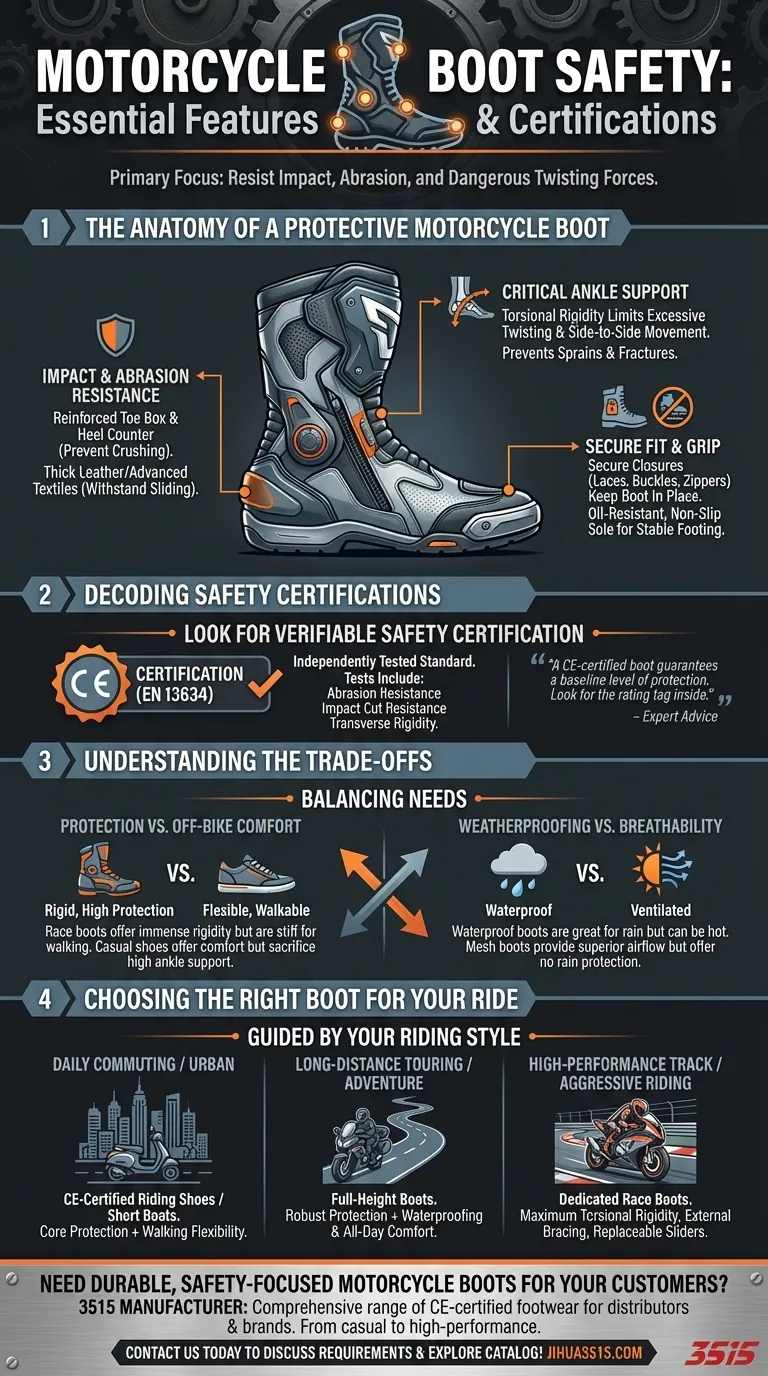
When choosing motorcycle boots, your primary focus should be on features that resist impact, abrasion, and dangerous twisting forces. Look for boots with reinforced toe boxes and heel counters, substantial ankle support, and a verifiable safety certification, such as a CE rating, which confirms the boot has been tested against established standards.
The most effective motorcycle boot is not simply the one with the most features, but the one that provides the appropriate level of protection for your specific type of riding while ensuring a secure and proper fit.
The Anatomy of a Protective Motorcycle Boot
A motorcycle boot is a piece of technical safety equipment designed to manage specific forces encountered in a crash. Understanding its core protective functions is key to making an informed choice.
Impact and Abrasion Resistance
In any accident, your feet are vulnerable to both direct impact and sliding. Protective boots use reinforced materials and integrated armor to shield these high-risk areas.
The toe box and heel counter are almost always reinforced to prevent crushing injuries. Look for boots made from thick leather or advanced abrasion-resistant textiles that can withstand a slide on pavement.
Critical Ankle Support
Your ankle is a complex joint highly susceptible to sprains, fractures, and unnatural twisting. A good riding boot is engineered to prevent this.
The boot's structure should be stiff enough to limit excessive side-to-side and rotational movement, often called torsional rigidity. This feature is what separates true riding boots from simple work boots.
Secure Fit and Grip
A boot can't protect you if it comes off during a crash. A secure closure system—whether laces, buckles, or zippers—is essential to keep the boot in place.
Furthermore, an oil-resistant, non-slip sole provides crucial grip on various surfaces. This helps you maintain control when stopped and prevents slips that could lead to a stationary drop.
Decoding Safety Certifications
Marketing terms can be misleading, but independent testing provides an objective measure of a boot's protective capabilities.
Why CE Certification Matters
The most common and trusted standard is the CE certification (EN 13634). This European standard tests boots for abrasion resistance, impact cut resistance, and transverse rigidity.
A CE-certified boot guarantees a baseline level of protection. The rating is often displayed on a tag inside the boot, giving you confidence that its safety features are proven.
Understanding the Trade-offs
Choosing the right boot always involves balancing competing needs. The safest possible boot may not be the most practical for your daily use.
Protection vs. Off-Bike Comfort
There is a direct trade-off between maximum protection and walkability. A race boot designed for the track offers immense rigidity and impact absorption but is stiff and awkward to walk in.
A casual riding shoe offers more flexibility and style for walking around your destination, but it sacrifices the higher level of ankle support and rigidity found in a full-height boot.
Weatherproofing vs. Breathability
A fully waterproof boot is excellent for touring in unpredictable weather but can become hot and uncomfortable in warm, dry climates.
Conversely, a highly ventilated or mesh boot provides superior airflow for summer riding but offers little to no protection from rain. Consider the primary climate you ride in.
Choosing the Right Boot for Your Ride
Your decision should be guided by an honest assessment of how you use your motorcycle.
- If your primary focus is daily commuting or casual urban riding: Look for CE-certified riding shoes or short boots that offer core protection (reinforced toe/heel, ankle armor) with better flexibility for walking.
- If your primary focus is long-distance touring or adventure riding: Prioritize full-height boots that blend robust protection with features like waterproofing and all-day comfort.
- If your primary focus is high-performance track or aggressive canyon riding: Choose dedicated race boots with maximum torsional rigidity, external bracing, and replaceable sliders for the highest level of safety.
Ultimately, investing in a quality motorcycle boot that matches your needs is one of the most important safety decisions you can make as a rider.
Summary Table:
| Key Feature | Why It Matters | What to Look For |
|---|---|---|
| CE Certification (EN 13634) | Verifies the boot meets tested safety standards for abrasion, impact, and rigidity. | Look for the CE rating tag inside the boot. |
| Ankle Support & Torsional Rigidity | Prevents sprains, fractures, and dangerous twisting of the ankle joint. | A stiff, structured boot that limits side-to-side and rotational movement. |
| Impact & Abrasion Resistance | Protects feet from crushing and sliding injuries during a crash. | Reinforced toe box, heel counter, and thick leather or advanced textiles. |
| Secure Fit & Grip | Ensures the boot stays on and provides stable footing when stopped. | A secure closure system (laces, buckles) and an oil-resistant, non-slip sole. |
Need Durable, Safety-Focused Motorcycle Boots for Your Customers?
As a large-scale manufacturer, 3515 produces a comprehensive range of CE-certified footwear for distributors, brand owners, and bulk clients. Our production capabilities encompass all types of protective motorcycle boots and shoes, from casual riding styles to high-performance race boots, ensuring your customers get the right blend of safety, comfort, and durability.
Contact us today to discuss your specific requirements and explore our catalog!
Visual Guide
Related Products
- Wholesale Tactical Boots High-Traction & Reflective for Bulk & Brand Orders
- High Performance Fire-Retardant Waterproof Safety Boots
- Durable Goodyear Welt Leather Work Boots for Wholesale & Private Label
- Wholesale High-Traction Camo Boots - Custom Manufacturer for Brands
- Heavy-Duty Waterproof Nubuck Safety Boots Safety Shoes for Bulk Supply
People Also Ask
- How do tactical boots protect against injuries? Discover the Integrated Safety System
- What are the different types of tactical boots available? Find the Right Boot for Your Mission
- What are the primary benefits of wearing tactical boots for everyday use? Get All-Day Comfort & Durability
- What makes the traction of tactical boots superior? Unlock the Science of Unbeatable Grip
- How do high-performance tactical boots and training shoes support performance? Enhance Safety & Energy for Professionals



















