
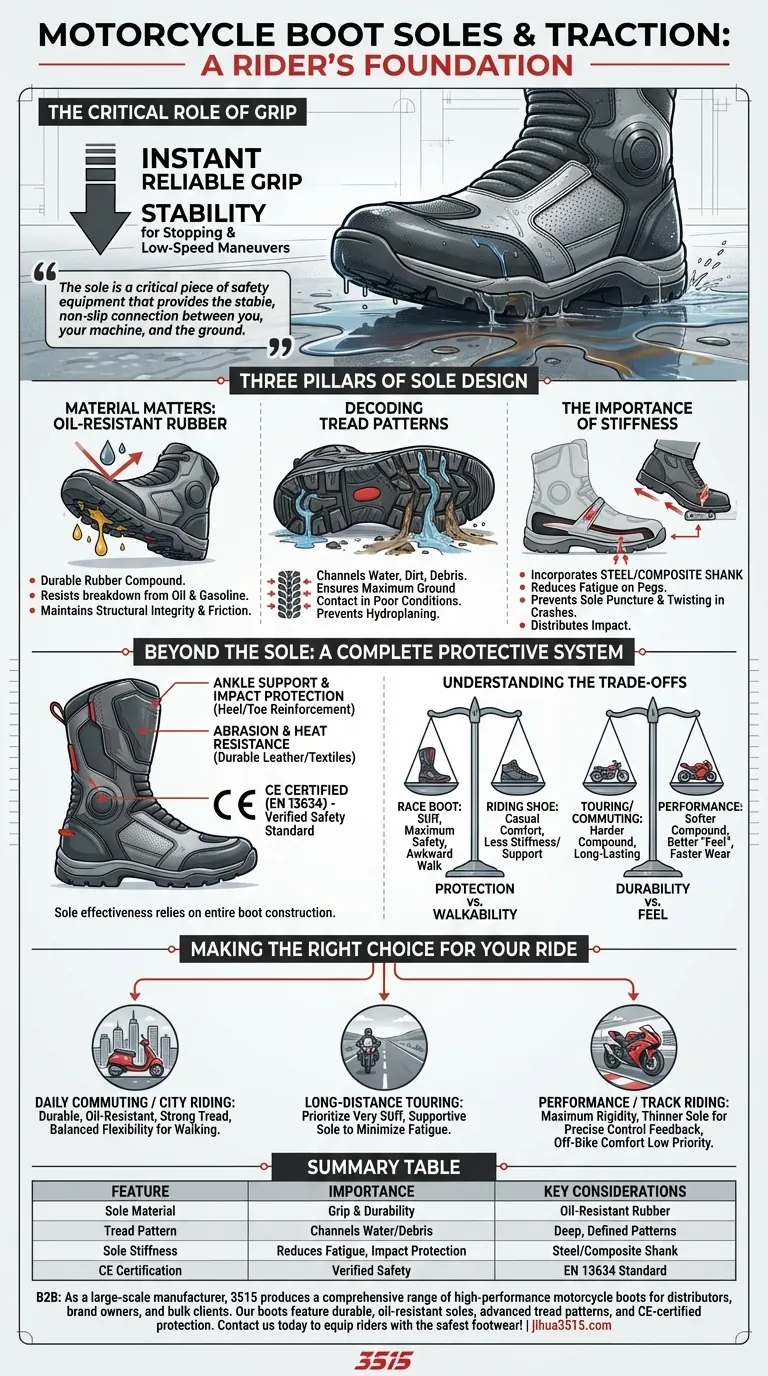
When choosing a motorcycle boot, you must look for a sole made of a durable, oil-resistant rubber compound. The ideal sole combines a tread pattern designed to channel away water and debris with a degree of stiffness that supports your foot on the pegs and protects it from impact forces.
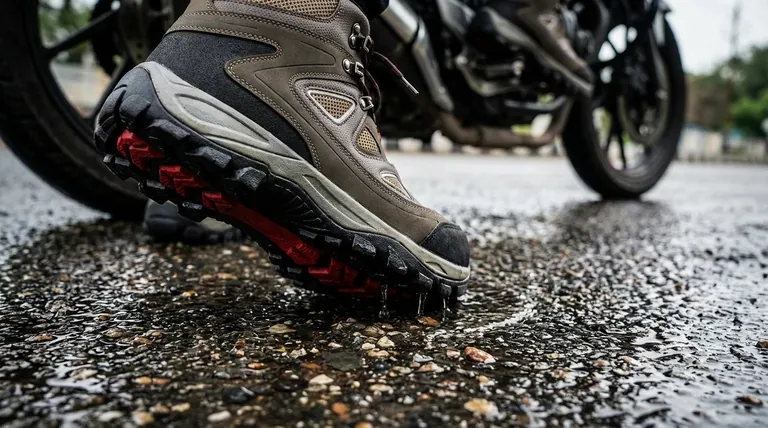
The sole of your motorcycle boot is more than just a walking surface; it is a critical piece of safety equipment that provides the stable, non-slip connection between you, your machine, and the ground, especially when you are stopped or maneuvering at low speeds.
Why the Sole is Your Foundation for Control
The interaction between your boot and the ground is a crucial moment of control. A failure at this point can lead to a dropped bike or an injury. This is why the sole's design and material are non-negotiable safety features.
The Critical Role of Grip
A boot's primary traction challenge occurs when you put your foot down. You need instant, reliable grip on unpredictable surfaces, which may be wet, oily, or covered in loose gravel.
Good grip provides the stability needed to hold a heavy bike upright at a stoplight or to maneuver it in a parking lot, directly contributing to rider confidence and safety.
Material Matters: Oil-Resistant Rubber
Motorcycle boots almost universally use rubber or synthetic rubber compounds for their soles. This material offers excellent friction on pavement.
It is critical that the sole be oil-resistant. Exposure to oil and gasoline on road surfaces can cause standard rubber to break down, becoming slick and losing its structural integrity.
Decoding Tread Patterns
The grooves and channels in a boot's sole serve the same purpose as the tread on a tire: to move water, dirt, and oil away from the contact patch.
A deep, well-defined pattern ensures the sole can maintain maximum contact with the ground, even in poor conditions. A shallow or worn-out tread significantly increases the risk of slipping.
The Importance of Stiffness
A key feature that separates motorcycle boots from casual shoes is sole rigidity. Many boots incorporate a steel or composite shank within the sole.
This stiffness prevents your foot from flexing uncomfortably over the footpeg during long rides, which reduces fatigue. Critically, it also helps distribute impact forces and prevents the sole from being punctured or twisted in a crash.
Beyond the Sole: A Complete Protective System
While traction is essential, the sole is just one part of a comprehensive safety system. Its effectiveness is directly tied to the construction of the entire boot.
Ankle Support and Impact Protection
A great sole is ineffective if your ankle can easily twist or be crushed. Proper motorcycle boots have built-in ankle support and are often reinforced at the heel and toe.
These features, mandated by safety certifications, work with the stiff sole to protect your foot's complex structure from crushing and impact injuries.
Abrasion and Heat Resistance
The upper materials of the boot must protect you from hazards like hot engine and exhaust pipes, as well as severe abrasion during a slide.
Durable leather or advanced textiles are used to ensure the boot stays intact, keeping the sole and all its protective features securely on your foot when you need them most.
The CE Certification Standard
To ensure you are getting proven protection, look for boots that are CE-certified. This is a European standard (EN 13634) that tests boots for key safety metrics.
This certification verifies the boot's resistance to abrasion, impact cuts, and sole delamination, giving you an objective measure of its protective capabilities.
Understanding the Trade-offs
Choosing the right boot often involves balancing competing needs. No single boot is perfect for every situation.
Protection vs. Walkability
Highly protective race boots with extremely stiff soles offer maximum safety on the bike but can be very awkward and uncomfortable to walk in.
Conversely, more casual "riding shoes" offer excellent off-bike comfort but provide significantly less stiffness, impact protection, and ankle support than a dedicated boot.
Durability vs. Feel
Some performance-oriented boots use softer sole compounds to provide a better "feel" for the controls. The trade-off is that these soles tend to wear out much faster than the harder compounds used on touring or commuting boots.
Making the Right Choice for Your Ride
Your boot's sole should match the demands of your specific type of riding.
- If your primary focus is daily commuting or city riding: Seek a durable, oil-resistant sole with a strong tread pattern for all-weather grip, balanced with enough flexibility for comfortable walking.
- If your primary focus is long-distance touring: Prioritize a very stiff, supportive sole to minimize foot fatigue on the pegs over many hours.
- If your primary focus is performance or track riding: Choose a boot with maximum rigidity and a thinner sole that provides precise feedback from the controls, where off-bike comfort is not a priority.
Ultimately, your boots are the only thing connecting you to the pavement, and their soles are engineered to make that connection as stable and secure as possible.
Summary Table:
| Feature | Importance for Riders | Key Considerations |
|---|---|---|
| Sole Material | Provides grip and durability | Must be oil-resistant rubber to prevent degradation |
| Tread Pattern | Channels water/debris for stable footing | Deep, defined patterns for maximum ground contact |
| Sole Stiffness | Reduces fatigue and protects from impact | Often includes a steel/composite shank for rigidity |
| CE Certification | Ensures tested safety standards | Look for EN 13634 certification for verified protection |
As a large-scale manufacturer, 3515 produces a comprehensive range of high-performance motorcycle boots for distributors, brand owners, and bulk clients. Our boots feature durable, oil-resistant soles, advanced tread patterns, and CE-certified protection designed for all riding styles. Let us help you equip riders with the safest and most reliable footwear. Contact us today to discuss your needs and explore our full production capabilities!
Visual Guide
Related Products
- Wholesale Tactical Boots High-Traction & Reflective for Bulk & Brand Orders
- High Performance Fire-Retardant Waterproof Safety Boots
- Durable Goodyear Welt Leather Work Boots for Wholesale & Private Label
- Wholesale High-Traction Camo Boots - Custom Manufacturer for Brands
- Heavy-Duty Waterproof Nubuck Safety Boots Safety Shoes for Bulk Supply
People Also Ask
- How do tactical boots protect against injuries? Discover the Integrated Safety System
- How does creative short video content support functional footwear sales? Boost Trust and Traffic with Visual Proof
- How is the compatibility of polymer materials demonstrated in smart footwear? Enhancing Tactical & Training Performance
- Importance of Professional Tactical Boots in Loess Gully Regions: Ensure Safety and Precision for Field Monitoring
- What are the weight and breathability characteristics of the boots? Find the Perfect Fit for Your Mission



















