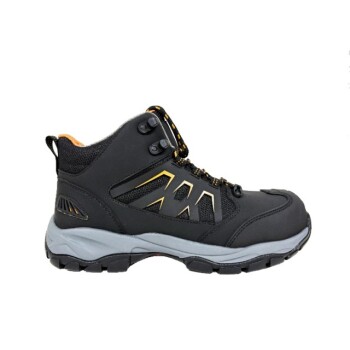
Ankle stabilization is the mechanical foundation of a precise gait. By securing the ankle joint, footwear prevents unintended rotations and maintains the foot's optimal angle of attack during ground contact. This alignment ensures that force is transmitted efficiently through the leg, keeping the wearer's forward path—or trajectory—accurate and controlled.
Proper ankle stabilization acts as a corrective mechanism that prevents foot drop and internal rotation, ensuring the foot hits the ground at the ideal angle. This structural support translates to a more predictable gait trajectory and significantly higher movement efficiency.
The Mechanics of Ankle Stabilization and Gait
Preventing Misalignment and Foot Drop
Rigid support structures, such as high-top designs or reinforced collars, physically restrict the ankle from "dropping" or rotating inward excessively. This ensures that the foot remains in a neutral, ready position before it ever makes contact with the ground.
Optimizing the Initial Contact Angle
When the ankle is stabilized, the foot strikes the surface at a precise, pre-determined angle. This consistency is vital for maintaining the intended direction of travel, as even minor deviations at the ankle can cause significant trajectory drift over several steps.
Maintaining Structural Integrity Under Load
Stabilization prevents the ankle from buckling under the weight of the body during the stance phase. By holding the joint in place, the footwear ensures that the physiological foundation remains intact throughout the entire motion cycle.
Impact on Force Transmission and Efficiency
Creating a Stable Foundation for Power
A stabilized ankle acts as a rigid lever, allowing energy to transfer from the leg to the ground without "leaking" through joint instability. This creates a solid base that allows the wearer to push off with maximum force and minimal wasted energy.
Improving Trajectory Accuracy
By eliminating lateral wobble or internal rotation, the force of each step is directed strictly along the intended path of travel. This results in a cleaner gait trajectory that requires less secondary muscular effort to correct for balance issues.
Enhancing Movement Efficiency
When the body does not have to compensate for an unstable ankle, it can focus resources on forward propulsion. This reduction in compensatory movements leads to a more fluid, rhythmic, and efficient walking or running gait.
Understanding the Trade-offs of Rigid Stabilization
Potential Reduction in Range of Motion
While stability improves trajectory, extreme rigidity can limit the ankle's natural flexibility. This may eventually lead to a reliance on the footwear's structure rather than the body's intrinsic muscle strength and proprioception.
Shift in Stress to Proximal Joints
If the ankle joint is completely immobilized by footwear, the impact forces of ground contact may be forced upward toward the knees or hips. It is critical to balance the need for stabilization with the need for natural shock absorption.
Dependency and Muscle Atrophy
Long-term use of high-stability footwear without supplemental strength training can lead to weakness in the stabilizing muscles. This makes the wearer more susceptible to injury when they are not wearing the supportive footwear.
Selecting the Right Level of Support
Choosing the appropriate level of ankle stabilization depends on your specific environment and your body's unique biomechanical needs.
- If your primary focus is maximum stability during heavy loads: Prioritize high-top, rigid structures that prevent internal rotation and provide a firm foundation for force transmission.
- If your primary focus is maintaining speed and agility: Look for footwear that offers targeted lateral support while still allowing the ankle to flex forward and backward naturally.
- If your primary focus is correcting gait abnormalities: Utilize footwear with specific medial or lateral reinforcement to counteract tendencies toward overpronation or supination.
Mastering your gait trajectory begins with providing your ankles the structural integrity required to move with consistent precision.
Summary Table:
| Feature | Mechanism of Action | Gait Impact |
|---|---|---|
| Rigid Collars | Restricts inward rotation & foot drop | Prevents trajectory drift & misalignment |
| Stabilizing Levers | Creates a rigid base for energy transfer | Maximizes push-off force & energy efficiency |
| Structural Support | Maintains joint integrity under load | Reduces lateral wobble & compensatory strain |
| Reinforced Medial/Lateral | Counteracts overpronation/supination | Corrects gait abnormalities for a cleaner path |
Elevate Your Footwear Standards with 3515
As a large-scale manufacturer serving distributors and brand owners, 3515 offers comprehensive production capabilities for all footwear types, anchored by our flagship Safety Shoes series. Our extensive portfolio covers work and tactical boots, outdoor shoes, training shoes, and sneakers, as well as Dress & Formal shoes to meet diverse bulk requirements.
We provide precision-engineered ankle stabilization to ensure your customers experience maximum safety and gait efficiency. Whether you need rugged tactical support or high-performance athletic stability, our expert team is ready to deliver quality at scale.
Ready to enhance your product line with industry-leading footwear? Contact us today to discuss your bulk manufacturing needs!
References
- Fabian Moll, Jens Adermann. Use of Robot-Assisted Gait Training in Pediatric Patients with Cerebral Palsy in an Inpatient Setting—A Randomized Controlled Trial. DOI: 10.3390/s22249946
This article is also based on technical information from 3515 Knowledge Base .
Related Products
- Durable High-Ankle Tactical Boots Wholesale Manufacturer for Custom & Bulk Orders
- Durable Leather High-Ankle Tactical Boots for Wholesale & Custom Manufacturing
- Durable High-Ankle Tactical Boots for Wholesale & Custom Manufacturing
- Puncture-Resistant Velcro Safety Boots for Wholesale & Custom Manufacturing
- Durable Steel Toe Safety Boots Wholesale & Custom Manufacturing
People Also Ask
- What specialized protections do tactical boots offer? Maximize Endurance with High-Performance Footwear
- How do tactical boots protect against injuries? Discover the Integrated Safety System
- What are the ideal use cases for tactical boots? Empower Your Performance in Demanding Scenarios
- Can tactical boots be stylish for everyday wear? Yes, with the right styling and features.
- What are the primary benefits of wearing tactical boots for everyday use? Get All-Day Comfort & Durability