
In an accident, motorcycle boots are purpose-built armor for your feet and ankles. Unlike standard footwear, which can disintegrate on impact with pavement, proper riding boots are engineered to absorb crushing forces, resist severe abrasion, and prevent the twisting motions that cause debilitating, life-altering injuries.
The fundamental difference is engineering: while regular shoes are designed for walking, motorcycle boots are designed to be a structural chassis for your foot, keeping it intact during the extreme forces of a crash.
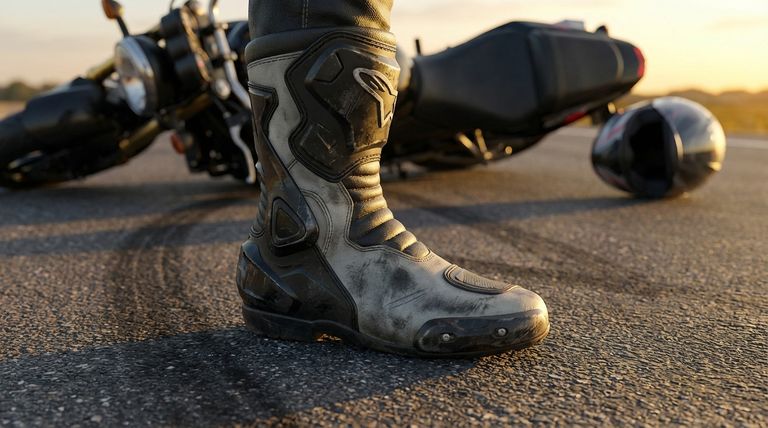
The Anatomy of Motorcycle Boot Protection
To understand their value, you must look beyond the appearance and analyze the specific protective functions they serve. Each element is designed to counter a specific type of injury common in motorcycle accidents.
Abrasion Resistance: Surviving the Slide
A motorcycle crash almost always involves a slide. Pavement acts like a high-speed belt sander, and standard shoes or sneakers can be shredded in less than a second.
Motorcycle boots are constructed from thick, heavy-duty leather or advanced synthetic textiles specifically chosen for their ability to withstand intense friction. This barrier is the only thing preventing the road from grinding away skin, muscle, and bone.
Impact Absorption: Shielding from the Force
Your feet are highly vulnerable to direct impact from the motorcycle, the road surface, or other vehicles.
Specialized boots integrate armor and reinforcement in critical areas. Hard protectors over the shin, heel, and toe box are designed to distribute and dampen the force of an impact, turning a potential shattering injury into a survivable bruise or swelling.
Torsional Rigidity: Preventing Twists and Breaks
One of the most severe and common riding injuries is a shattered ankle caused by the foot twisting unnaturally or being trapped.
High-quality riding boots have a rigid, reinforced structure that severely limits this kind of dangerous flexion. This torsional stiffness prevents your ankle from twisting beyond its normal range of motion, which is something no hiking boot or casual shoe is designed to do.
Why Other Footwear Fails
Many riders assume any sturdy-looking boot will suffice. This is a dangerous misconception, as footwear not designed for motorcycling can often introduce new risks.
The Hiking Boot Fallacy
Hiking boots are a particularly poor choice for riding. Their deep, grippy treads are designed to catch on uneven terrain, but on pavement, this same feature can cause the boot to snag during a slide.
This snagging can violently twist the rider's leg, leading to the exact kind of severe ankle and leg fractures that a proper motorcycle boot is built to prevent.
The Illusion of Work Boots
Steel-toed work boots provide excellent crush protection from a falling object, but they are not designed for a motorcycle crash.
They typically lack any meaningful torsional support for the ankle and do not have the robust abrasion resistance needed to survive a slide. The laces can also become caught on bike components.
The Failure of Casual Shoes
Sneakers, dress shoes, or other daily footwear offer virtually zero protection.
They will shred almost instantly upon contact with pavement and provide no impact absorption or structural support, guaranteeing catastrophic damage to the foot and ankle in even a low-speed incident.
Making the Right Choice for Your Goal
The right boot is a critical piece of safety equipment. Your choice should align directly with your primary type of riding.
- If your primary focus is daily commuting: Seek a CE-rated short boot or riding shoe that offers reinforced ankle, heel, and toe protection without sacrificing all-day comfort.
- If your primary focus is touring or sport riding: Choose a full-height boot that prioritizes maximum torsional rigidity, shin protection, and robust abrasion resistance.
- If your primary focus is track or racing: Invest in a top-tier boot with external bracing, replaceable sliders, and the highest level of structural reinforcement available.
Ultimately, choosing to wear purpose-built motorcycle boots is as fundamental to safety as wearing a helmet.
Summary Table:
| Protection Feature | How Motorcycle Boots Help | Risk with Regular Footwear |
|---|---|---|
| Abrasion Resistance | Thick leather/textiles withstand pavement slides. | Shoes shred instantly, exposing skin and bone. |
| Impact Absorption | Armor on shin, heel, and toe disperses crash forces. | No protection, leading to fractures and breaks. |
| Torsional Rigidity | Reinforced structure prevents ankle twists and breaks. | Ankle can twist unnaturally, causing severe injury. |
Equip Your Riders with Superior Protection from 3515
As a large-scale manufacturer, 3515 produces a comprehensive range of CE-certified motorcycle boots for distributors, brand owners, and bulk clients. Our production capabilities encompass all types of protective footwear, from durable commuter boots to high-performance racing models with external bracing.
We ensure every pair meets the highest standards of abrasion resistance, impact absorption, and torsional rigidity to provide life-saving protection. Partner with us to offer your customers the essential armor they need.
Contact 3515 today to discuss your motorcycle boot manufacturing needs and secure your supply of high-quality, safety-focused footwear.
Visual Guide

Related Products
- Wholesale Tactical Boots High-Traction & Reflective for Bulk & Brand Orders
- High Performance Fire-Retardant Waterproof Safety Boots
- Durable Goodyear Welt Leather Work Boots for Wholesale & Private Label
- Wholesale High-Traction Camo Boots - Custom Manufacturer for Brands
- Wholesale Waterproof Tactical Boots Custom Suede & High-Traction Soles
People Also Ask
- How do tactical boots protect against injuries? Discover the Integrated Safety System
- What is the necessity of high-performance tactical boots in exoskeletons? Enhancing Load Efficiency and Safety
- Why is the management of Initial Inventory (II) critical in the production and supply of tactical boots?
- What are the consequences of wearing ill-fitting tactical boots? Avoid Injury and Boost Performance
- What are the primary characteristics of tactical boots? Lightweight, Agile, and Built for All-Day Missions



















