
At their core, motorcycle boots protect your toes and heels using integrated armor designed to resist crushing and impact forces. This is accomplished through a hardened, reinforced toe box and a rigid, supportive heel counter or "cup," both of which are engineered to shield your feet from the unique dangers of a motorcycle accident.
The protection in a motorcycle boot is not just a single feature but a complete system. It combines impact absorption, crush resistance, and abrasion-proof materials to defend against forces that would shatter the bones in your feet in an instant.
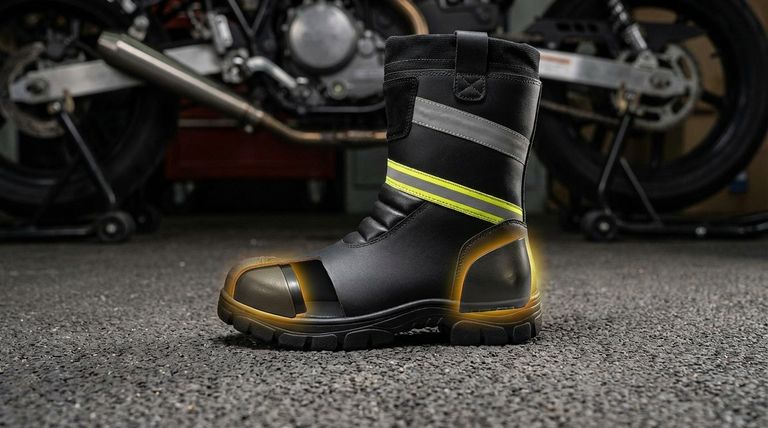
The Anatomy of Impact Protection
To understand a boot's value, you must look beyond the leather exterior and analyze the protective structures built within. These components are specifically designed to manage the forces of a motorcycle crash.
The Reinforced Toe Box
A proper motorcycle boot features a reinforced toe box, typically made from a tough thermoplastic (TPU) or composite material. This isn't just a hard shell; it's engineered to distribute the force of a frontal impact from debris or a crash.
It also provides critical crush protection, preventing your toes from being pinned between the bike and the road or another object. This is fundamentally different from a steel-toed work boot, which is only designed for top-down impacts.
The Rigid Heel Counter
The back of the boot incorporates a rigid heel counter, also known as a heel cup. This component serves two primary functions.
First, it cups the heel to stabilize the foot and help prevent it from twisting or rolling during a slide. Second, it provides a crucial shield against rear and side impacts, an area highly vulnerable in many types of accidents.
External Sliders
Often seen on sport and track-oriented boots, toe and heel sliders are replaceable pucks made of hard plastic or metal.
Their purpose is to allow the boot to slide smoothly across the pavement during a fall, particularly at a high lean angle. This prevents the boot from catching or digging into the asphalt, which could violently twist your leg and cause severe injury.
Why Standard Footwear is a Critical Failure
Many riders underestimate the forces involved in even a low-speed incident. Understanding why regular shoes and boots fail highlights the essential nature of specialized gear.
The Myth of "Tough" Work Boots
A common mistake is assuming a leather work boot offers adequate protection. While durable for walking, they provide almost no defense against the specific dangers of riding.
Their construction offers zero torsional rigidity, meaning they do nothing to stop the violent twisting that breaks ankles. A steel toe, designed for falling objects, can even bend and entrap the toes in a crushing motorcycle accident.
Abrasion and Impact Vulnerability
Standard footwear, including sneakers and hiking boots, will be shredded from the pavement in seconds during a slide.
They lack the reinforced structure, specialized stitching, and impact-absorbing materials needed to protect your feet. A secure closure system on a motorcycle boot also ensures it will actually stay on your foot when you need it most.
Understanding the Trade-offs
Choosing the right boot involves balancing maximum protection with the practical needs of your specific type of riding. Not every rider needs a full-height, track-ready race boot.
Protection vs. Walkability
There is a direct trade-off between protective rigidity and off-the-bike comfort. A race boot with extreme stiffness offers the highest level of protection but is clumsy and uncomfortable to walk in.
Conversely, a short riding shoe offers superior comfort and flexibility but sacrifices shin protection and some torsional support. Touring boots often represent a carefully engineered middle ground.
Materials and Certification
The level of protection is often tied to the materials and the boot's certification. Entry-level boots may use simple reinforced leather and basic TPU armor.
Higher-end models use advanced composites, carbon fiber, and hinged exoskeleton designs for superior protection without sacrificing all mobility. Always look for a CE rating, which verifies the boot has passed standardized tests for crush resistance, abrasion, and impact protection.
Making the Right Choice for Your Goal
Your boot should be chosen to match the risks and demands of your riding style.
- If your primary focus is track days or aggressive sport riding: Prioritize boots with maximum torsional rigidity, external armor, and replaceable toe sliders.
- If your primary focus is long-distance touring: Seek a CE-rated waterproof boot that balances robust ankle, toe, and heel protection with all-day comfort and support.
- If your primary focus is casual urban commuting: Look for CE-rated riding shoes that offer reinforced toe and heel cups and ankle protection in a more discreet, walkable package.
Ultimately, investing in proper motorcycle footwear is a direct investment in your ability to walk away from an accident.
Summary Table:
| Protective Feature | Core Function | Key Benefit |
|---|---|---|
| Reinforced Toe Box | Distributes frontal impact force | Prevents toe crushing and impact injuries |
| Rigid Heel Counter | Stabilizes foot and shields heel | Protects against rear/side impacts and twisting |
| External Sliders | Allows boot to slide on pavement | Prevents catching and reduces leg torsion |
| CE Certification | Verifies passed safety tests | Ensures standardized crush, abrasion & impact protection |
Protect Your Ride with Professional-Grade Footwear
As a large-scale manufacturer, 3515 produces a comprehensive range of CE-certified motorcycle boots for distributors, brand owners, and bulk clients. Our expertise ensures every pair delivers the critical toe and heel protection detailed in this article, combining advanced materials like TPU and composites with superior craftsmanship.
Ready to equip your customers with boots that offer real safety? Contact our team today to discuss your production needs and explore our full catalog of touring, sport, and urban riding footwear.
Visual Guide

Related Products
- Wholesale Tactical Boots High-Traction & Reflective for Bulk & Brand Orders
- High Performance Fire-Retardant Waterproof Safety Boots
- Durable Goodyear Welt Leather Work Boots for Wholesale & Private Label
- Wholesale High-Traction Camo Boots - Custom Manufacturer for Brands
- Wholesale Waterproof Tactical Boots Custom Suede & High-Traction Soles
People Also Ask
- How do tactical boots protect against injuries? Discover the Integrated Safety System
- What features do tactical boots typically have? A Guide to Rugged Durability & Performance
- What types of boots are used by Bravo in SEAL Team? Salomon & Merrell for Elite Performance
- What are the important features of tactical boots for military operators? A Guide to Mission-Critical Footwear
- What materials are used in tactical boot uppers? A Guide to Durability & Performance



















