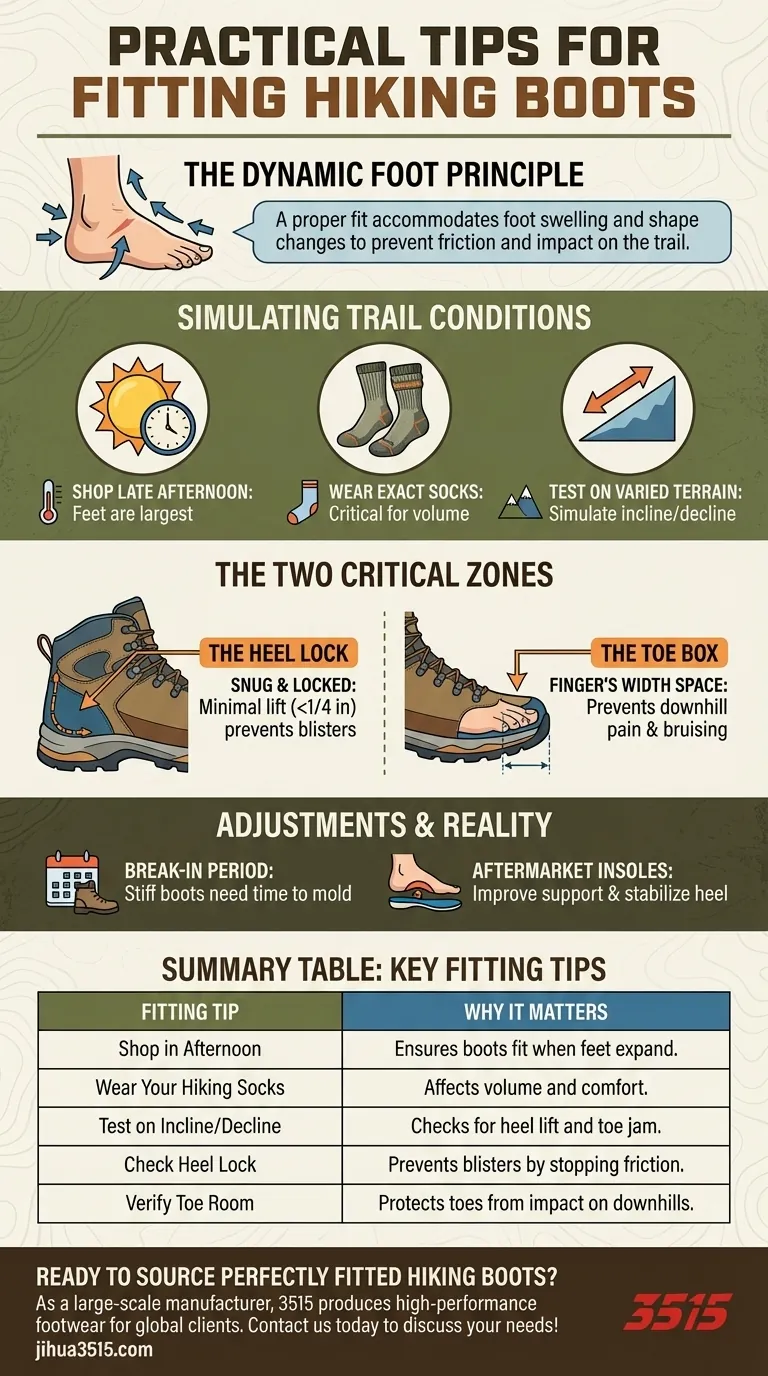
To properly fit hiking boots, you must simulate the conditions of a real hike inside the store. This means shopping in the late afternoon when your feet have naturally swollen, wearing the exact socks you'll hike in, and ensuring you have a locked-in heel with enough room to wiggle your toes freely.
The core challenge in fitting a hiking boot is that your feet are dynamic—they swell and change shape. A proper fit isn't about finding a boot that feels perfect when you're sitting still; it's about finding one that accommodates these changes to prevent friction and impact on the trail.
The Foundation: Simulating Trail Conditions
A boot that feels good in the first 30 seconds can become an instrument of torture after three miles. The goal of an in-store fitting is to replicate the stresses your feet will endure on a hike, exposing potential issues before you commit.
Why Timing and Socks are Crucial
Your feet swell throughout the day and even more so during a long hike. Trying on boots in the morning can lead you to buy a pair that is too small.
By shopping in the late afternoon or evening, your feet will be at their largest, giving you a more accurate baseline for a proper fit.
Socks are a critical component of your footwear system, not an afterthought. The thickness of your hiking sock directly impacts the volume inside the boot. Always fit boots with the exact type of socks you intend to wear on the trail.
Testing on Varied Terrain
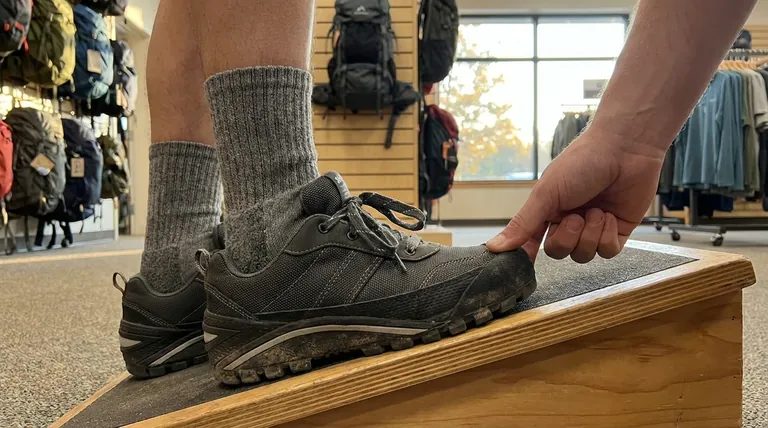
Simply walking on a flat floor is not an adequate test. A good outdoor retailer will have a small ramp or set of stairs for this purpose.
Walking on an incline and decline simulates the forces of ascending and descending a trail. This is the single best way to check for the two most common fit problems: heel lift and forward toe slide.
Diagnosing the Fit: The Two Critical Zones
A successful fit is a balance between securing your foot in place and allowing it space to flex and swell. This balance is most important in two key areas: the heel and the toe box.
The Heel Lock: Your Anchor for Stability
Your heel should feel snug and locked into place. Any significant slipping or lifting as you walk is a major red flag.
This movement, known as heel lift, is the primary cause of blisters on the back of your heel. While a tiny amount of movement is acceptable, anything more than a quarter-inch suggests a poor fit or a boot that isn't right for your foot shape.
The Toe Box: Preventing Downhill Pain
You must have adequate room for your toes. When you descend a steep trail, gravity will push your foot forward inside the boot.
If your toes are already touching the end of the boot on flat ground, they will slam into the front on every downhill step. This can lead to intense pain and bruised or lost toenails.
Ensure there is about a finger's width of space between your longest toe and the end of the boot when you are standing. When testing on a decline ramp, your toes should not make hard contact with the front.
Understanding the Trade-offs and Adjustments
No single boot is perfect for every foot. Individual foot shapes vary, and your left and right feet are often slightly different sizes. The key is to find the best starting point and know how to fine-tune it.
The Myth of "Perfect Out of the Box"
While lightweight trail shoes may feel great immediately, medium and heavy-weight hiking boots, especially those with leather uppers, require a break-in period.
This process allows the stiffer materials to mold to the unique shape of your foot. Wear your new boots around the house and on short walks before committing to a long trek. This helps prevent sore feet and reveals any subtle fit issues.
The Power of Aftermarket Insoles
The stock insoles that come with most boots offer minimal support. Replacing them is one of the most effective ways to customize your fit.
Aftermarket insoles from brands like Superfeet can improve arch support, stabilize your heel, and adjust the overall volume inside the boot. If a boot feels almost perfect but has slightly too much space, a better insole can often solve the problem.
Making the Right Choice for Your Hike
Focus your fitting process on solving the problems you are most likely to encounter on the trail.
- If your primary focus is preventing blisters: Prioritize achieving a secure heel lock with absolutely minimal lift when walking up an incline.
- If your primary focus is avoiding downhill toe pain: Ensure there is ample room in the toe box and confirm your toes don't jam into the front when testing on a decline.
- If your primary focus is all-day comfort and support: Pay close attention to arch support and consider investing in aftermarket insoles from the start.
Ultimately, a well-fitted boot works with your foot, providing the support and protection you need to focus on the journey.
Summary Table:
| Fitting Tip | Key Action | Why It Matters |
|---|---|---|
| Shop in the Afternoon | Try on boots when feet are naturally swollen. | Ensures boots fit during a hike when feet expand. |
| Wear Your Hiking Socks | Use the exact socks you'll wear on the trail. | Affects boot volume and overall comfort. |
| Test on Incline/Decline | Walk on a ramp to simulate trail forces. | Checks for heel lift and toe jam on descents. |
| Check Heel Lock | Ensure heel is snug with minimal lift. | Prevents blisters by stopping friction. |
| Verify Toe Room | Leave a finger's width of space at the front. | Protects toes from impact and bruising on downhills. |
Ready to Source Perfectly Fitted Hiking Boots?
As a large-scale manufacturer, 3515 produces a comprehensive range of high-performance hiking footwear for distributors, brand owners, and bulk clients. Our production capabilities encompass all types of durable and comfortable hiking boots and shoes, designed with the precise fit and support that outdoor enthusiasts demand.
Let us help you provide your customers with the quality and comfort they need for the trail. Contact our team today to discuss your manufacturing needs!
Visual Guide
Related Products
- Wholesale High-Traction Camo Boots - Custom Manufacturer for Brands
- Durable Rubber Sole Outdoor Shoes Wholesale & Custom Manufacturing
- Durable Spiked Camouflage Boots Wholesale & Factory Production
- Wholesale Lightweight Tactical Boots Custom Manufacturer for Desert & Combat Use
- Wholesale Waterproof Tactical Boots Custom Suede & High-Traction Soles
People Also Ask
- What are the key features of the new line of camo boots? Built for Extreme Cold & Rugged Terrain
- Are camo boots necessary for hunting success? Prioritize Performance Over Pattern
- What is the technical logic behind using closed-eye testing for tactical boots? Unlocking Peak Footwear Stability
- How does the Rank Score Test identify the primary causes of premature failure in tactical and work boots? Key Insights
- What shoes to wear for a security job? Durable, Protective Footwear for Long Shifts