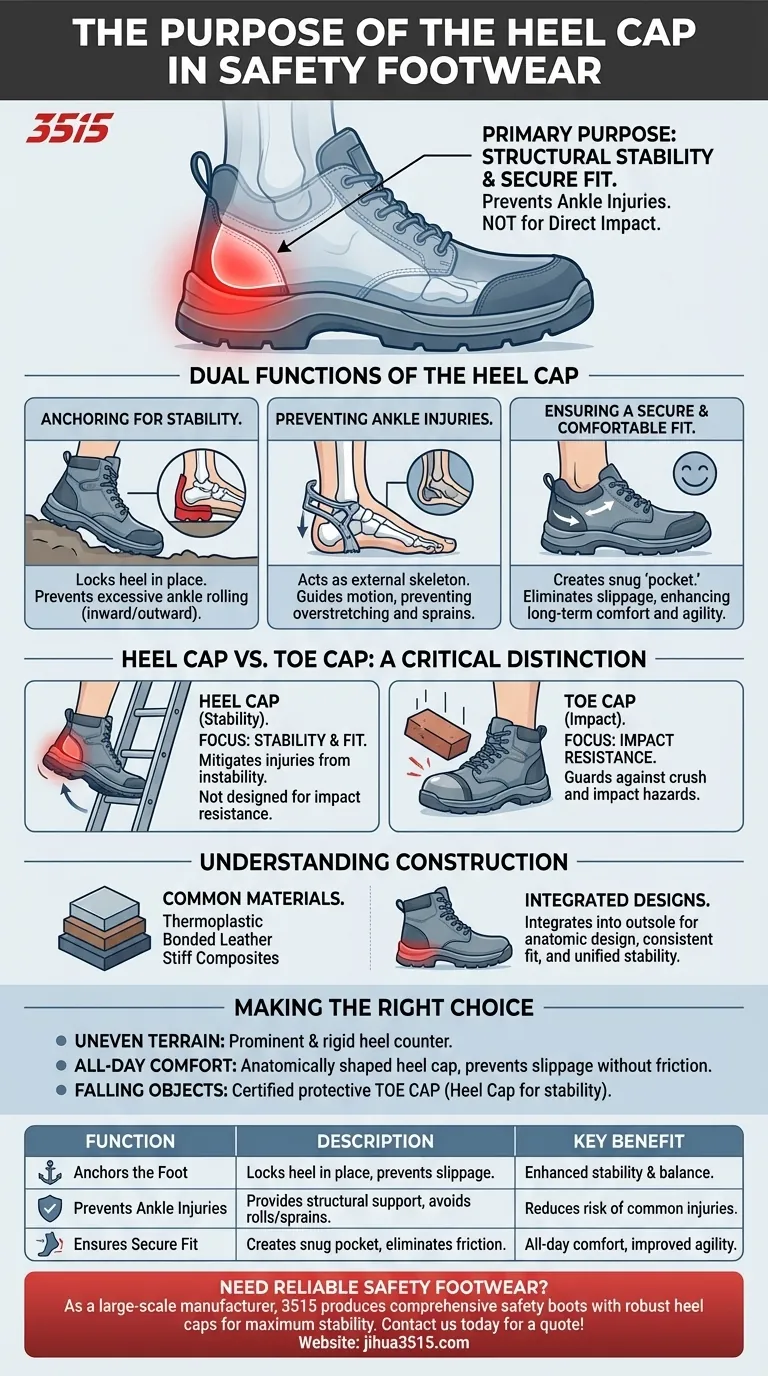
The primary purpose of the heel cap in safety footwear is to provide structural stability and ensure a secure fit, which are critical for preventing common ankle injuries. Often called a "heel counter," this rigid component cups the back of the foot to prevent it from rolling or slipping, offering protection against sprains and strains rather than direct impact.
While the protective toe cap guards against crush and impact hazards, the heel cap's function is fundamentally about stability. It anchors your foot within the footwear, transforming the boot into a stable platform that minimizes the risk of twists, slips, and falls.

The Dual Functions of the Heel Cap
To fully grasp its importance, we must look beyond impact resistance and focus on the structural role the heel cap plays in both safety and long-term comfort.
Anchoring the Foot for Stability
The heel cap is a rigid, molded insert at the rear of the footwear. Its primary job is to lock your heel in place.
This rigidity prevents the ankle from rolling excessively inward or outward. This is crucial when working on uneven surfaces, climbing ladders, or making sudden movements, where an ankle sprain is a significant risk.
Preventing Common Ankle Injuries
By providing this structural support, a well-designed heel cap directly mitigates the risk of sprains and strains.
It acts as an external skeleton for your heel, guiding its motion and preventing the ligaments of the ankle from being overstretched during a misstep.
Ensuring a Secure and Comfortable Fit
A secure fit is a key component of safety. If your heel slips up and down inside your boot, it can cause painful blisters and reduce your sense of control and balance.
The heel cap creates a snug "pocket" for your heel, eliminating this slippage. This not only enhances comfort over a long workday but also ensures the footwear moves with your foot, improving agility.
Heel Cap vs. Toe Cap: A Critical Distinction
A common point of confusion is mistaking the function of the heel cap for that of the protective toe cap. Their roles are distinct and complementary.
The Role of the Toe Cap
A protective toe cap, typically made of steel or composite materials, is designed for one primary purpose: direct impact and compression resistance.
Safety standards mandate that it withstand significant force, such as 200 Joules of impact energy, to protect the toes from falling objects or crushing hazards.
The Role of the Heel Cap
The heel cap, in contrast, is not designed for impact resistance. It is a structural component focused on stability.
While it offers minor protection against bumps, its main safety value comes from preventing the injuries caused by instability, which are statistically far more common in many work environments.
Understanding Heel Cap Construction
The effectiveness of a heel cap is determined by its material and how it is integrated into the footwear's design.
Common Materials
Heel caps are typically made from rigid materials that can be molded and retain their shape. These include thermoplastic, bonded leather, or other stiff composites.
The goal is to achieve firmness without adding excessive weight or creating a component that will break down over time.
Integrated Designs
Modern safety footwear often integrates the heel cap directly into the outsole or overall structure of the boot.
This approach allows for a more anatomic heel design, which provides a more consistent quality of fit and a higher degree of stability by unifying the supportive elements of the footwear.
Making the Right Choice for Your Goal
When selecting safety footwear, consider how the heel design aligns with the primary risks and demands of your job.
- If your primary focus is working on uneven terrain or ladders: Prioritize footwear with a prominent and rigid heel counter that you can feel firmly cupping your heel.
- If your primary focus is all-day comfort and walking long distances: Seek out an anatomically shaped heel cap that prevents slippage without causing friction or Achilles tendon irritation.
- If your primary focus is protection from falling objects: Confirm your footwear has a certified protective toe cap, and understand that the heel cap's contribution to safety is through stability, not impact absorption.
Choosing the right footwear means understanding that true safety is a system, where each component is engineered to protect you from a specific type of risk.
Summary Table:
| Function | Description | Key Benefit |
|---|---|---|
| Anchors the Foot | Locks the heel in place to prevent slippage. | Enhanced stability and balance. |
| Prevents Ankle Injuries | Provides structural support to avoid rolls and sprains. | Reduces risk of common workplace injuries. |
| Ensures a Secure Fit | Creates a snug pocket for the heel, eliminating friction. | All-day comfort and improved agility. |
Need reliable safety footwear that protects your entire workforce? As a large-scale manufacturer, 3515 produces a comprehensive range of safety boots and shoes for distributors, brand owners, and bulk clients. Our production capabilities ensure every pair is built with essential features like robust heel caps for maximum stability. Let us provide the durable, high-quality footwear your business depends on.
Contact us today for a quote and discover the 3515 advantage!
Visual Guide
Related Products
- Puncture-Resistant Velcro Safety Boots for Wholesale & Custom Manufacturing
- Wholesale Durable Safety Boots | Custom Steel Toe & Puncture-Resistant Manufacturing
- Premium Grain Leather Safety Boots for Bulk Supply
- Heavy-Duty Waterproof Nubuck Safety Boots Safety Shoes for Bulk Supply
- Premium High-Cut Waterproof Safety Boots Manufacturing & Wholesale Solutions
People Also Ask
- Why are industrial safety boots with steel toes necessary for machine operators? Essential Foot Protection for Safety
- What are the characteristics of steel toe safety boots? Maximum Protection, Key Trade-offs
- Is it true that steel toes can cause toes to get cut off? Debunking the Dangerous Myth
- What are the primary safety functions of safety boots with steel-toe designs? Essential Protection for Industry
- What are the different types of safety toe boots available? Choose the Right Protection for Your Job