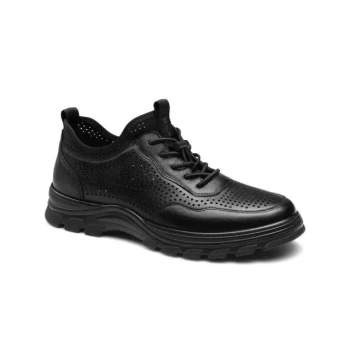
Precise gait cycle quantification relies on accurate event detection. Foot-switches embedded in the soles of training shoes serve a critical function: detecting the exact moments of heel-strike and toe-off with high precision. This hardware provides the necessary data to segment continuous movement into discrete cycles, acting as the fundamental prerequisite for calculating time-dependent gait parameters.
By establishing exact temporal boundaries, foot-switches transform raw movement data into analyzable segments. Without this precise segmentation, accurate gait adaptation analysis is impossible due to signal noise and lack of discrete event markers.
The Mechanics of Precision
Defining the Gait Cycle Boundaries
To analyze gait scientifically, you must first define exactly when a step begins and ends. Foot-switches are necessary because they detect the specific instant of ground contact (heel-strike) and propulsion (toe-off).
This detection creates a binary "on/off" signal. It provides an objective timestamp that is far more reliable than inferring contact from acceleration data alone.
Segmenting Continuous Data
Raw motion tracking results in a continuous stream of trajectory data. Without segmentation, this data is merely a long line of movement without context.
Foot-switches slice this continuous stream into discrete, manageable units known as gait cycles. This segmentation allows researchers to compare one step to another with high fidelity.
Ensuring Data Integrity
Filtering Interference Signals
A major challenge in gait analysis is "noise" generated during the swing phase of walking or running. As the limb swings, it creates acceleration and movement signals that can be mistaken for impact or active propulsion.
Foot-switches effectively filter out these interference signals. Because the switch is not depressed during the limb swinging phase, the system knows to ignore the motion data occurring between toe-off and the next heel-strike.
The Foundation for Time-Dependent Parameters
Calculations such as stance time, swing time, and cycle duration are entirely dependent on accurate start and stop times.
The reference dictates that foot-switches are a prerequisite for these calculations. You cannot derive accurate time-dependent parameters without the precise event detection these switches provide.
Understanding the Trade-offs
Hardware Integration Requirements
The necessity of installing switches directly into the soles implies a hardware constraint. The analysis is tied to specific, modified footwear rather than the subject's standard shoes.
This integration is required for accuracy but limits the flexibility of the testing environment.
Data Scope Specificity
It is important to recognize that these switches are specialized for temporal detection (timing).
They excel at identifying when an event happens to segment the data. However, they are not described as measuring the magnitude of force or the angle of the foot, only the precise timing of the contact.
Making the Right Choice for Your Goal
When designing a gait analysis protocol, the inclusion of foot-switches depends on your specific data requirements:
- If your primary focus is precise segmentation: You must use foot-switches to determine the exact moments of heel-strike and toe-off, as this is the only way to accurately break continuous movement into discrete cycles.
- If your primary focus is signal purity: Use foot-switches to automatically filter out interference signals caused by limb swinging, ensuring your analysis focuses solely on the relevant adaptation patterns.
For rigorous gait adaptation analysis, foot-switches are the essential baseline for establishing temporal ground truth.
Summary Table:
| Feature | Function in Gait Analysis | Impact on Data Quality |
|---|---|---|
| Event Detection | Identifies exact heel-strike and toe-off | Eliminates timing estimation errors |
| Data Segmentation | Slices continuous motion into discrete cycles | Enables step-by-step comparison |
| Noise Reduction | Filters signals during the swing phase | Prevents false contact triggers |
| Time Parameters | Calculates stance and swing duration | Provides high-fidelity temporal metrics |
Elevate Your Footwear Performance with 3515 Custom Solutions
As a large-scale manufacturer serving global distributors and brand owners, 3515 offers comprehensive production capabilities across all footwear categories. Whether you are developing advanced Training Shoes with integrated gait-tracking technology or expanding your line of Safety Shoes, Tactical Boots, or Formal Footwear, we provide the technical expertise to bring your vision to life.
Partner with us to leverage our flagship durability and precision engineering. Contact us today to discuss your bulk production requirements and discover how our manufacturing excellence can drive your brand's success.
References
- Dulce M. Mariscal, Amy J. Bastian. Context-Specificity of Locomotor Learning Is Developed during Childhood. DOI: 10.1523/eneuro.0369-21.2022
This article is also based on technical information from 3515 Knowledge Base .
Related Products
- Lightweight Breathable Training Shoes for Wholesale & Custom OEM Manufacturing
- Custom OEM Training Shoes Wholesale Manufacturer Durable & Breathable
- Wholesale Breathable & Cushioned Training Shoes Custom Factory Production
- Wholesale Durable & Breathable Training Shoes for Custom Brands
- Wholesale Breathable Training Shoes Custom Athletic Footwear Manufacturer
People Also Ask
- Why are lightweight training shoes often preferred over professional hiking boots in urban walking? Maximize City Comfort
- What is the primary role of specialized training or orthopedic shoes? Enhance Safety in Elderly Balance Training
- Why are professional-grade training shoes essential for physical therapy? Ensure Patient Safety and Gait Stability
- Why are the slip-resistance and stability performance of training shoes critical in gait analysis? Ensure Data Accuracy
- Why is the use of flat-soled or professional training shoes essential for WBV? Maximize Vibration Energy Transfer