Yes, snake bite boots work, but not in the way you might think. They are highly effective at preventing the vast majority of snake bites from penetrating to the skin, significantly reducing your risk in the field. However, no boot is 100% "snake-proof," as factors like the snake's size, the angle of the strike, and the boot's material all play a role in their effectiveness.
The core takeaway is that snake boots are a critical tool for risk mitigation, not risk elimination. Their purpose is to act as a formidable last line of defense when situational awareness fails, turning a potentially life-threatening event into a non-issue.

How Snake Boots Provide Protection
True snake-resistant footwear is an engineered safety system. Its effectiveness comes from a combination of material science and design that addresses how a snake actually strikes.
The Principle of Material Resistance
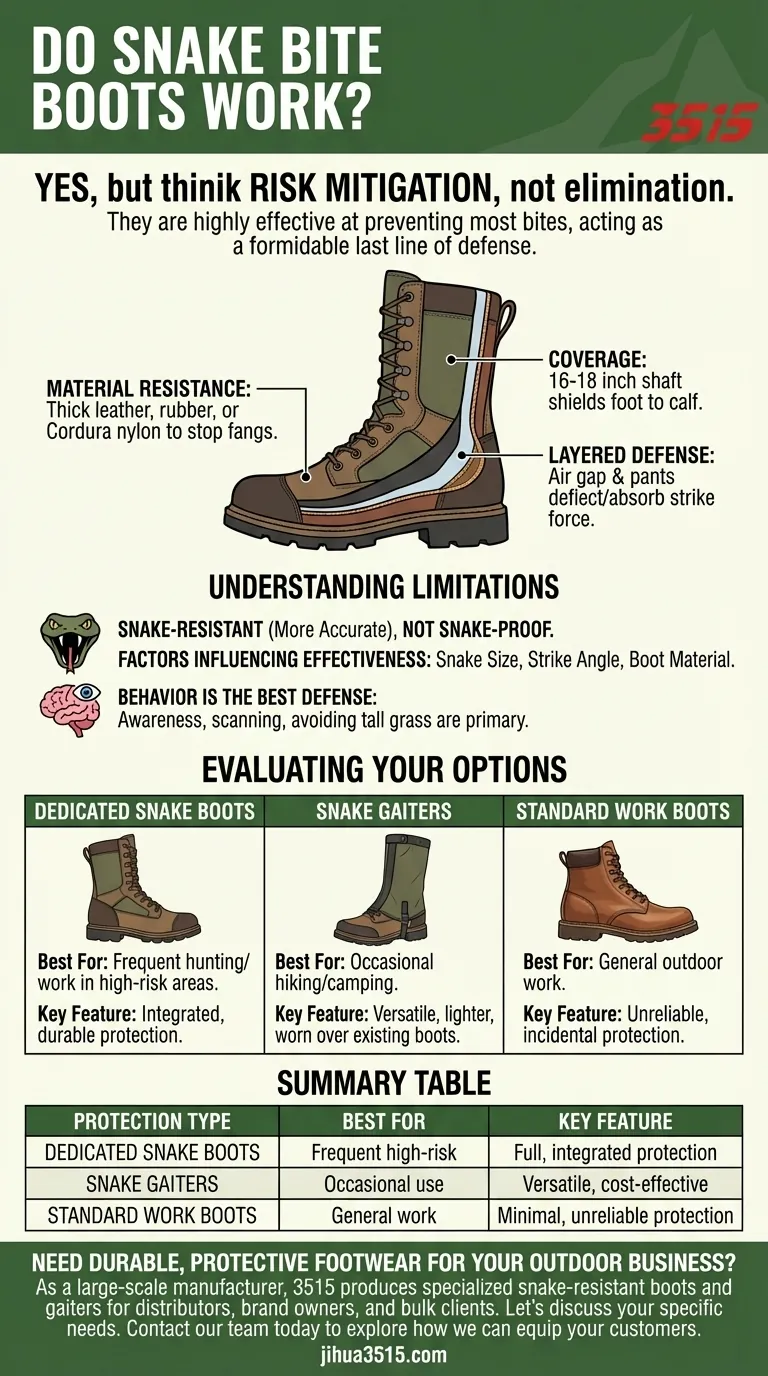
Snake boots are constructed from materials designed to stop fangs. This often includes thick leather, durable rubber, or tightly woven synthetic fabrics like Cordura nylon. The goal is to create a barrier that is too tough or too dense for fangs to puncture under the pressure of a typical strike.
The Importance of Coverage
Most venomous snake bites in North America occur below the knee. Snake boots are designed with high shafts, typically 16 to 18 inches, to protect the entire area from the foot to the calf. This comprehensive coverage shields the most common and vulnerable strike zones.
The "Layered Defense" Factor
Protection isn't just about the boot itself. A small air gap between your leg and the boot provides an additional buffer. When combined with thick pants, you create a layered defense system that can help deflect or absorb the force of a strike even before the fangs reach the boot's primary material.
Understanding the Trade-offs and Limitations
Trusting your gear requires understanding its limits. Objectivity is crucial when it comes to personal safety.
"Snake-Proof" vs. "Snake-Resistant"
This is the most critical distinction to understand. No commercially available boot is truly snake-proof. The term snake-resistant is more accurate. It means the boot has been designed and tested to prevent penetration from the fangs of common venomous snakes in its intended region.
Factors That Influence Effectiveness
A boot's performance can be compromised by several real-world variables. The bite from a very large rattlesnake with longer fangs and greater force is more challenging to stop than a strike from a smaller snake. Furthermore, a direct, perpendicular strike to a flat surface is easier to defend against than a glancing blow or a bite that catches the vulnerable top of the foot (the vamp).
Behavior is the Best Defense
The most effective safety tool you have is your awareness. Snake boots are a passive measure for when things go wrong. Actively scanning the ground ahead, avoiding tall grass when possible, and never putting your hands or feet where you can't see are primary safety practices that should never be neglected.
Evaluating Your Options
Choosing the right protection depends on your specific activities and the level of risk you face.
Dedicated Snake Boots
These are all-in-one solutions that offer seamless protection from foot to calf. They are built for durability and are the most straightforward option, requiring no extra accessories. The downside can be their weight, warmth, and cost.
Snake Gaiters
Gaiters are protective leggings worn over your regular pants and hiking boots. They offer excellent versatility, allowing you to use your preferred, broken-in footwear. They are a cost-effective and often lighter alternative to full snake boots.
Standard Work or Cowboy Boots
While a thick leather work boot is certainly better than a sneaker, it offers unreliable and incidental protection. These boots are not designed or tested to stop a snake bite, and their coverage is often insufficient. Relying on them for snake protection provides a false sense of security.
Making the Right Choice for Your Activity
Your decision should be based on your environment, frequency of exposure, and personal risk tolerance.
- If your primary focus is hunting or working frequently in high-risk areas: Invest in a pair of high-quality, dedicated snake boots for the most reliable, integrated protection.
- If your primary focus is occasional hiking, camping, or exploring: Snake gaiters provide an excellent, flexible, and cost-effective solution that you can pair with your existing footwear.
- If your primary focus is general outdoor work with standard boots: Recognize that you have minimal protection and make situational awareness your absolute top priority.
Ultimately, proper snake bite protection is an informed decision to control your risk in the wild.
Summary Table:
| Protection Type | Best For | Key Feature |
|---|---|---|
| Dedicated Snake Boots | Frequent hunting/work in high-risk areas | Full, integrated protection from foot to calf |
| Snake Gaiters | Occasional hiking/camping | Versatile; worn over your existing boots |
| Standard Work Boots | General outdoor work | Offers only incidental, unreliable protection |
Need Durable, Protective Footwear for Your Outdoor Business?
As a large-scale manufacturer, 3515 produces a comprehensive range of high-performance footwear, including specialized snake-resistant boots and gaiters, for distributors, brand owners, and bulk clients. Our production capabilities ensure durable, tested protection for professionals and outdoor enthusiasts.
Let's discuss your specific needs: Contact our team today to explore how we can equip your customers with reliable safety gear.
Visual Guide
Related Products
- Premium High-Cut Waterproof Safety Boots Manufacturing & Wholesale Solutions
- Wholesale Durable Safety Boots | Custom Steel Toe & Puncture-Resistant Manufacturing
- Puncture-Resistant Velcro Safety Boots for Wholesale & Custom Manufacturing
- Heavy-Duty Waterproof Nubuck Safety Boots Safety Shoes for Bulk Supply
- Premium Oil Wax Leather Safety Boots for Bulk Purchase
People Also Ask
- Which industries commonly use safety boots and why? Protect Your Workforce from Top Hazards
- What are the common hazards present in work environments that safety boots protect against? Find Your Perfect Match
- What future trends are emerging in safety boot technology? Discover Lighter, Smarter, and More Sustainable Footwear
- What are the slip resistance requirements for safety boots? Professional Grip Standards for Poultry Facility Cleaning
- Why is a high-precision 3D motion capture system necessary for measuring joint range of motion? Optimize Safety & Mobility