
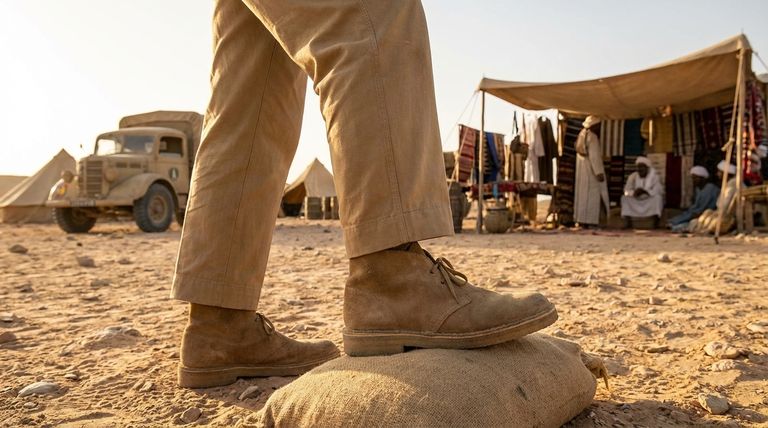
The modern desert boot has its direct origins in the North African campaign of World War II. It was not a product of a corporate design studio but a practical solution developed by local cobblers in Cairo's Khan el-Khalili bazaar for British Eighth Army officers who found their standard-issue military boots wholly unsuitable for the desert climate.
The desert boot is a testament to functional design, born from battlefield necessity. It was a soldier-inspired, locally-crafted solution that was later recognized, refined, and popularized for a global audience by the C & J Clark Company.
The Battlefield Necessity: A Boot for the Desert
To understand the desert boot, you must first understand the problem it was designed to solve. Standard military footwear was simply not engineered for the heat and sand of North Africa.
The Problem with Standard Issue
Traditional military boots were heavy, rigid, and hot. In the desert, they were impractical, causing discomfort and fatigue for the soldiers who wore them day in and day out.
The Cairo Bazaar Solution
Seeking a better option, British officers stationed in Cairo commissioned footwear from cobblers in the city's famous Khan el-Khalili bazaar. They needed something lightweight, comfortable, and better suited for the terrain.
Defining Features: Suede and Crepe
The local artisans crafted an ankle-high boot using two key materials. They used suede uppers, which were much lighter and more breathable than thick leather, and a crepe rubber sole, which provided excellent grip on sand while being flexible and quiet.
From Military Hack to Global Icon
The transition from a custom-made field boot to an international style staple happened because one person recognized the genius of the design.
Nathan Clark's Observation
Nathan Clark, a great-grandson of the founder of the C & J Clark shoe company, was serving as an infantryman in the Eighth Army. In 1941, he noticed his fellow officers wearing these unique suede boots and understood their immense potential beyond the battlefield.
The Commercial Debut
After the war, Nathan Clark developed the design for his family's company. The Clark's Desert Boot was officially unveiled at the Chicago Shoe Fair in 1949, where its simple, clean silhouette and unique sole immediately caught the attention of style editors.
The Rise to Popularity
The boot was introduced in America in 1950 and quickly grew in popularity throughout the decade. Its combination of ruggedness and comfort appealed to a generation looking for practical yet stylish footwear.
Understanding the Distinctions
The desert boot's identity is often confused with similar styles, but its specific construction is what truly defines it.
Desert Boot vs. Chukka Boot
A desert boot is a specific type of chukka boot. While "chukka" refers to any ankle-high boot with two or three eyelets for lacing, a desert boot is distinguished by its signature combination of a suede upper and a crepe sole.
Not Your Average Work Boot
Unlike protective footwear like the early 20th-century wooden sabot or the steel-toed boots that emerged in the 1940s, the desert boot was never about industrial safety. Its purpose was singular: to provide comfort, flexibility, and grip in a dry, dusty environment.
Making the Right Choice for Your Goal
Understanding the history of the desert boot clarifies its enduring appeal and purpose-driven design.
- If your primary focus is historical authenticity: The true origin lies with the anonymous cobblers of Cairo's bazaar, who first solved the problem for British soldiers.
- If your primary focus is brand history: Nathan Clark and the C & J Clark Company are credited with recognizing the design's potential and successfully commercializing it for a global audience.
- If your primary focus is design function: Its lasting appeal comes from the perfect marriage of a lightweight suede upper and a flexible crepe sole, a combination purpose-built for comfort.
The desert boot remains a perfect example of how a simple, functional solution to a real-world problem can become a timeless style icon.
Summary Table:
| Key Milestone | Year | Key Figure/Group | Contribution |
|---|---|---|---|
| Battlefield Necessity | Early 1940s | Cairo Bazaar Cobblers | Created the original suede & crepe sole boot for British officers. |
| Commercial Recognition | 1949 | Nathan Clark (C & J Clark) | Debuted the refined Clark's Desert Boot at the Chicago Shoe Fair. |
| Global Popularity | 1950s | C & J Clark Company | Launched the style in America, cementing its status as a fashion icon. |
Inspired by Timeless, Functional Design?
Just as the desert boot solved a critical need for soldiers in WWII, 3515 Factory provides functional, high-quality footwear solutions for today's market. As a large-scale manufacturer, we produce a comprehensive range of shoes and boots for distributors, brand owners, and bulk clients.
Let us help you build your next iconic style. Contact our team today to discuss your production needs and leverage our expertise in creating footwear that combines comfort, durability, and style.
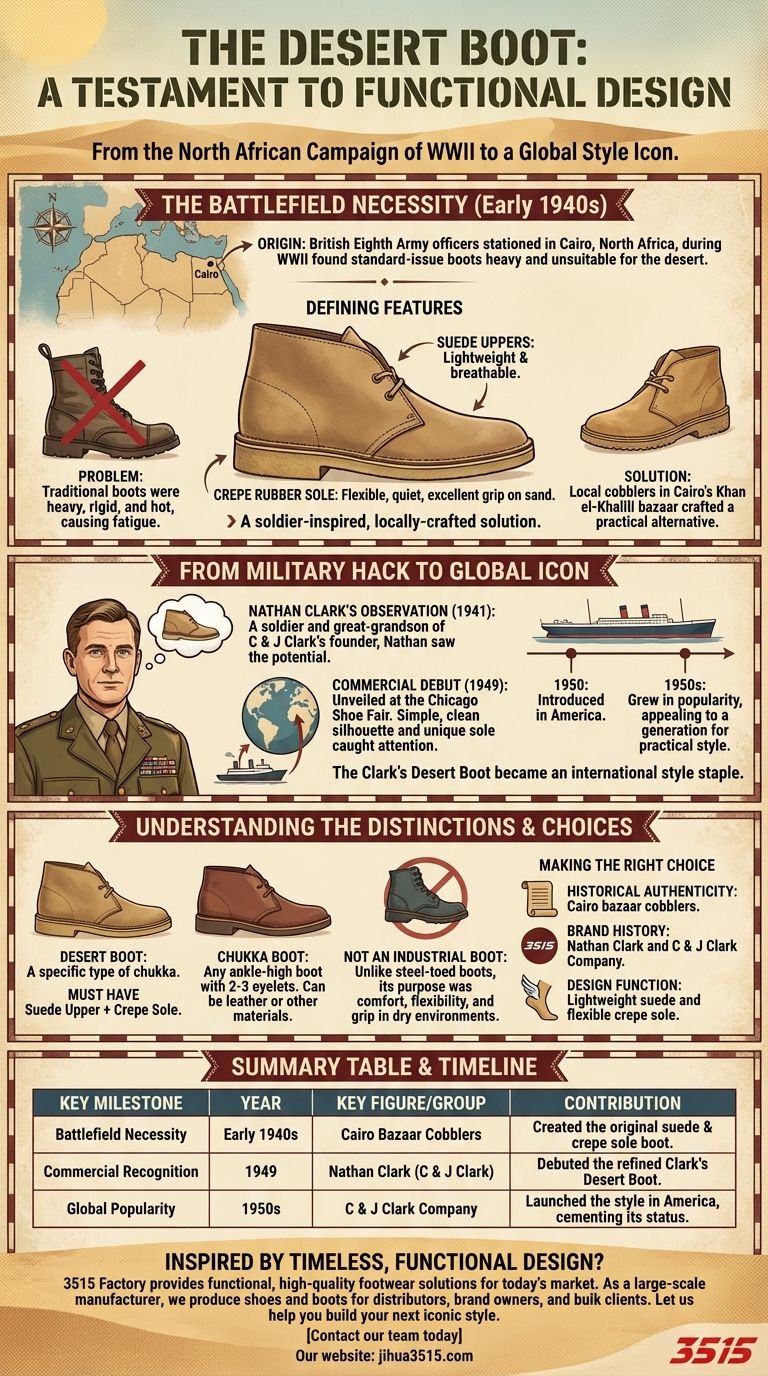
Visual Guide
Related Products
- Wholesale Lightweight Tactical Boots Custom Manufacturer for Desert & Combat Use
- Wholesale High-Traction Camo Boots - Custom Manufacturer for Brands
- Durable Waterproof Rain Boots | Custom Manufacturer for Wholesale & Brands
- High Performance Fire-Retardant Waterproof Safety Boots
- Durable Military Combat Boots with Water Drainage for Wholesale & OEM
People Also Ask
- What are the common types of combat boots? Find the Right Boot for Your Mission
- What specialized protections do tactical boots offer? Maximize Endurance with High-Performance Footwear
- What is the role of high-frequency acquisition hardware in technical skill analysis for outdoor and tactical boots?
- How does additive manufacturing equipment reduce environmental risks? Sustainable Tactics for Modern Footwear Production
- What are the different types of tactical boots available? Find the Right Boot for Your Mission
















