
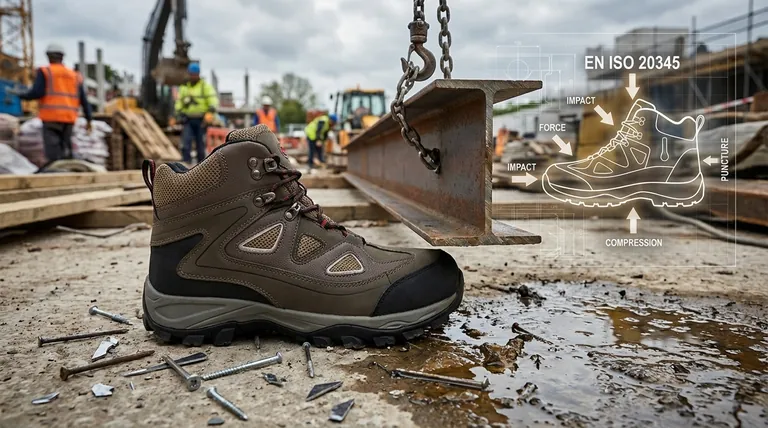
The EN ISO 20345 standard is the fundamental European regulation that specifies the basic and additional requirements for safety footwear. It establishes a unified system of testing and classification, ensuring that any shoe bearing its mark provides a guaranteed level of protection against specific workplace hazards, most notably impact and compression to the toes.
EN ISO 20345 is more than a compliance label; it is a clear, systematic language for risk assessment. It categorizes footwear into tiered levels of protection, allowing you to precisely match the shoe's capabilities to the known hazards of a specific job role.
Deconstructing the Safety Classifications
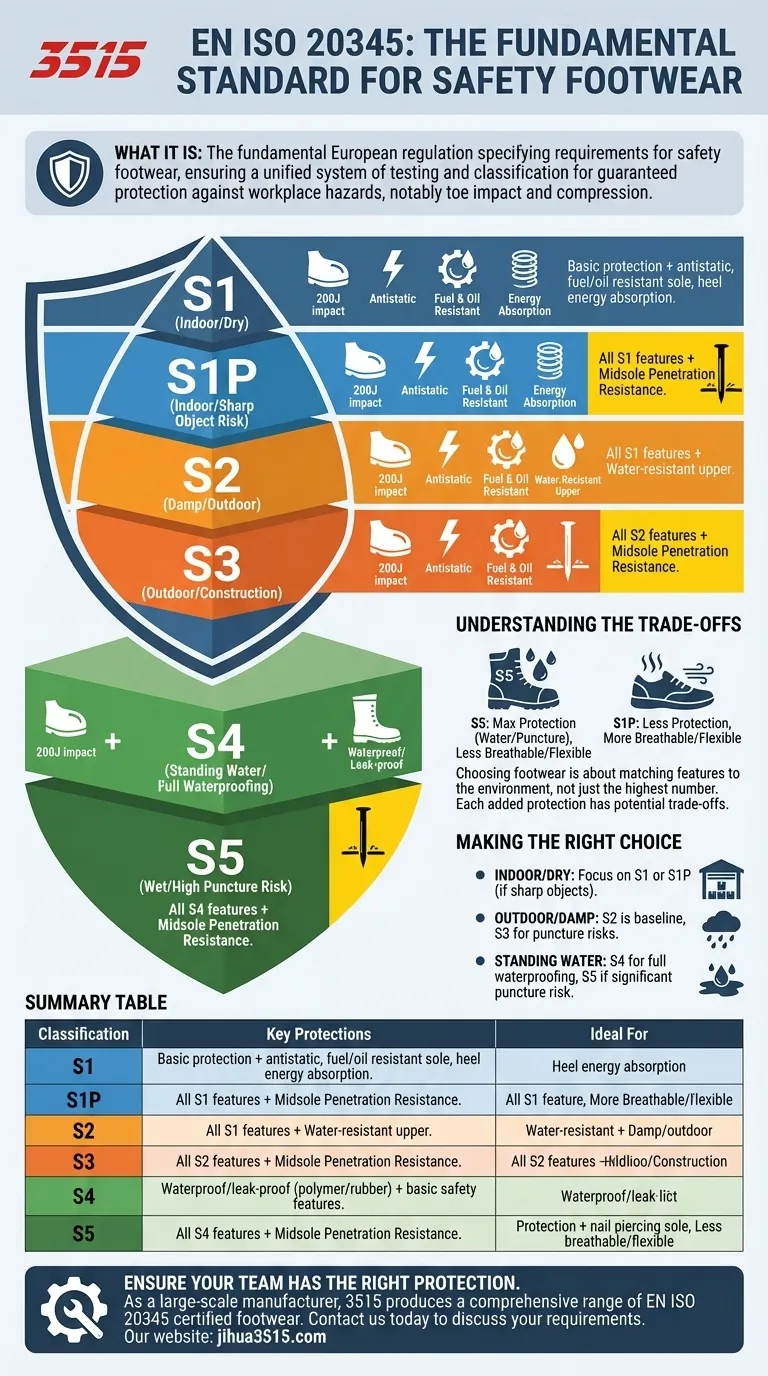
The power of the standard lies in its logical classification system. Each level builds upon the previous one, adding specific protective features. This allows for a clear selection process based on environmental risks.
The Foundation: S1 Requirements
All safety footwear under this standard must first meet a baseline requirement for a protective toecap (rated for 200-joule impact). The S1 classification is the first major level, designed for indoor and dry environments.
It includes the basic toecap protection plus:
- Antistatic properties to prevent static buildup.
- Fuel and oil resistant outsole.
- Energy absorption in the heel region for comfort and shock reduction.
Adding Puncture Resistance: The 'P' Designation
The S1P classification includes all the protections of S1 but adds a critical feature: midsole penetration resistance. This protects the foot from being pierced from below by sharp objects like nails or metal shards.
Protection for Wet Environments: S2 and S3
When work moves to damp or outdoor settings, the standard addresses water resistance.
The S2 classification includes all the features of S1 but adds a water-resistant upper. This prevents water penetration and absorption, keeping the wearer's feet dry in wet conditions.
Following the same logic, the S3 classification is an S2 shoe with the addition of midsole penetration resistance. It combines water resistance with protection from sharp objects underfoot, making it a common choice for construction and outdoor work.
For Full Waterproof Integrity: S4 and S5
For environments with standing water or where leak-proof performance is mandatory, the standard defines a separate category.
S4 and S5 boots are typically made from a moulded polymer or rubber, making them fully waterproof and leak-proof. An S4 boot has all the basic safety features (toecap, fuel resistance, etc.). The S5 classification is simply an S4 boot with the addition of midsole penetration resistance.
Understanding the Trade-offs
Choosing the right safety footwear is not about picking the highest number. It's about matching the features to the environment, as every added protection comes with a potential trade-off.
The Myth of "Better" vs. "Appropriate"
An S5 boot is not inherently "better" than an S1P boot. While offering maximum protection against water and punctures, a rubber S5 boot will be far less breathable and flexible than an S1P shoe. Using it in a hot, dry warehouse could lead to significant discomfort and foot health issues.
Certification and Validity
Footwear is rigorously tested by certified bodies. If a model passes, it receives an "Attestation of Type Examination" (AET), which is valid for five years. This means even if the standard updates (like the recent change from the 2011 to the 2022 version), footwear certified under the previous standard is still fully compliant and safe for its entire validation period.
Making the Right Choice for Your Environment
Use the classification system as a tool to assess your specific workplace hazards and select the most appropriate protection.
- If your primary work is indoors and dry: Focus on S1 for basic protection or S1P if there is a risk of sharp objects on the floor.
- If you work outdoors or in frequently damp conditions: S2 is your baseline for water resistance, and S3 is essential if puncture risks are also present.
- If you require complete waterproofing for standing water: Choose S4 for waterproof integrity, upgrading to S5 only if penetration from below is a significant hazard.
By understanding this framework, you can move beyond simple compliance and make an informed decision that ensures genuine safety and comfort for your team.
Summary Table:
| Classification | Key Protections | Ideal For |
|---|---|---|
| S1 | Basic toecap, antistatic, fuel/oil resistant sole | Indoor, dry environments |
| S1P | All S1 features + midsole penetration resistance | Indoor areas with sharp object risks |
| S2 | All S1 features + water-resistant upper | Damp or outdoor settings |
| S3 | All S2 features + midsole penetration resistance | Outdoor/construction with water & puncture risks |
| S4 | Waterproof/leak-proof construction (polymer/rubber) | Standing water, need for full waterproofing |
| S5 | All S4 features + midsole penetration resistance | Wet environments with significant puncture hazards |
Ensure your team has the right protection. As a large-scale manufacturer, 3515 produces a comprehensive range of EN ISO 20345 certified footwear for distributors, brand owners, and bulk clients. Our expertise ensures you get the precise safety, comfort, and durability your workforce needs. Contact us today to discuss your requirements and receive a custom quote.
Visual Guide
Related Products
- Premium Suede Sport Safety Shoes for Wholesale & Bulk Orders
- Premium Lightweight Safety Shoes for Wholesale & Bulk Orders
- Wholesale Anti-Smash & Puncture-Proof Safety Shoes Custom Manufacturing for Brands
- Premium KPU Injection Athletic Style Safety Shoes
- Premium Safety Shoes with Rotating Buckle Safety Sneakers
People Also Ask
- What industries have specific OSHA footwear requirements? Ensure Compliance & Protect Your Workforce
- What are the primary functions of professional safety shoes? Maximize Safety in Water Supply Confined Spaces
- What role do specialized safety shoes play in preventing falls? Engineering Stability in Industrial Environments
- What are the technical advantages of integrating sensors into safety shoes? Achieve Superior Motion Capture Precision
- What are the main components of safety shoes? A Guide to Protective Footwear Design



















