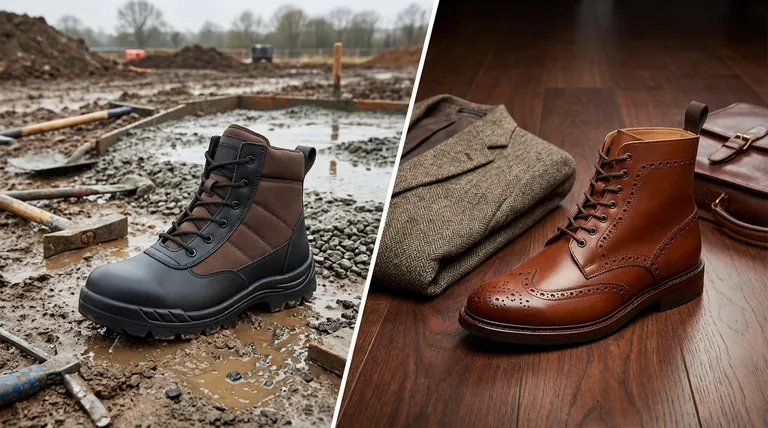
The most distinctive feature of a brogue boot is its decorative perforations, a pattern of small holes known as "broguing." These patterns, often found along the seams and on the toe cap, are purely for aesthetic purposes in modern footwear. This design element has a rich history, originating in the late 1700s as a functional feature for farmers in Scotland and Ireland, where the holes were designed to drain water from the boots while trekking through wet bogs.
While their origins were purely functional, the defining characteristic of modern brogue boots—the perforations—is now entirely a matter of style. This transforms them from a historical utility item into a statement of classic, sophisticated design that sets them apart from purpose-built footwear.
From Utilitarian Tool to Style Icon
To understand what makes a brogue boot distinctive, you must first understand its evolution. The very feature that defines it today once served a completely different, practical purpose.
The Functional Origin
The term "brogue" originates from an old Gaelic word for shoe. These early versions were rugged footwear designed for harsh, wet environments.
The perforations were not decorative; they were practical holes that went all the way through the leather. This allowed water to drain out, helping the wearer's feet dry more quickly after crossing a marsh or bog.
The Modern Aesthetic
Today, the broguing on a boot is a nod to its heritage, but it is purely decorative. The perforations do not penetrate the boot's lining, so they offer no water-draining capability.
Instead, the patterns serve as a key style element, adding texture and character. This shift from function to fashion is what makes the brogue boot a unique piece of footwear history.
How Brogues Compare to Other Boots
The brogue's distinctiveness becomes clearest when compared to boots defined by their specific function or construction. Its identity is rooted in its surface decoration, not its protective capabilities or specialized shape.
Not a Specialized Work Boot
Dedicated work and safety boots are defined by their protective features. A safety boot has a 200-joule protective toe cap and a penetration-resistant midsole. Wildfire boots have a minimum 8-inch height for ankle stability.
Brogue boots lack these features. Their purpose is style and everyday wear, not protection in hazardous environments.
Not a Performance Boot
Similarly, boots built for specific activities prioritize performance. Racing boots are heavily armored with reinforced shins, ankles, and heels for high-speed riding. Army boots are engineered for durability, grip, and support during demanding physical activity.
A brogue boot is not designed for these high-stress scenarios. It offers the comfort of a standard boot but lacks specialized performance or protective elements.
Defined by Decoration, Not Shape
Other boots are defined by their unique silhouette. Western boots, for example, are immediately recognizable by their tall shaft, angled heel, and distinct toe shape.
The term "brogue," however, refers only to the decorative perforations. This pattern can be applied to various boot styles, from a dress boot to a more casual design, making it a decorative classification rather than a structural one.
Understanding the Trade-offs
Choosing a brogue boot means prioritizing a specific set of characteristics. Understanding the inherent trade-offs is key to making an informed decision.
Style Over Ruggedness
The primary trade-off is choosing aesthetic appeal over specialized function. You gain a classic, versatile look suitable for many social and business-casual settings, but you sacrifice the protection of a true work or tactical boot.
Maintenance and Care
The intricate holes and serrated edges of the broguing can trap dirt and dust more easily than a plain leather boot. This means they often require more detailed cleaning and conditioning to maintain their appearance.
Versatility Has Limits
While highly versatile, the level of broguing can affect formality. A boot with heavy broguing (a "full brogue" or "wingtip") is considered less formal than a sleek, unadorned dress boot. For the most formal business settings, a simpler boot is often the more appropriate choice.
Making the Right Choice for Your Goal
Selecting a brogue boot depends entirely on what you need it to accomplish. Its distinctive style is its greatest strength, as long as it aligns with your purpose.
- If your primary focus is classic style and versatility: The brogue boot is an exceptional choice for smart-casual and most business environments.
- If your primary focus is on-the-job safety or protection: You should choose a dedicated safety or work boot with certified features like steel toes and slip-resistant soles.
- If your primary focus is a specific activity or cultural look: Consider specialized footwear like Western, racing, or army boots that are engineered for those distinct purposes.
Ultimately, understanding that broguing is a statement of design, not function, is the key to selecting the right boot for the right occasion.
Summary Table:
| Feature | Brogue Boots | Work/Safety Boots | Performance Boots |
|---|---|---|---|
| Defining Characteristic | Decorative perforations (broguing) | Protective features (steel toe, etc.) | Activity-specific engineering |
| Primary Purpose | Style and everyday wear | On-the-job safety and protection | High-stress performance (racing, military) |
| Best For | Smart-casual, business-casual settings | Hazardous work environments | Specific activities requiring durability/support |
| Formality | Versatile, depends on level of broguing | Utilitarian | Utilitarian / Specialized |
Looking for High-Quality Brogue Boots for Your Brand or Store?
As a large-scale manufacturer, 3515 produces a comprehensive range of footwear for distributors, brand owners, and bulk clients. Our production capabilities encompass all types of shoes and boots, including classic and modern brogue designs. We combine timeless style with robust manufacturing quality to deliver products that your customers will love.
Let's discuss your specific needs: Contact our team today to explore our catalog and manufacturing solutions.
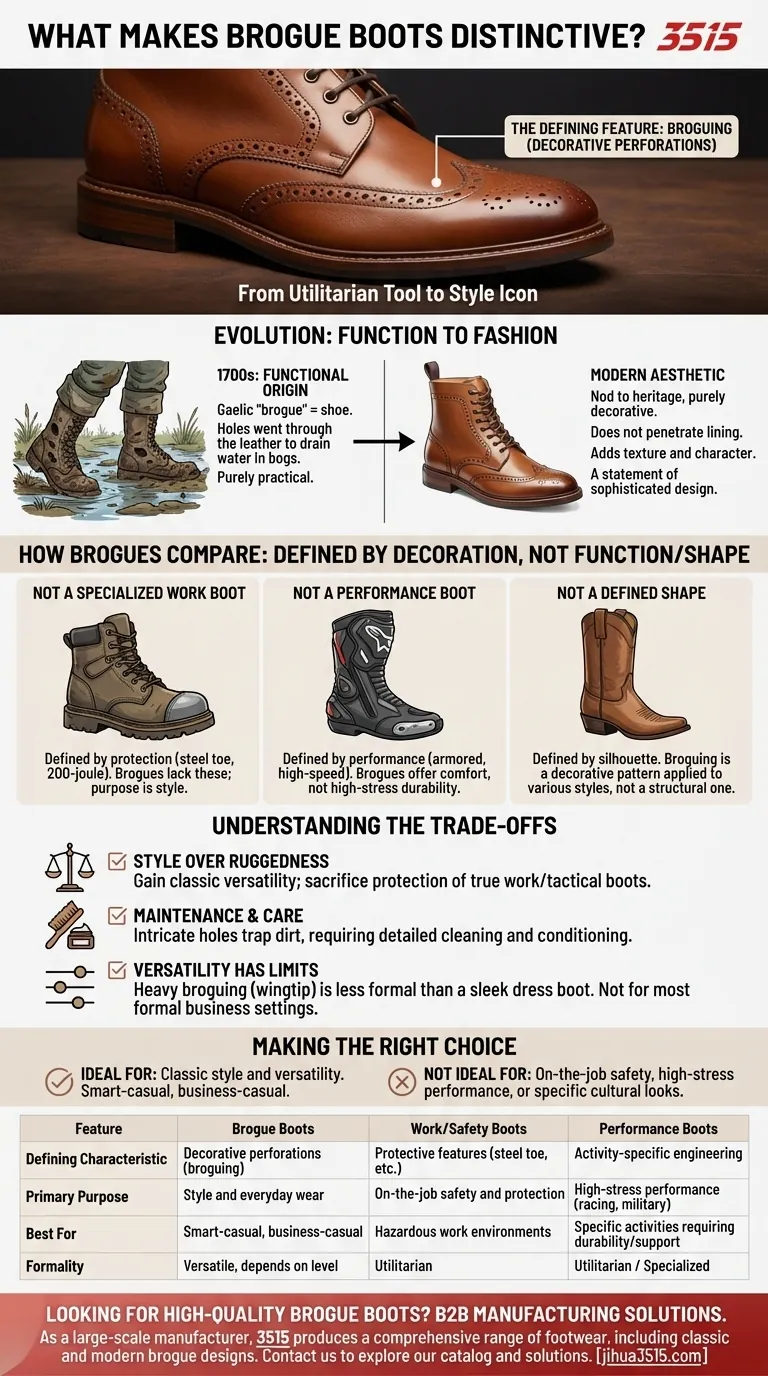
Visual Guide
Related Products
- Wholesale Perforated Comfort Dress Shoes | Custom Derby Shoe Manufacturer
- Wholesale High-Traction Camo Boots - Custom Manufacturer for Brands
- High-Traction Suede Tactical Boots Wholesale & Custom Manufacturing
- Wholesale Lightweight Tactical Boots Custom Manufacturer for Desert & Combat Use
- Durable Leather High-Ankle Tactical Boots for Wholesale & Custom Manufacturing
People Also Ask
- How do comfort dress shoes differ from traditional dress shoes? Discover the Ergonomic Advantage
- What are the recommended construction methods for quality dress shoes? Goodyear Welt vs. Blake Stitch Explained
- What are some quick tips for achieving a mirror shine on dress shoes? Speed Up Your Shine with Pro Hacks
- What is aniline leather and why is it considered high quality for dress shoes? Discover the Pinnacle of Luxury
- What role do socks play in improving the comfort of dress shoes? Essential Tips for All-Day Wear