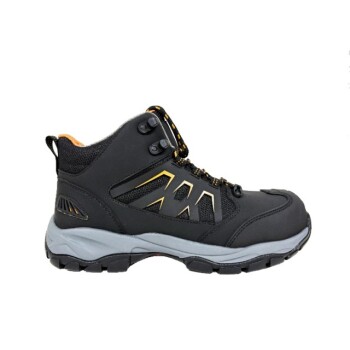
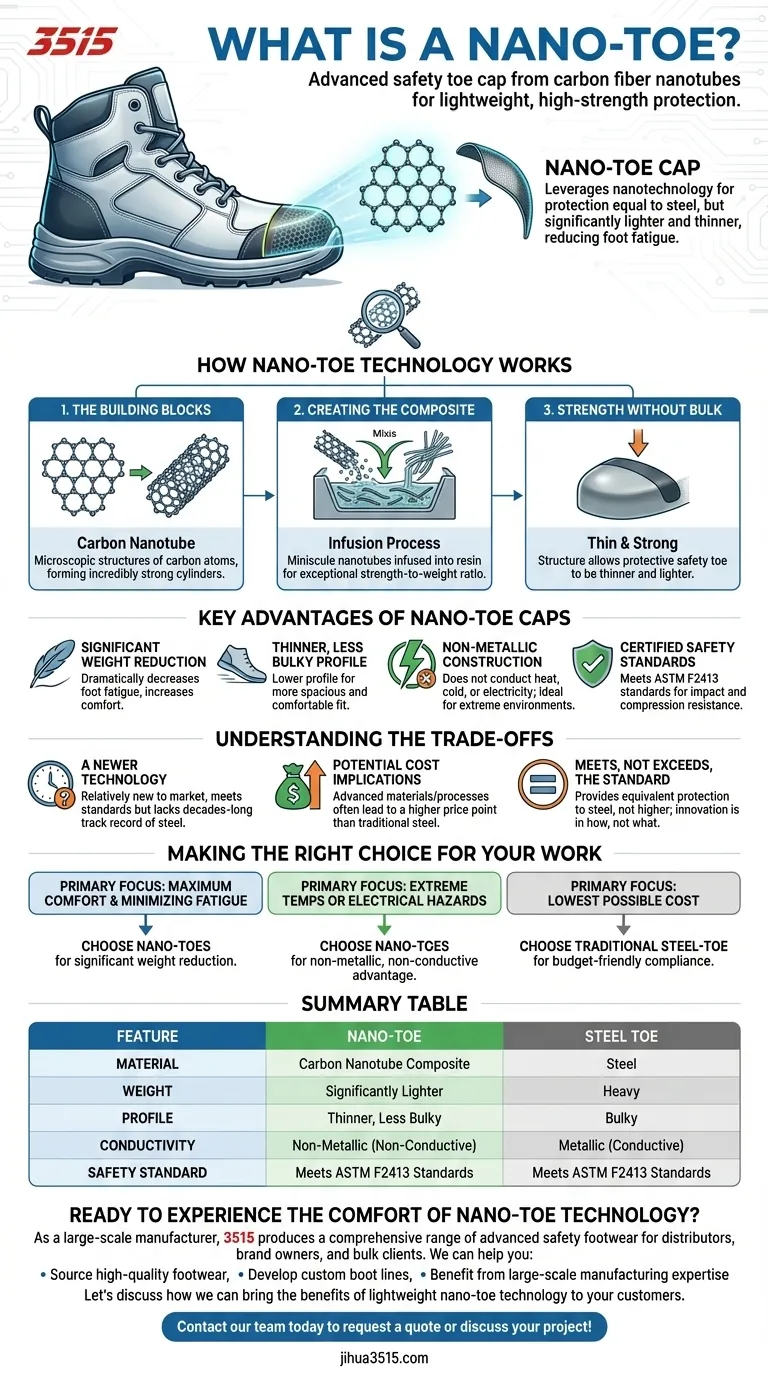
In the world of safety footwear, a nano-toe is an advanced safety toe cap constructed from carbon fiber nanotubes. It leverages nanotechnology to provide protection that meets the same rigorous safety standards as steel, but in a significantly lighter and thinner package. This innovation directly addresses the common issue of foot fatigue caused by heavy work boots.
The core innovation of a nano-toe is its use of carbon nanotechnology to create a safety toe that is as strong as steel but significantly lighter and thinner, improving comfort without compromising on certified safety.
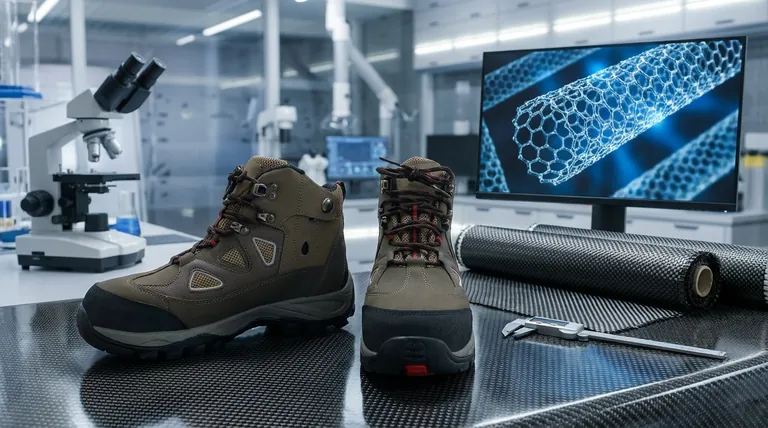
How Nano-Toe Technology Works
Understanding how nano-toes achieve their unique properties requires looking at the microscopic level. The technology is a significant step forward from traditional composite materials.
The Building Blocks: Carbon Nanotubes
The foundation of this technology is the carbon nanotube. These are microscopic structures made of carbon atoms arranged in a honeycomb-like pattern, which are then rolled into a tiny, incredibly strong cylinder.
Creating the Composite
These minuscule nanotubes are infused into a resin, often with other materials like fiberglass. This process creates a composite material that possesses an exceptional strength-to-weight ratio.
Strength Without the Bulk
The incredible strength of the carbon nanotube structure is what allows the safety toe to be protective while remaining much thinner and lighter than its steel or even standard composite counterparts.
Key Advantages of Nano-Toe Caps
The primary driver for choosing nano-toe footwear is the significant improvement in user comfort and a reduction in physical strain over a long workday.
Significant Weight Reduction
This is the most noticeable benefit. By reducing the weight at the front of the boot, nano-toes can dramatically decrease foot fatigue and increase overall comfort.
Thinner, Less Bulky Profile
Because the material is so strong, the toe cap can be made with a lower profile. This often results in a more spacious and comfortable fit inside the boot.
Non-Metallic Construction
Like other composite toes, nano-toes do not conduct heat, cold, or electricity. This makes them ideal for work in extreme temperatures or environments where electrical hazards are a concern.
Certified Safety Standards
It is critical to understand that nano-toes are not a compromise on safety. They must meet the same ASTM F2413 standards for impact and compression resistance that steel and composite toes do.
Understanding the Trade-offs
While nano-toe technology offers clear advantages, as a discerning professional, you should also be aware of the context and potential considerations.
A Newer Technology
Nano-toes are relatively new to the safety footwear market. While they meet all required standards, they do not have the decades-long track record of traditional steel toes.
Potential Cost Implications
Advanced materials and manufacturing processes often mean that footwear with nano-toes can come at a higher price point than traditional steel-toe options.
Meets, Not Exceeds, the Standard
The goal of a nano-toe is to meet the existing, rigorous safety standard more comfortably. It provides an equivalent level of protection to steel, not necessarily a higher one. The innovation is in the how, not the what, of protection.
Making the Right Choice for Your Work
Selecting the right safety toe comes down to balancing your specific job requirements with your personal comfort needs and budget.
- If your primary focus is maximum comfort and minimizing fatigue: Nano-toes are an excellent choice due to their significant weight reduction over steel.
- If you work in extreme temperatures or around electrical hazards: The non-metallic, non-conductive nature of nano-toes provides a clear safety and comfort advantage.
- If your primary focus is the lowest possible cost: Traditional steel-toe boots often remain the most budget-friendly, fully compliant safety option.
Ultimately, understanding the technology behind nano-toes empowers you to choose safety footwear based on the specific demands of your job and your personal comfort.
Summary Table:
| Feature | Nano-Toe | Steel Toe |
|---|---|---|
| Material | Carbon Nanotube Composite | Steel |
| Weight | Significantly Lighter | Heavy |
| Profile | Thinner, Less Bulky | Bulky |
| Conductivity | Non-Metallic (Non-Conductive) | Metallic (Conductive) |
| Safety Standard | Meets ASTM F2413 Standards | Meets ASTM F2413 Standards |
Ready to Experience the Comfort of Nano-Toe Technology?
As a large-scale manufacturer, 3515 produces a comprehensive range of advanced safety footwear for distributors, brand owners, and bulk clients. Our production capabilities encompass all types of safety shoes and boots, including those featuring the latest innovations like nano-toe caps.
We can help you:
- Source high-quality, comfortable safety footwear that meets the latest standards.
- Develop custom safety boot lines tailored to your market's specific needs.
- Benefit from our large-scale manufacturing expertise to ensure competitive pricing and reliable supply.
Let's discuss how we can bring the benefits of lightweight nano-toe technology to your customers.
Contact our team today to request a quote or discuss your project!
Visual Guide
Related Products
- Premium Safety Shoes with Rotating Buckle Safety Sneakers
- Premium Lightweight Safety Shoes for Wholesale & Bulk Orders
- Wholesale Mesh Steel Toe Safety Shoes with Dial Closure Factory Production
- Advanced KPU Athletic Safety Shoe with Steel Toe Cap Anti-Slip Rotary Lacing System
- Premium Wheat Nubuck Safety Shoes for Bulk Distribution
People Also Ask
- How do complex outsole tread designs in safety shoes work with coated floors? Master Slip Resistance Engineering
- How do I choose the best safety shoes? Match Certified Features to Your Hazards
- What happens during the cutting stage of safety shoes manufacturing? Precision, Process & Quality
- Why should ergonomics and comfort be prioritized when selecting safety shoes? Boost Compliance & Worker Health
- What role do specialized safety shoes play in preventing falls? Engineering Stability in Industrial Environments