
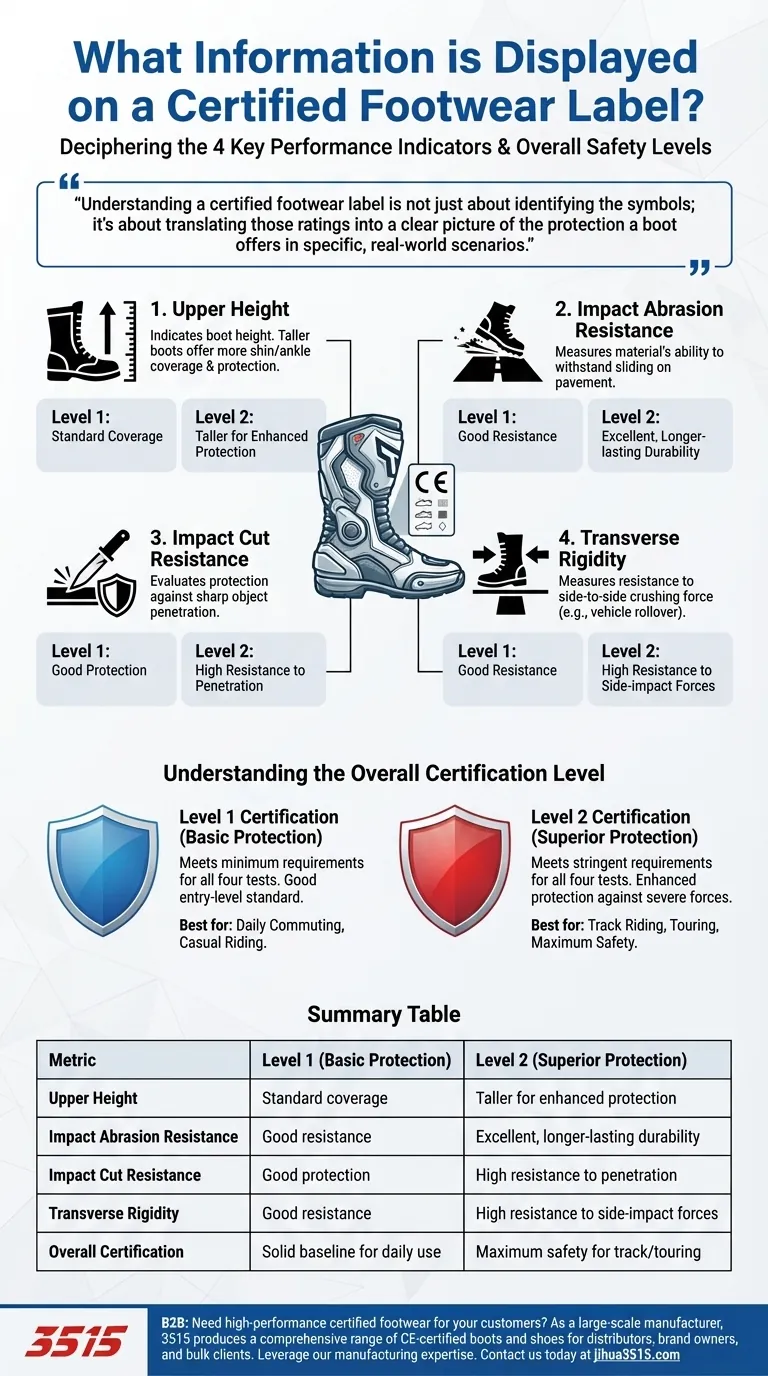
A certified footwear label displays four key performance indicators. It shows the boot's upper height, its resistance level to impact abrasion, its resistance to impact cuts, and its level of transverse rigidity. Each of these four tests is graded individually, and an overall certification level is also provided to summarize its protective capacity.
Understanding a certified footwear label is not just about identifying the symbols; it's about translating those ratings into a clear picture of the protection a boot offers in specific, real-world scenarios.
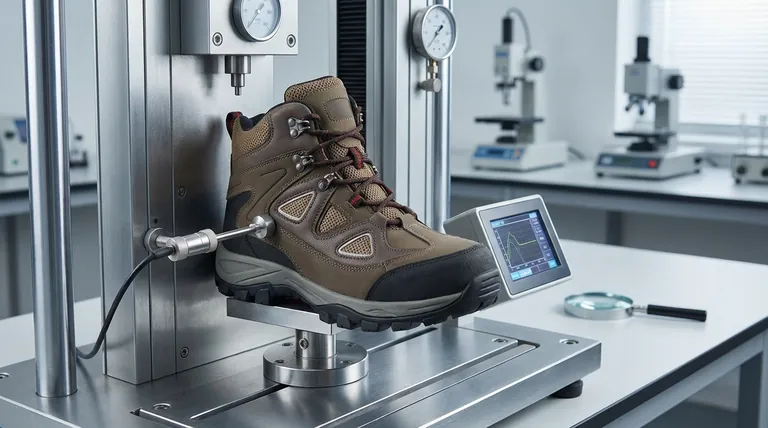
Decoding the CE Certification Label
The label on a piece of certified footwear, such as a motorcycle boot, is a standardized report card. It communicates how the footwear performed in a series of rigorous laboratory tests designed to simulate real-world accidents. The label provides an at-a-glance summary of its protective capabilities.
The Four Core Performance Metrics
Each test results in a rating of either Level 1 (offering a basic level of protection) or Level 2 (offering a superior level of protection).
Upper Height
This first number indicates the height of the boot. Taller boots generally offer more coverage and protection for the shin and ankle area, which is a crucial factor in many types of accidents.
Impact Abrasion Resistance
This metric measures how well the boot's material can withstand being scraped against a rough surface, simulating a slide on pavement. A Level 2 rating means the material survived for a longer duration under abrasion than a Level 1 material.
Impact Cut Resistance
This test evaluates the boot's ability to protect against cuts from sharp objects. A blade is dropped onto the boot material with a specific force to determine its resistance to penetration. A Level 2 rating signifies a higher degree of cut protection.
Transverse Rigidity
This measures the boot's resistance to being crushed from side to side. It simulates the force of a vehicle rolling over the foot, a critical safety feature. A Level 2 rating indicates the boot is significantly more rigid and resistant to this type of crushing force.
Understanding the Overall Certification Level
While the individual ratings for the four metrics are important, the label also provides a single, overall certification rating. This is your primary indicator of the boot's total protective performance.
Level 1 Certification
A boot with a Level 1 overall rating provides a good, entry-level standard of protection suitable for many riders. It meets the minimum requirements for all four mandatory tests.
Level 2 Certification
A Level 2 certification represents a higher standard of safety. To achieve this, a boot must meet the more stringent Level 2 requirements in all four tested categories. These boots offer enhanced protection against more severe impacts and forces.
Making the Right Choice for Your Needs
The label empowers you to match the level of protection to your specific requirements.
- If your primary focus is daily commuting or casual riding: A boot with a Level 1 certification provides a solid baseline of protection that is often more comfortable and flexible for everyday use.
- If your primary focus is track riding, touring, or maximum safety: A boot with a Level 2 certification is the clear choice, as it offers superior resistance to abrasion, cuts, and crushing forces.
By understanding these ratings, you can make an informed decision based on objective performance data rather than just marketing claims.
Summary Table:
| Metric | Level 1 (Basic Protection) | Level 2 (Superior Protection) |
|---|---|---|
| Upper Height | Standard coverage | Taller for enhanced shin/ankle protection |
| Impact Abrasion Resistance | Good resistance to scraping | Excellent, longer-lasting material durability |
| Impact Cut Resistance | Good protection from sharp objects | High resistance to penetration |
| Transverse Rigidity | Good resistance to crushing | High resistance to side-impact forces |
| Overall Certification | Solid baseline protection for daily use | Maximum safety for track/touring |
Need high-performance certified footwear for your customers?
As a large-scale manufacturer, 3515 produces a comprehensive range of CE-certified boots and shoes for distributors, brand owners, and bulk clients. Our production capabilities encompass all types of protective footwear, ensuring you get the right combination of safety, comfort, and durability for your market.
Contact us today to discuss your footwear needs and leverage our manufacturing expertise.
Visual Guide
Related Products
- Premium Lightweight Safety Shoes for Wholesale & Bulk Orders
- Wholesale Durable Safety Boots Manufacturer Customizable Steel Toe Work Boots
- Premium Suede Sport Safety Shoes for Wholesale & Bulk Orders
- Lightweight Breathable Training Shoes for Wholesale & Custom OEM Manufacturing
- Custom Safety Shoe Manufacturer for Wholesale & OEM Brands
People Also Ask
- What is a recommended alternative to using hairspray for slip resistance? Ditch Unreliable Hacks for Real Safety
- What role does blockchain play in footwear supply chain transparency? Enhance Safety Shoe Traceability and Verification
- How is the absence of PPE (safety shoes & helmets) categorized in construction motion data labeling? Unlock Real-Time Safety Insights!
- What workplace hazards indicate the need for safety shoes? Identify risks to protect your workforce.
- What role do specialized safety shoes play in preventing falls? Engineering Stability in Industrial Environments



















