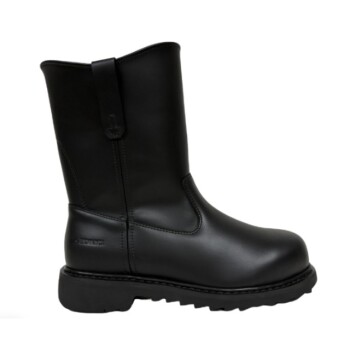
The definitive features of a supportive boot are a tall, stiff cuff that provides ankle support and a rigid sole structure that creates torsional stability. These two elements work together to protect your foot and translate your movements precisely onto challenging ground or a ski edge.
The core purpose of a supportive boot isn't just comfort; it's about control. A truly supportive boot acts as a stable platform, preventing dangerous twisting of the foot on uneven terrain and ensuring your energy is transferred efficiently.
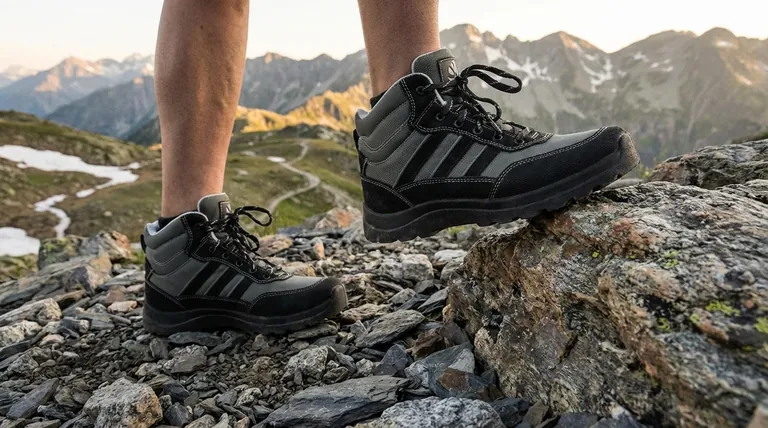
The Foundation of Support: Torsional Rigidity
What is Torsional Rigidity?
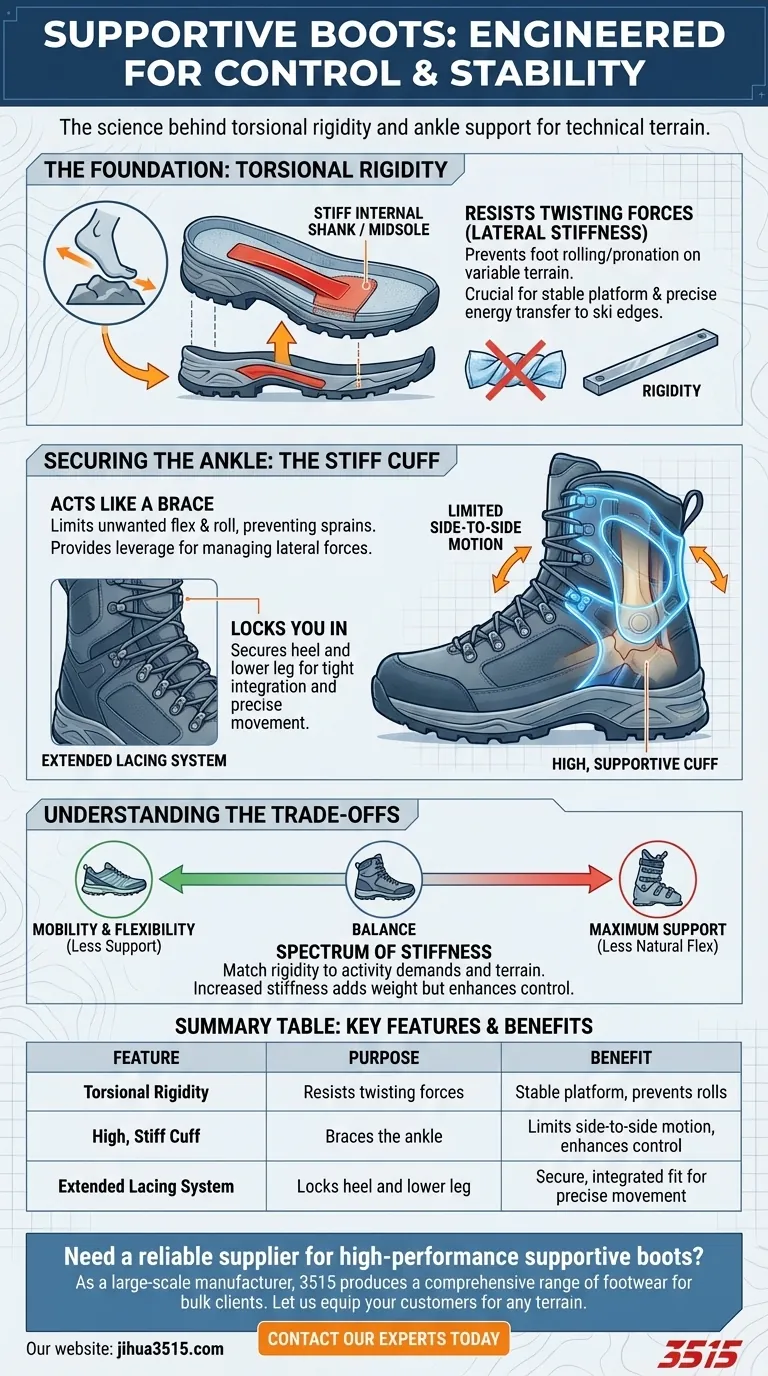
Torsional rigidity, or lateral stiffness, is a boot's resistance to twisting forces. Imagine trying to wring out a wet towel—a boot with high torsional rigidity is extremely difficult to twist along its length.
This stiffness comes from the boot's underfoot construction, often involving a stiff midsole or an internal plate called a shank.
Why It's Critical for Stability
On variable terrain, your foot is constantly landing on uneven surfaces like rocks or the side of a hill. A torsionally rigid boot prevents your foot from rolling or pronating excessively, providing a stable platform with every step.
For skiing, this rigidity is non-negotiable. It ensures that the subtle movements of your body are transferred directly to the ski's edges, allowing for precise control.
Key Features for Rigidity
The two primary contributors to this stiffness are a robust underfoot support system and a tall boot cuff. The sole provides the base platform, while the cuff prevents the structure from deforming under the force of your ankle.
Securing the Ankle: The Role of the Cuff
Preventing Unwanted Flex and Roll
The ankle is a complex and vulnerable joint. A high, supportive cuff acts like a brace, limiting side-to-side motion that can lead to sprains and instability.
It protects your feet and ankles from impacts with rocks and other trail hazards.
The Importance of a High Cuff
A taller boot cuff provides more leverage against rolling forces. It physically supports the lower leg, integrating it with the boot to create a single, solid unit.
This is why ski boots have extremely high, rigid cuffs, as they must manage immense lateral forces.
How Extended Lacing Locks You In
A high cuff is only effective if it's secured properly. An extended lacing system, with eyelets or hooks that go high up the ankle, allows you to customize the fit and lock your heel and lower leg into place.
This tight integration ensures the boot moves with you, not against you.
Understanding the Trade-offs
Support vs. Mobility
The central trade-off is between absolute support and natural movement. An extremely rigid boot is perfect for technical applications but can feel cumbersome and restrictive for simple walking.
More stiffness almost always means less natural ankle flexion, which can make walking on flat ground feel less efficient.
The Spectrum of Stiffness
View boot support as a spectrum, not a simple "good" or "bad" quality. A lightweight trail runner has minimal support but maximum flexibility, while a high-altitude mountaineering or ski boot sits at the opposite extreme.
The key is to match the level of stiffness to the demands of your activity and the terrain.
Material and Weight
Tough, stiff materials are essential for creating a supportive structure, but they often add weight. The most supportive boots are rarely the lightest, which is a factor to consider for long-distance endeavors.
Making the Right Choice for Your Goal
To select the right boot, you must first define its primary purpose.
- If your primary focus is technical skiing: You need maximum torsional rigidity and the stiffest cuff possible for precise power transmission to your ski edges.
- If your primary focus is hiking on steep, uneven trails: Prioritize a boot with a high cuff and significant underfoot stiffness to protect against ankle rolls and provide stability.
- If your primary focus is walking on moderate or rolling terrain: A mid-height boot with moderate torsional rigidity offers the best balance of protection and walking comfort.
Ultimately, the right supportive boot gives you the confidence to move decisively and safely across any terrain.
Summary Table:
| Feature | Purpose | Benefit |
|---|---|---|
| Torsional Rigidity | Resists twisting forces | Provides a stable platform, prevents ankle rolls |
| High, Stiff Cuff | Braces the ankle | Limits side-to-side motion, enhances control |
| Extended Lacing System | Locks heel and lower leg | Ensures a secure, integrated fit for precise movement |
Need a reliable supplier for high-performance supportive boots?
As a large-scale manufacturer, 3515 produces a comprehensive range of footwear for distributors, brand owners, and bulk clients. Our production capabilities encompass all types of supportive shoes and boots, engineered with the precise torsional rigidity and ankle support detailed in this article.
Let us help you equip your customers with the confidence to tackle any terrain. Contact our experts today to discuss your manufacturing needs.
Visual Guide
Related Products
- Wholesale Tactical Boots High-Traction & Reflective for Bulk & Brand Orders
- Durable High-Ankle Tactical Boots for Wholesale & Custom Manufacturing
- Durable High-Ankle Tactical Boots Wholesale Manufacturer for Custom & Bulk Orders
- Durable Leather Tactical Boots Wholesale & Custom Manufacturing for Brands
- Durable Leather High-Ankle Tactical Boots for Wholesale & Custom Manufacturing
People Also Ask
- How do tactical boots protect against injuries? Discover the Integrated Safety System
- What role does repairable design play in tactical boots? Extend Lifespan & Cut Total Ownership Costs
- Are tactical boots suitable for hiking? Discover the Ultimate Footwear for Rugged Trails
- What are the advantages and disadvantages of tactical boots? Lightweight Comfort vs. Rugged Durability
- How does the extraction of sociodemographic factors via NLP influence the design of tactical boots and work shoes?