
Your choice of equestrian boot is a foundational decision that impacts your comfort, performance, and presentation. The primary factors to consider when choosing between tall boots and paddock boots are your specific riding discipline, whether you are schooling or competing, your experience level, and your budget.
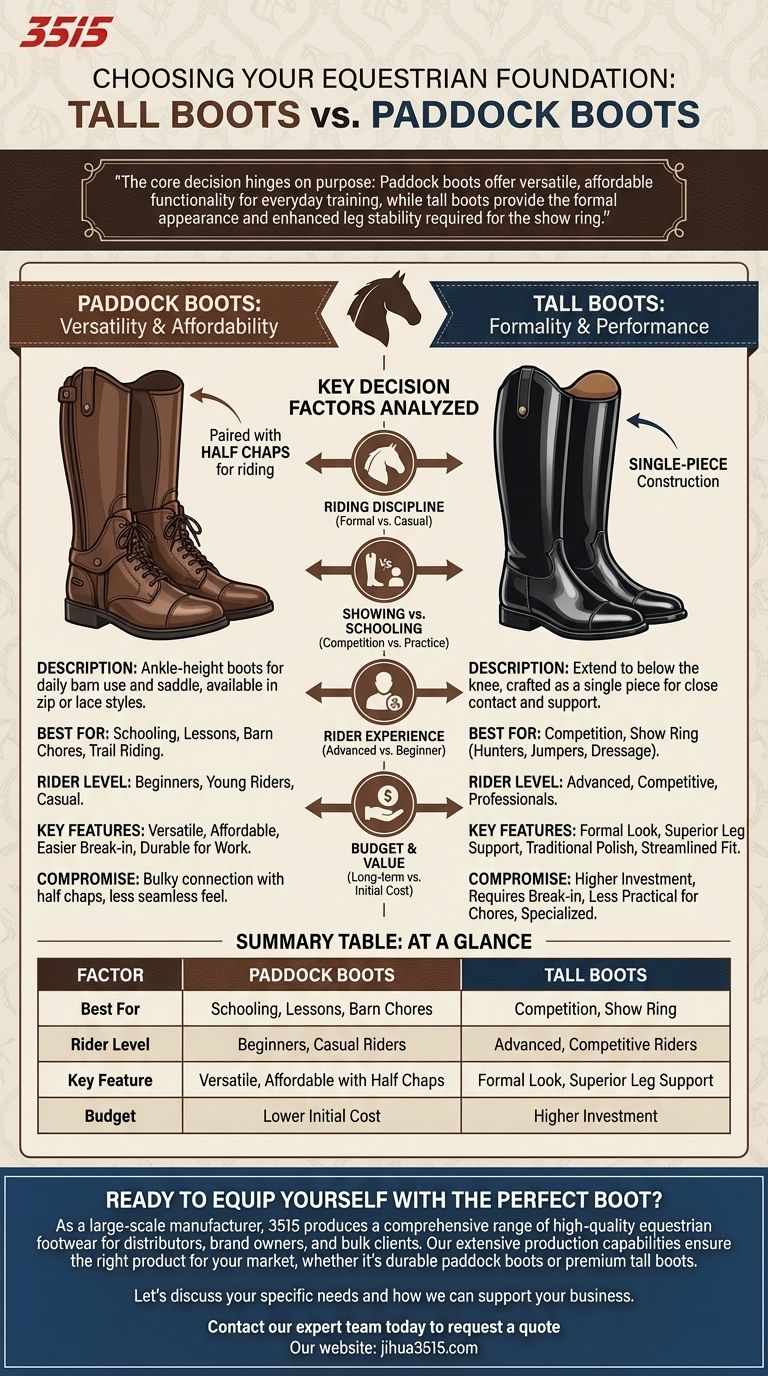
The core decision hinges on purpose: Paddock boots offer versatile, affordable functionality for everyday training and lessons, while tall boots provide the formal appearance and enhanced leg stability required for the show ring.
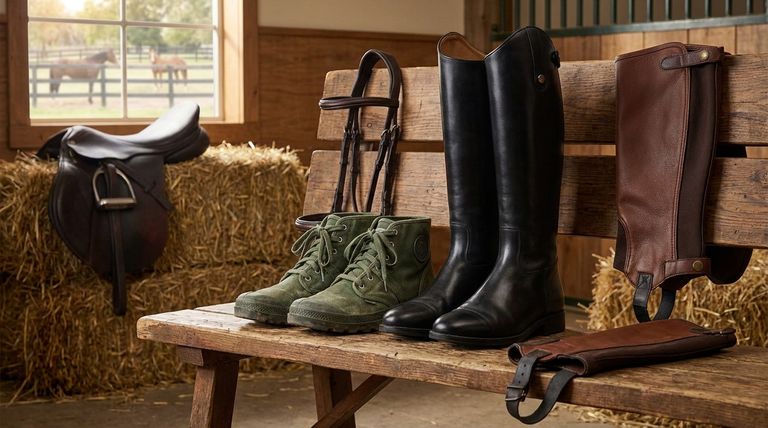
The Fundamental Difference: Form and Function
Understanding the distinct design of each boot is the first step. They are purpose-built for different contexts within the equestrian world.
What Are Paddock Boots?
Paddock boots are ankle-height boots, available in zip-up or lace-up styles. They are designed for daily use around the barn and in the saddle.
For riding, they are almost always paired with half chaps, which are leather or synthetic leggings that cover the lower leg. This combination mimics the feel and leg protection of a tall boot.
What Are Tall Boots?
Tall boots, also known as riding boots or top boots, extend up the lower leg to just below the knee. They are crafted as a single, streamlined piece of footwear.
Their primary function is to provide a close contact feel with the horse's side, offer support to the rider's leg, and present a traditional, polished look required for competition.
Key Decision Factors Analyzed
Your personal riding journey will be the clearest guide to the right boot. Four factors will dictate the most practical choice.
Your Riding Discipline
Different equestrian sports have different standards. In disciplines like Hunters, Jumpers, and Dressage, tall boots are standard and often required for competition.
For more casual riding, trail riding, or certain Western disciplines, the paddock boot and half chap combination is perfectly acceptable and often more comfortable.
Showing vs. Schooling
This is the most common dividing line. Paddock boots are the workhorse for schooling (everyday practice and lessons) because they are durable, comfortable for barn chores, and less expensive to replace.
Tall boots are generally considered show attire. Many riders preserve their expensive tall boots exclusively for competitions to keep them in pristine condition.
Rider Experience Level
For beginners and young riders, paddock boots are the ideal starting point. They are more affordable, easier to break in, and offer more flexibility as the rider develops.
As a rider progresses and decides to compete, they typically invest in their first pair of tall boots.
Budget and Long-Term Value
There is a significant price difference. A quality pair of paddock boots and half chaps is almost always less expensive than a quality pair of entry-level tall boots.
Many riders find the ideal solution is to own both. They use paddock boots for daily wear and tear, extending the life of their more costly tall boots.
Understanding the Trade-offs
Neither boot is universally superior; each comes with compromises that you must weigh against your needs.
Paddock Boots: The Versatility Compromise
The greatest strength of paddock boots is their versatility for both riding and groundwork. However, when paired with half chaps, they can never perfectly replicate the seamless feel and support of a well-fitted tall boot.
The connection between the boot and the half chap can sometimes feel bulky or shift during a ride compared to the single-unit construction of a tall boot.
Tall Boots: The Commitment to Formality
Tall boots offer unparalleled leg stability and the formal look required for showing. This comes at the cost of a higher price point and a more involved break-in period, which can be uncomfortable.
They are also less practical for walking long distances or performing barn chores, making them a specialized piece of equipment rather than an all-day boot.
The Critical Importance of Fit
Regardless of your choice, a proper fit is non-negotiable. A poorly fitting boot, whether tall or paddock, can cause discomfort, sores, and hinder your effectiveness as a rider. Consulting an expert at a tack store is highly recommended, especially for your first purchase.
Making the Right Choice for Your Goals
Your selection should directly support your current and future equestrian ambitions.
- If you are a beginner or focus on lessons and schooling: Your best choice is a quality pair of paddock boots with matching half chaps for their affordability and versatility.
- If you plan to compete in formal English disciplines: Tall boots are a necessary and expected part of your show attire, so you will need to invest in a pair.
- If your budget is a primary concern: Begin with paddock boots and half chaps, and add tall boots to your gear collection only when you are ready to enter the show ring.
Ultimately, choosing the right boot is about equipping yourself with the proper tool for the task at hand.
Summary Table:
| Factor | Paddock Boots | Tall Boots |
|---|---|---|
| Best For | Schooling, Lessons, Barn Chores | Competition, Show Ring |
| Rider Level | Beginners, Casual Riders | Advanced, Competitive Riders |
| Key Feature | Versatile, Affordable with Half Chaps | Formal Look, Superior Leg Support |
| Budget | Lower Initial Cost | Higher Investment |
Ready to Equip Yourself with the Perfect Boot?
As a large-scale manufacturer, 3515 produces a comprehensive range of high-quality equestrian footwear for distributors, brand owners, and bulk clients. Whether you need durable paddock boots for everyday training or premium tall boots for the show ring, our extensive production capabilities ensure you get the right product for your market.
Let's discuss your specific needs and how we can support your business.
Contact our expert team today to request a quote
Visual Guide
Related Products
- Durable High-Ankle Tactical Boots Wholesale Manufacturer for Custom & Bulk Orders
- Wholesale Tactical Boots High-Traction & Reflective for Bulk & Brand Orders
- Wholesale Lightweight Tactical Boots Custom Manufacturer for Desert & Combat Use
- Durable Leather High-Ankle Tactical Boots for Wholesale & Custom Manufacturing
- Durable High-Ankle Tactical Boots for Wholesale & Custom Manufacturing
People Also Ask
- What specialized protections do tactical boots offer? Maximize Endurance with High-Performance Footwear
- How do tactical boots protect against injuries? Discover the Integrated Safety System
- What are the ideal use cases for tactical boots? Empower Your Performance in Demanding Scenarios
- Can tactical boots be stylish for everyday wear? Yes, with the right styling and features.
- What are the primary benefits of wearing tactical boots for everyday use? Get All-Day Comfort & Durability












