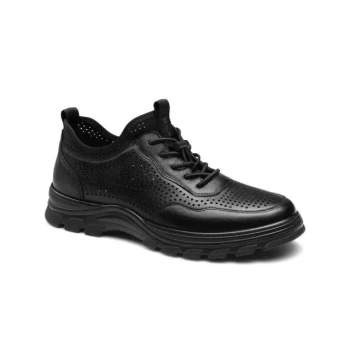
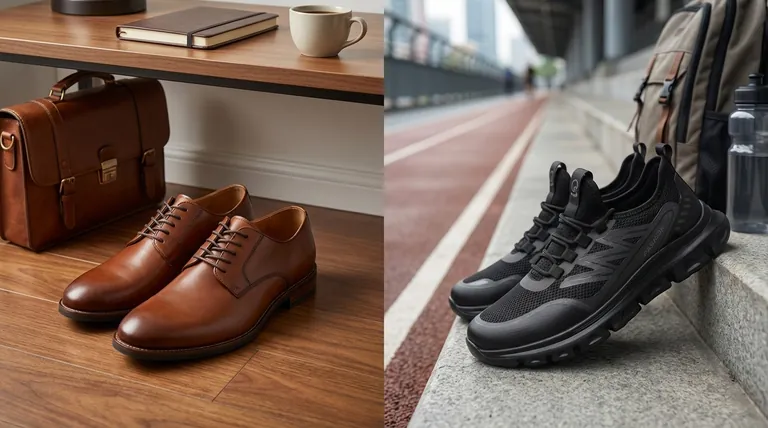
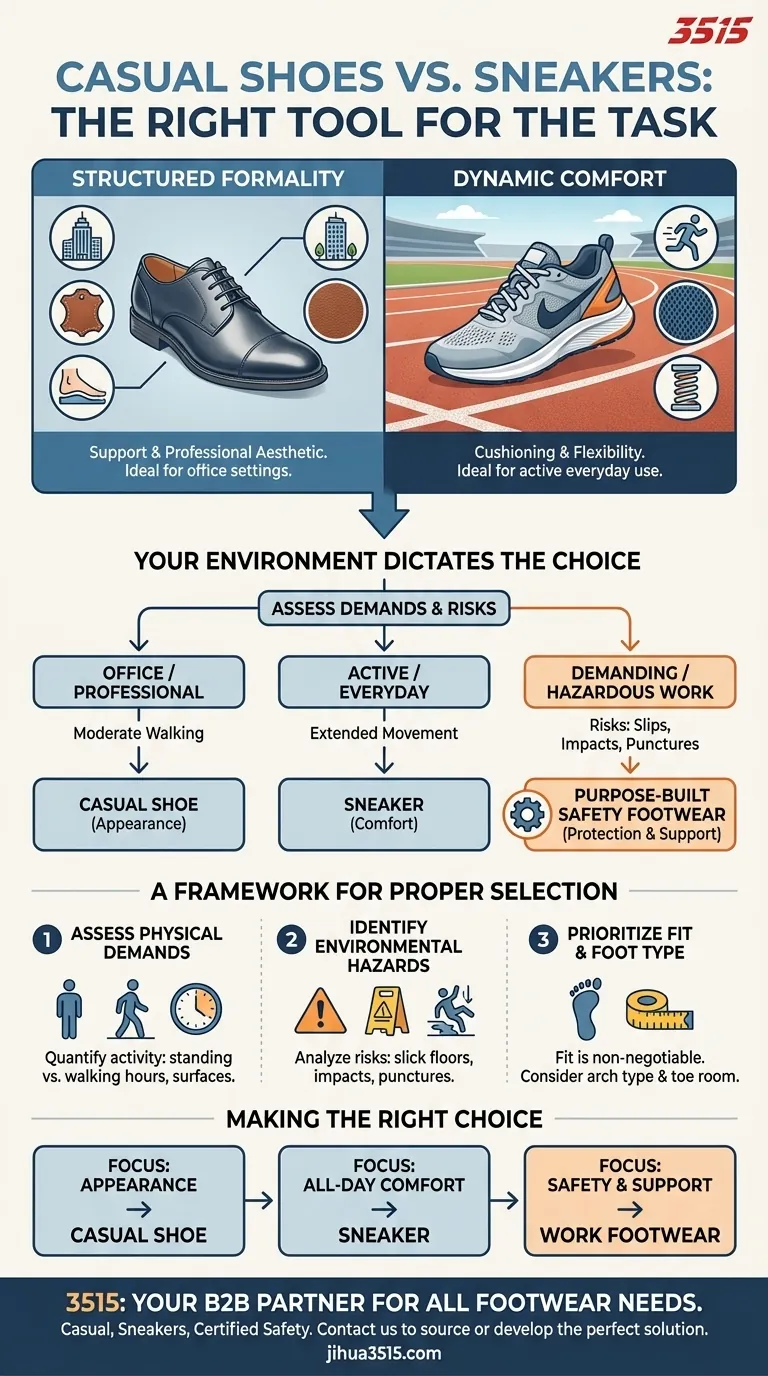
The fundamental choice between casual shoes and sneakers hinges on a direct trade-off between structured formality and dynamic comfort. Casual shoes, typically made of leather or suede, are engineered for support and a professional aesthetic, making them ideal for office or formal settings. Sneakers, built from lighter materials with flexible, cushioned soles, prioritize shock absorption and comfort for physical or everyday activities.
The decision is not merely about style, but about selecting the appropriate tool for the task. The core challenge is to correctly diagnose your environment's demands—balancing appearance, all-day comfort, and, most critically, safety and support for your specific activities.
Deconstructing the Core Differences
To make an informed choice, you must first understand the distinct design philosophies behind each type of footwear. They are built with fundamentally different purposes in mind.
Intended Environment and Aesthetics
Casual shoes are designed to complement professional or smart-casual attire. Their classic designs, often featuring leather or suede, signal a more formal or business-oriented context.
Sneakers, by contrast, are rooted in athletic performance and everyday wear. Their appearance is inherently sportier and more relaxed, suitable for informal settings and active use.
Material and Construction
The materials dictate the shoe's function. Casual shoes use more rigid materials like leather to provide a structured shape and greater stability.
Sneakers employ lightweight, often synthetic materials like canvas or mesh for breathability and flexibility, paired with rubber soles designed for grip and cushioning.
Biomechanical Function
This is the most critical technical distinction. A well-made casual shoe offers superior arch support and stability due to its more structured and less-forgiving construction.
A sneaker is engineered for shock absorption. Its cushioned midsole and flexible outsole are designed to dissipate the impact forces generated by walking, running, and other dynamic movements.
The Critical Factor: Your True Environment
The simple "casual vs. sneaker" question often masks a more complex need, especially in a professional context. The right choice is determined entirely by the demands of your environment.
The Office or Professional Setting
For traditional business environments, the structure and aesthetic of a casual shoe are the appropriate choice. They provide adequate support for a setting that involves moderate walking and standing.
The Active and Everyday Setting
For daily errands, commuting, or recreational activities, the comfort and cushioning of a sneaker are unmatched. They are designed to reduce fatigue over hours of movement on hard surfaces.
The Demanding Work Environment
If your role involves long periods of standing, constant movement, or potential hazards, neither a standard casual shoe nor a typical sneaker is the correct tool. This is where purpose-built work and safety footwear becomes necessary.
These specialized shoes integrate features from both categories—such as support and durability—but add critical protections like slip-resistant outsoles, puncture-proof midsoles, or safety toes.
Understanding the Trade-offs and Pitfalls
Objectivity requires acknowledging the limitations of each category. Choosing the wrong shoe for the environment introduces risks to both comfort and safety.
The Limits of Standard Casual Shoes
While supportive, most casual shoes lack the deep cushioning needed for all-day standing or extensive walking on hard surfaces. This can lead to foot fatigue and musculoskeletal discomfort over time.
The Downsides of Standard Sneakers
A standard sneaker offers poor protection against workplace hazards like falling objects, punctures, or chemical spills. Furthermore, its soft construction may not provide sufficient stability for carrying loads or working on uneven terrain.
The Myth of "Breaking In"
A common and dangerous mistake is to purchase ill-fitting shoes, particularly safety footwear, assuming they will "break in." Purpose-built work shoes are constructed to hold their shape. The fit must be correct from the moment you put them on.
A Framework for Proper Selection
To move beyond a simple style choice, use these factors to analyze your needs and select the correct footwear.
Assess Your Physical Demands
Quantify your daily activity. Consider the hours you spend standing versus walking, the surfaces you move across (e.g., concrete, carpet), and whether your tasks involve kneeling or climbing. More demanding activity requires more specialized cushioning and support.
Identify Environmental Hazards
Analyze your workspace for specific risks. Do you work on slick floors requiring slip resistance? Is there a danger of punctures from below or impacts from above? This analysis dictates the required safety features.
Prioritize Fit and Foot Type
Proper fit is non-negotiable. Your foot type—whether you have flat feet, high arches, or a neutral arch—will determine the kind of insole and support structure you need. Always measure both feet and ensure there is adequate room in the toe box.
Making the Right Choice for Your Goal
Ultimately, your selection should be a conscious decision based on function, not just a reaction to dress code.
- If your primary focus is a professional appearance for an office setting: A classic casual shoe made from leather or suede provides the necessary structure and style.
- If your primary focus is all-day comfort for commuting and casual wear: A well-cushioned sneaker with a breathable upper is the superior choice for reducing fatigue.
- If your primary focus is safety and support in a demanding work environment: You must elevate your search beyond these two categories and invest in purpose-built work footwear that meets certified safety standards.
Choosing the right footwear is a foundational decision for your daily comfort, health, and safety.
Summary Table:
| Factor | Casual Shoes | Sneakers |
|---|---|---|
| Primary Use | Office & Formal Settings | Active & Everyday Wear |
| Key Feature | Structured Support & Professional Look | Dynamic Cushioning & Shock Absorption |
| Ideal For | Moderate walking, professional aesthetics | Long periods of standing, physical activity |
| Material | Leather, Suede (Rigid for stability) | Canvas, Mesh, Synthetic (Lightweight & flexible) |
Need the right footwear for your team or brand?
As a large-scale manufacturer, 3515 produces a comprehensive range of footwear for distributors, brand owners, and bulk clients. Our production capabilities encompass all types of shoes and boots, from professional casual styles to high-performance sneakers and certified safety footwear.
We can help you source or develop the perfect footwear solution that balances style, comfort, and safety for your specific market needs.
Contact our experts today to discuss your project and get a quote.
Visual Guide
Related Products
- Wholesale Leather Business Casual Shoes with Dial Closure - Manufacturer of Comfort Dress Sneakers
- Wholesale Smart Casual Sneakers with Dial Closure | Factory Direct Manufacturing
- Wholesale Comfortable Business Casual Shoes Custom Manufacturing
- Wholesale Breathable Athletic Sneakers - Custom Lightweight Cushioned Footwear Manufacturer
- Lightweight Breathable Sneakers with Wet-Traction Grip for Wholesale & Private Label
People Also Ask
- What factors should be considered to ensure the right business casual shoe choice? A Guide to Professional Footwear
- What are the key characteristics of the best business casual shoes? Find Versatile, Professional Footwear
- How important is comfort in business casual shoes? The Key to All-Day Professional Performance
- What are some ways to style business casual shoes with skirts? Elevate Your Professional Wardrobe
- What materials are recommended for business casual shoes? Choose the Right Material for a Polished Look