
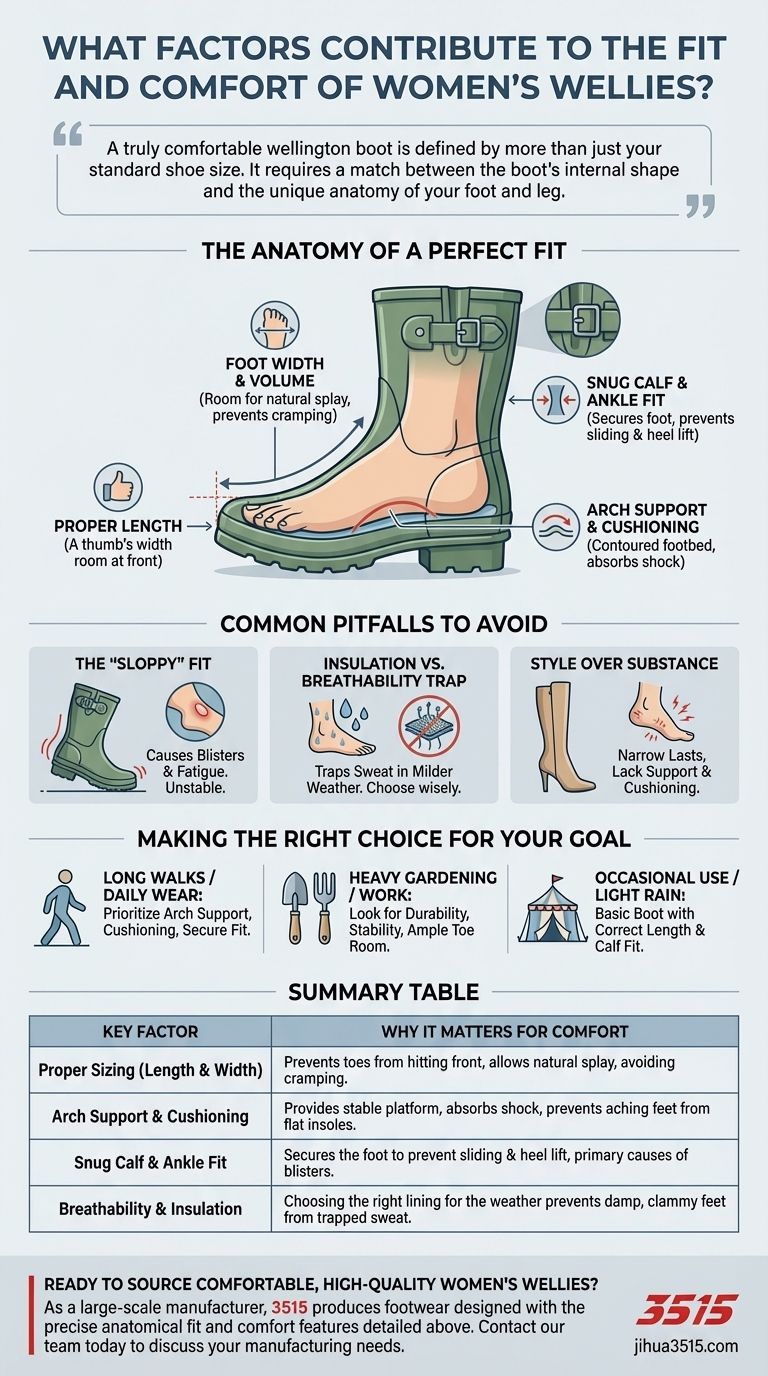
The key factors contributing to the fit and comfort of women's wellies are proper sizing that accounts for both foot length and width, adequate arch support and cushioning, and a snug fit around the calf and ankle to prevent your foot from sliding. These elements work together to provide stability and prevent the discomfort and fatigue common with poorly fitting boots.
A truly comfortable wellington boot is defined by more than just your standard shoe size. It requires a match between the boot's internal shape—its width, volume, and arch—and the unique anatomy of your foot and leg.
The Anatomy of a Perfect Fit
Choosing wellies is fundamentally different from choosing a laced boot. Without the ability to tighten them, the initial fit is everything. We must look at the key dimensions that determine long-term comfort.
Beyond Just Your Shoe Size
The most common mistake is focusing only on length. While crucial, it's just the starting point.
A proper fit allows for a little room—about a thumb's width—between your longest toe and the front of the boot. This prevents your toes from hitting the end when walking, especially downhill.
The Importance of Foot Width and Volume
Many comfort issues stem from a mismatch in width, not length. Boots that are too narrow can cause significant forefoot pain and even injury over time.
Your foot needs space to naturally splay as you walk. A boot that feels overly tight across the ball of your foot will restrict movement and lead to cramping and fatigue.
Arch Support and Cushioning
Traditional wellies are notoriously flat inside, offering little to no support. This is a primary cause of aching feet after a short period of wear.
Look for models with a contoured footbed that supports your arch. Proper cushioning absorbs shock and distributes pressure evenly across your foot, providing a stable platform for walking.
Securing the Calf and Ankle
A major source of blisters and discomfort is a "sloppy" fit. If the boot is too wide around your ankle and calf, your foot will slide forward and your heel will lift with every step.
A snug fit around the calf is essential to hold your foot securely in place. Some wellies feature adjustable buckles or gussets at the top, which help customize the fit for different calf sizes and allow you to tuck in trousers.
Common Pitfalls to Avoid
Understanding the potential trade-offs is critical to making a choice you won't regret. A boot designed for one purpose may be entirely unsuitable for another.
The Problem with a "Sloppy" Fit
It's tempting to size up for thicker socks, but a boot that is too large is a recipe for disaster. Constant friction from your foot moving inside the boot is the number one cause of blisters.
This instability also forces the small muscles in your feet and ankles to work overtime just to keep you balanced, leading to rapid fatigue.
The Insulation vs. Breathability Trap
Insulated or neoprene-lined wellies are excellent for cold weather, but they can be incredibly uncomfortable in milder conditions.
Without a breathable lining, moisture from sweat becomes trapped, leading to damp, clammy feet. For all-season use, a non-insulated boot with room for a warm sock is often a more versatile choice.
Style Over Substance
Many fashion-oriented wellies are built on a narrow, shallow last that prioritizes a slim silhouette over anatomical function.
While they may look appealing, these designs often lack the necessary width, arch support, and cushioning for anything more than very brief, casual wear.
Making the Right Choice for Your Goal
Your intended use should be the ultimate guide for your decision. Prioritize the features that matter most for your specific activities.
- If your primary focus is long walks or frequent daily wear: Prioritize excellent arch support, a cushioned footbed, and a secure calf fit to prevent foot fatigue and sliding.
- If your primary focus is heavy gardening or farm work: Look for durable materials, a stable and protective fit, and ample toe room for all-day comfort.
- If your primary focus is occasional use at festivals or for light rain: A basic, lightweight boot may suffice, but still ensure the length and calf fit are correct to avoid discomfort.
Ultimately, investing a moment to assess the complete fit of a welly will ensure it becomes a comfortable and reliable piece of footwear.
Summary Table:
| Key Factor | Why It Matters for Comfort |
|---|---|
| Proper Sizing (Length & Width) | Prevents toes from hitting the front and allows natural foot splay, avoiding cramping. |
| Arch Support & Cushioning | Provides a stable platform, absorbs shock, and prevents aching feet from flat insoles. |
| Snug Calf & Ankle Fit | Secures the foot to prevent sliding and heel lift, which are primary causes of blisters. |
| Breathability & Insulation | Choosing the right lining for the weather prevents damp, clammy feet from trapped sweat. |
Ready to Source Comfortable, High-Quality Women's Wellies?
As a large-scale manufacturer, 3515 produces a comprehensive range of footwear for distributors, brand owners, and bulk clients. Our production capabilities encompass all types of shoes and boots, including wellington boots designed with the precise anatomical fit and comfort features detailed above.
We can help you provide your customers with wellies that combine lasting comfort with durable performance.
Contact our team today to discuss your manufacturing needs and get a quote.
Visual Guide
Related Products
- Durable Waterproof Rain Boots | Custom Manufacturer for Wholesale & Brands
- Wholesale Classic Leather Lace-Up Ankle Boots for Brand Manufacturing
- Wholesale Women's Leather Derby Shoes Custom Factory Production
- Durable Goodyear Welt Leather Work Boots for Wholesale & Private Label
- Durable Leather High-Ankle Tactical Boots for Wholesale & Custom Manufacturing
People Also Ask
- What are the main materials for waterproof rain boots? Choose the Right Material for Durability & Comfort
- What is the overall recommendation for choosing rain boot materials? A Guide to Rubber vs. PVC
- How does boot height affect waterproofing? Choose the Right Height for Ultimate Protection
- Why are rain boots more flexible and comfortable than snow boots? The Key Differences Explained
- What are the best types of shoes for different gardening conditions? Find Your Perfect Match.
















